

“Hurry up, please, it’s time.”
—T.S. Eliot, The Waste Land
It’s that time again.
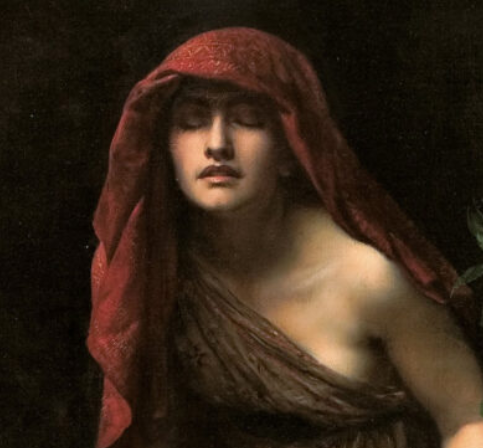
The secular solar year turns, and, as is our tradition at The Wild Hunt on New Year’s Day, I engage in a familiar exercise: channeling Cassandra, listening for Pythia, and opening a dialogue with whatever seers remain willing to speak about the social and cultural currents likely to shape the lives of Pagans, Witches, Heathens, and polytheists in the year ahead.
I don’t particularly care who’s on the other side of the palantír; I just hope they’re chatty and clear.
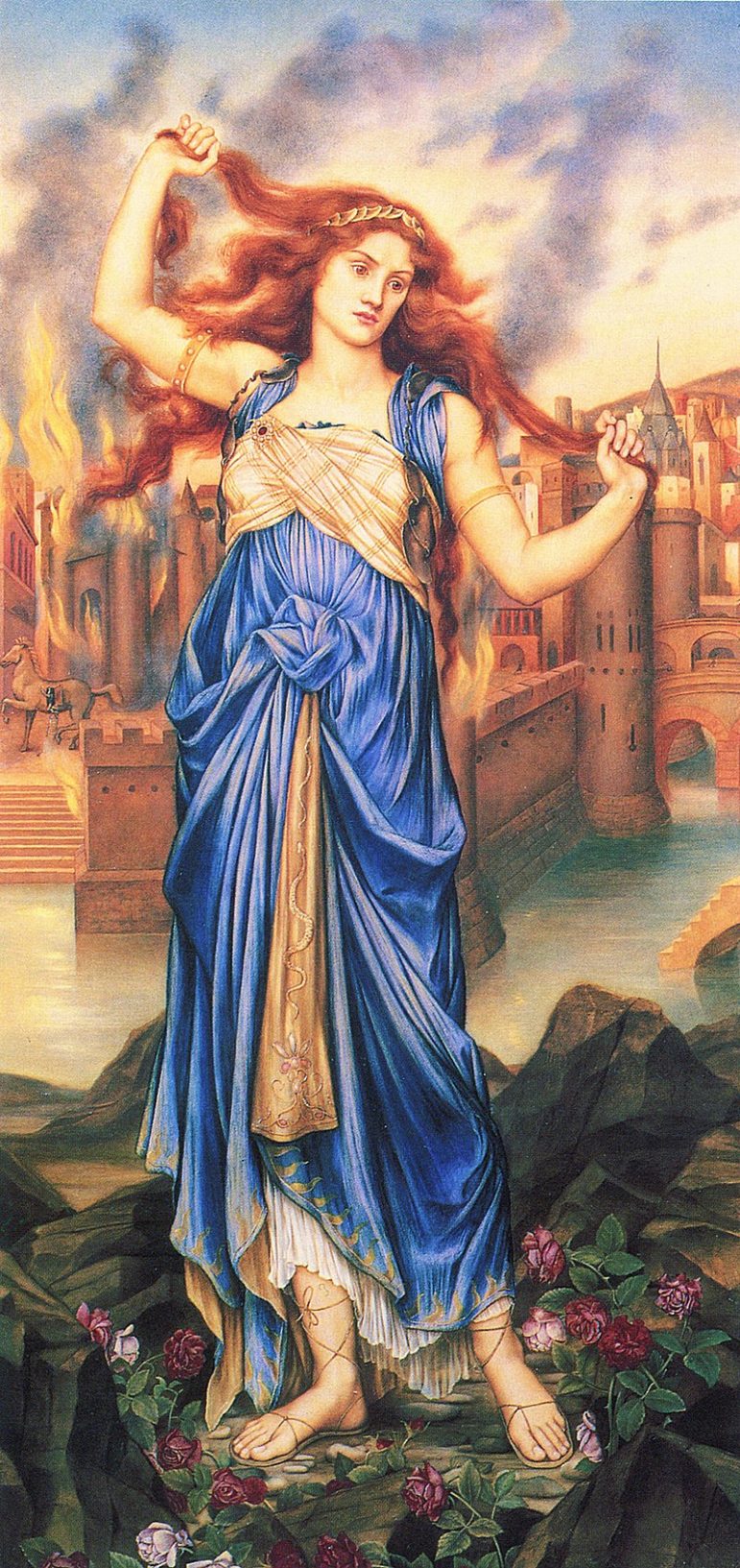
Cassandra by Evelyn De Morgan (1898, London); Cassandra in front of the burning city of Troy
I am fairly confident that 2026 will move into its share of pearl-clutching. The announcement that Bad Bunny will headline the Super Bowl LX halftime show on February 8 has already triggered it. The reaction has been swift and predictable: conservative outrage over his criticism of President Donald Trump and ICE; claims that he “hates America”; even assertions that he is somehow foreign, despite the inconvenient fact that Puerto Ricans are American citizens. The outrage tells us far less about the performer than it does about the fault lines already exposed and ready to widen.
Those fault lines will only deepen as the year unfolds. July 4, 2026, will mark the 250th anniversary of the signing of the Declaration of Independence, a milestone that will be commemorated through a year-long series of celebrations coordinated by the America250 Commission and the White House’s Task Force on Celebrating America’s 250th Birthday.
The scale will be immense, and with it (get ready!), the heightened risk that religious nationalism and rigid, exclusionary ideals of identity will be amplified rather than examined. Plans already include a full military parade on the National Mall, nationwide and state exhibits, fireworks, patriotic pageantry, youth competitions, national prayer events, oral-history projects, volunteer campaigns, and even the construction of a National Garden of American Heroes. We should expect not a single shared story of America, but sharply diverging, and often competing, narratives about the nation’s past, present, and future. Nor will these debates remain contained within U.S. borders; nationalism has a way of echoing outward.
With these commemorations will likely come more warrior imagery, more fixation on “traditional” gender roles, and more aggressive myth-making. In 2025, we were already asked to remain vigilant — responding to political shocks, legal threats, cultural misinformation, and moments of sudden exposure. There is little reason to believe 2026 will be gentler, especially as midterm elections approach and the patriotic spectacle intensifies. I hope I am wrong.
What is already clear is that “religious freedom” has continued its shift away from an abstract protection for all religions and into limitations for every religion except for conservative forms of “approved” Christianity. Rather than isolated court cases or headline-grabbing disputes, minority faiths increasingly encounter restrictions woven into everyday life, in schools, prisons, workplaces, healthcare systems, protest spaces, and public ritual. As we move into 2026, the defining question is not whether religious freedom exists in theory, but how it is practiced, negotiated, and defended in ordinary circumstances. Documentation, local reporting, and shared knowledge matter more than ever, as small decisions accumulate into lasting consequences.
Paganism’s growing visibility adds complexity. Recognition will continue to bring legitimacy, but it will also invite opportunities for distortion. We saw this already in late 2025, as Pagan identities were pulled into broader culture-war narratives not of our making in speeches by Trump administration officials like Pete Hegseth and Kash Patel. There is little reason to expect that trend to reverse. The challenge ahead is not whether to be seen, but how to remain visible without being simplified, politicized, or instrumentalized by those who neither understand nor respect the traditions they reference.
Nuance, I must say, rarely thrives in an environment that rewards spectacle over substance.
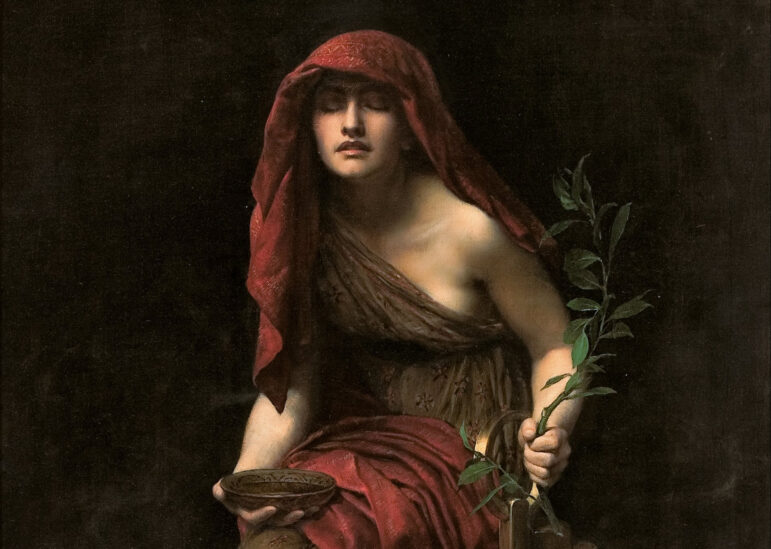
Priestess of Delphi by John Collier [oil on canvas, 1891]
It is also important to acknowledge that Pagan communities are not politically monolithic. We reflect the diversity of the societies in which we live, in the United States and beyond. That diversity, however, should not obscure a sobering reality: recent signals from political leaders suggest that conservative alliances are unlikely to offer meaningful protection for religious difference or pluralism. Diversity, in these contexts, is tolerated only until it becomes inconvenient.
Against this backdrop, one of the clearest through-lines of recent years has been the centrality of care. Grief work, mutual aid, spiritual support, and the protection of vulnerable community members are no longer peripheral concerns; they have become essential strategies for survival. They reinforce our voice and clarify who we are. Community care does not stand in opposition to political engagement — it stands alongside it, sustaining the people and relationships that make any form of advocacy possible. Tending to one another has increasingly become a form of resistance.
But I must also add that I am concerned about the economy and what it may mean for the bookstores and metaphysical shops that have long served as our community’s cornerstones. The rapid expansion of artificial intelligence, along with its environmental challenges, continues to undermine artists, teachers, and creators whose labor sustains our spiritual cultures. Our festivals, too, are under pressure, not only from declining attendance in some regions, but from rising costs for housing, food, insurance, and even security.
Many of us are feeling fear in a time when compassion can feel in short supply. I hope we are listening to one another. When we come together, we are more creative, more effective, and, most importantly, more resilient.
While we may find ourselves increasingly marginalized, our collective history and the strategies shared with us by other marginalized allies have equipped us with exceptional skills for living in liminal spaces. Each year, I reflect on this and find that my hope endures. This year is no different. Hope remains hard to kill.
We shall see.
Whatever challenges arise, The Wild Hunt will continue to share the stories of our community and the wider world through a Pagan lens and voice.
Happy Secular New Year! May the year ahead bring clarity, courage, and care.
The Wild Hunt is not responsible for links to external content.
To join a conversation on this post:
Visit our The Wild Hunt subreddit! Point your favorite browser to https://www.reddit.com/r/The_Wild_Hunt_News/, then click “JOIN”. Make sure to click the bell, too, to be notified of new articles posted to our subreddit.