

Walking out of the theater after seeing the new Wicked: For Good film—Cynthia Erivo’s fierce, wounded Elphaba and Ariana Grande’s trembling, glittering Glinda—I kept hearing one line repeating itself like an incantation I couldn’t quite shake: No good deed goes unpunished.
The song had always been powerful, but in Erivo’s hands it felt like something older than Oz, older than Broadway, older even than the myth itself. She delivered it not as a villain’s turning point but as a woman realizing, with devastating clarity, that the world she has tried to save will destroy her anyway. There is a particular timbre to her voice in that scene—grief turning to heat, bewilderment turning to something sharper—that reminded me less of a musical number and more of the moments in myth when a character crosses an invisible threshold and becomes ungovernable.
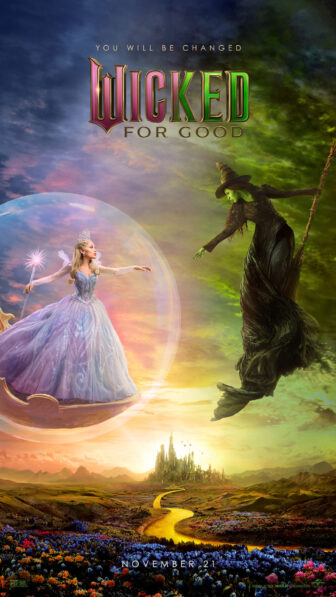
Wicked: For Good poster [Universal]
It made me think of the figures in history whose compassion became the very thing used to condemn them: Joan of Arc, driven by visions to save her country and then burned for it; Hypatia, who preserved knowledge and was torn apart for daring to think freely; countless midwives, healers, and “wise women” across Europe who were necessary to their communities until the moment their authority threatened the wrong man. A pattern as old as civilization: the person who disrupts cruelty is punished for the disruption, not the cruelty. When Erivo’s Elphaba cries out the names of those she tried to protect—Dillamond, Fiyero, Nessarose—it feels like an invocation of that entire lineage. Each name is a wound. Each wound is a doorway.
In Pagan ethics, a Good Deed is rarely the gentle thing popular culture imagines. It is not niceness. It is not purity. It is the choice to intervene where silence would be safer. It is the refusal to let harm masquerade as order. Elphaba’s Good Deeds—saving the Animals, exposing the Wizard’s propaganda, refusing to be complicit—are all acts that, in any reasonable world, would be recognized as bravery. But Oz is not a reasonable world, and neither is our own. Both reward charm more than courage, obedience more than truth. Which is why Ariana Grande’s Glinda is such a haunting contrast: her goodness is socially endorsed, performative, crowned in pink light. Elphaba’s goodness, by contrast, threatens the entire architecture of power. And so it must be punished.
The moment “No Good Deed” erupts from Erivo’s body feels eerily akin to the initiatory breaking points that appear in myth, literature, and magical practice. The Greeks called this anagnorisis: that brutal instant when a character sees the truth too clearly to ever return to innocence. Antigone burying her brother even though the state forbids it. Shakespeare’s King Lear in the storm, stripped of illusions, finally seeing the world for what it is. Morgan le Fay, in certain Arthurian tellings, realizing she will never be forgiven for her power and choosing to claim it anyway. The moment in every Witch’s story where she understands she will never be granted permission to be who she is — and so she stops asking.
What Erivo captures so precisely is not the birth of wickedness, but the collapse of the fantasy that goodness guarantees safety. Her Elphaba is not corrupted; she is awakened. The phrase “So be it” lands not as surrender but as decision. The world will call her wicked no matter what she does — so she might as well act from truth rather than apology. That is the moment the Witch archetype is born: not in malice, but in refusal.
Watching it in 2025, in a world already trembling from political tumult, climate grief, and the general unmaking of so many assumed certainties, the scene feels almost too real. Many of us know what it is to try to do the right thing and be punished for it. To tell the truth and be labeled divisive. To care fiercely and be accused of threat. To hold a boundary and be recast as difficult. The line “No good deed goes unpunished” is not bitterness; it is recognition.
And yet — this is the part that stayed with me — it is also the seed of transformation. Elphaba does not crumble under the accusation. She does not soften herself to fit the contour of someone else’s comfort. Instead, she steps into a deeper version of herself, stripped of illusion but not stripped of heart. Her vow is fierce, but it is not empty. It is the vow of someone who will no longer contort herself to remain palatable.
In Paganism, this is the beginning of real magic: not the sparkle, not the spectacle, but the moment a person’s will aligns with their integrity. The moment the world’s narrative no longer dominates their own. The moment the Witch steps into her sovereignty, not because she seeks power, but because every other option has proven to be a lie.
What Erivo brings to the role is the sobering truth that once a person has crossed that threshold—once the Good Deed has been punished and the mask has shattered—what grows in its place is a kind of clarity that cannot be undone. The Witch is no longer asking to be understood. She is no longer negotiating for her humanity. She is only following the current of what must be done, and that is the most dangerous thing of all: a woman whose actions are no longer shaped by the desire to be harmless.
There is, hidden inside the tragedy of the song, a kind of liberation. Not triumph, not victory—just the stark freedom of knowing that the world’s labels have lost their power. That the punishment has already been delivered. That the worst has already happened, and the self that remains is the one that will endure.
And perhaps that is why the song hits so hard now. Because so many of us recognize that moment of disillusionment. So many of us know what it means to try to do good and watch the world contort it into something monstrous. So many of us have stood in that threshold space, breath shaking, heart torn open, realizing that the only path left is the one where we walk forward anyway, without permission.
Elphaba’s vow, in this new film, is not the cry of a villain. It is the prayer of a woman who finally understands her own myth. A woman who will no longer be broken. A woman whose Good Deeds may have gone punished, but whose transformation—once sparked—cannot be reversed.
The Wild Hunt is not responsible for links to external content.
To join a conversation on this post:
Visit our The Wild Hunt subreddit! Point your favorite browser to https://www.reddit.com/r/The_Wild_Hunt_News/, then click “JOIN”. Make sure to click the bell, too, to be notified of new articles posted to our subreddit.