
MIAMI – Last month, Florida Attorney General James Uthmeier ignited controversy after posting a letter on X (formerly Twitter) warning that “Two days before Christmas, Pensacola will host a demonic, sexually explicit drag show at the city-owned Saenger Theatre.” In the letter, Uthmeier claimed he had “learned that Pensacola’s Saenger Theatre will be hosting A Drag Queen Christmas on December 23,” describing the annual show as one that “openly mocks one of the most sacred holidays in the Christian faith.”
The drag-show letter came amid a rapid-fire series of similar public threats Uthmeier issued against three separate institutions: Microsoft, the American Bar Association (ABA), and the City of Pensacola. In each instance, the attorney general accused organizations of harboring “anti-Christian” bias or failing to properly protect Christian rights. Together, the letters represent a growing and troubling pattern: the use of state power to advance a narrow religious ideology while mischaracterizing the First Amendment.
Editor’s Note: Some readers have pointed out that the performers in “A Drag Queen Christmas” do not identify their stage personas as demonic or theologically themed. Trinity the Tuck’s name does not reference Christian doctrine, Bosco’s drag centers on burlesque, and Suzie Toet adopted “demonic Betty Boop” only after the Attorney General used the phrase. The descriptions in this article refer to claims made by the Attorney General and not to the performers’ own branding.
Civil liberties groups, religious minority advocates, and First Amendment scholars warn that Uthmeier’s actions reflect an increasingly aggressive trend within Christian nationalist politics—one that seeks to recast Christians as a persecuted class despite their overwhelming cultural and political influence.
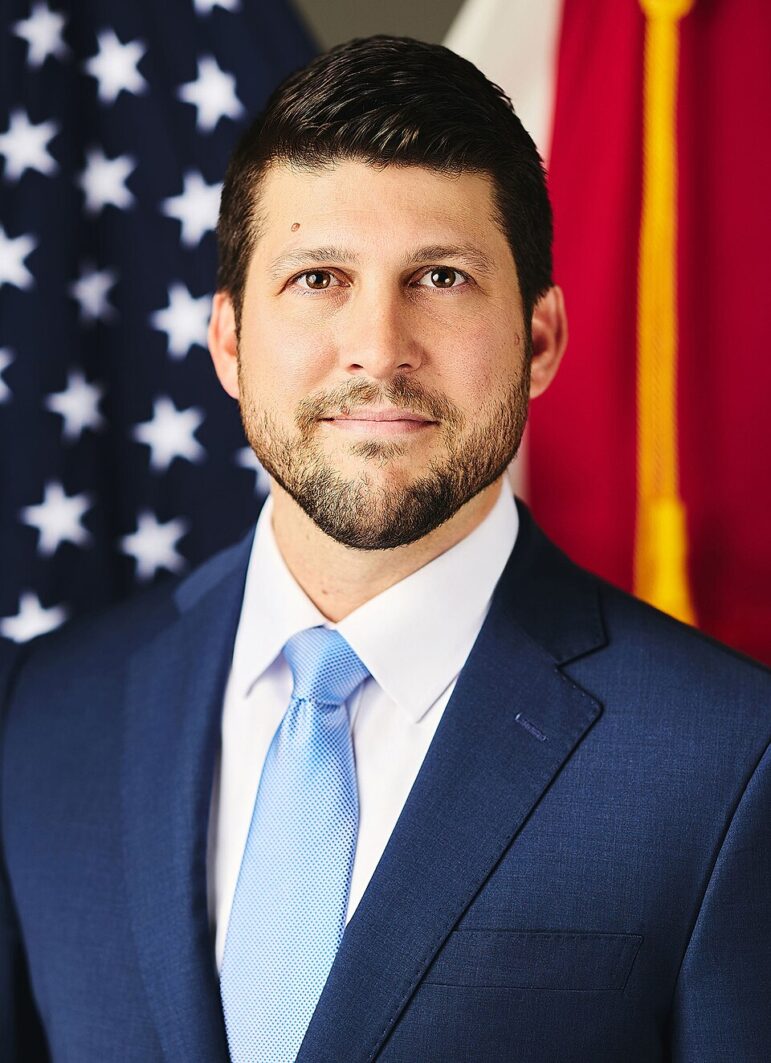
Official portrait of Attorney General James Uthmeier of Florida, 2025 [Public Domain
Microsoft: Accusations of “Anti-Life” Bias
In his first letter, Uthmeier accused Microsoft of discriminating against Christian pregnancy centers after the company initially declined to offer some of them nonprofit software discounts. The discounts, Microsoft said, are limited to organizations that fall within the company’s philanthropic mission. Some pregnancy centers were reportedly told they did not qualify because they do not provide “full women’s health services.”
Uthmeier rejected that rationale entirely, calling “full women’s health services” a “euphemism for abortions.” He wrote: “If Microsoft is pro-abortion and hostile to the pro-life community, then make that position plain. If Microsoft harbors some hostility to Christian educational institutions, then come out and say it.”
He further warned the company: “We expect Microsoft’s cooperation in fixing this problem, or there will be consequences.”
Microsoft has, in some cases, reversed its decisions and granted the discounts. But Uthmeier criticized the company for not creating a new enforcement mechanism to prevent future denials.
ABA: Investigating Accreditation Becomes a Culture-War Flashpoint
The attorney general next targeted the American Bar Association after it reviewed whether a Florida Catholic law school was meeting accreditation standards. Rather than allow the process to unfold through established regulatory channels, Uthmeier framed the review as an attack on religious education and inserted his office into the dispute.
Critics have argued that the Attorney General’s involvement is unusual and potentially improper, raising concerns that state officials may be pressuring independent accreditation bodies on ideological grounds.
“A Drag Queen Christmas”: Accusations of Religious Discrimination
Uthmeier’s most widely circulated letter targeted the City of Pensacola for permitting a drag performance on city-owned property near Christmas. In the letter, he said allowing the show “may amount to religious discrimination” because some performers joke about Christian themes. Previous productions of A Drag Queen Christmas have incorporated campy or supernatural personas, such as a performer named “Trinity The Tuck Taylor,” whose name some view as a playful nod to Christian theology. This year’s cast includes the “Demon Queen of Seattle,” known for a demon-themed costume, as well as “Suzie Toot,” a performer styled as a “demonic Betty Boop.”
This argument, however, is legally baseless. The First Amendment does not allow a city, nor an attorney general, to censor artistic expression simply because some viewers consider it irreverent or offensive. Satire, drag, parody, and even explicit critique of religion fall squarely within constitutionally protected speech.
Yet Uthmeier urged the city to cancel the performance anyway, arguing it offended Christian residents and posed unspecified risks to children, despite no evidence of legal wrongdoing by the performers or organizers.
The Obvious Christian Nationalist Framing
Uthmeier’s letters position Christians as the primary victims of religious discrimination in America. This framing, long used by Christian nationalist organizations, contrasts with demographic and political realities. By all estimates, including the Pew Research Center, Christians make up over 60% of the U.S. population and nearly 90% of Congress. They are represented at disproportionate levels in the systems of power in the USA, including state legislatures, governorships, school boards, and the judiciary.
Civil Liberties Advocates Push Back
The Freedom From Religion Foundation (FFRF) has condemned Uthmeier’s actions as a misuse of state authority.
“These actions are completely inappropriate,” said FFRF attorney Chris Line. “Florida is not a Christian state, and the United States is not a Christian nation. No one can be forced to accept religious dogma or discrimination under the guise of ‘Christian rights.’”
FFRF Co-President Annie Laurie Gaylor added, “This is a shocking attempt to weaponize governmental power to privilege one religion over all others and over non-religion.”
USAToday noted that experts they contacted were hesitant to comment, some citing fears of retaliation in the tense public environment following recent high-profile political violence, including repercussions against employees fired for their speech.
Implications for Pagans and Minority Faiths
For Pagan, polytheist, and other minority-religion practitioners, the attorney general’s actions raise particularly acute concerns. When officials single out “anti-Christian bias” as the nation’s foremost religious liberty issue, they implicitly redefine religious freedom around a single dominant faith. This reframing can obscure or undermine the rights of smaller religious communities—communities with long histories of marginalization and surveillance.
The attorney general’s arguments suggest that cultural expression deviating from Christian norms may be subject to government interference. His framing implies that Christianity deserves special protection when criticized or satirized, while other religions may not receive similar concern. In practice, this approach invites the state to determine which religious beliefs are worthy of protection and which artistic expressions are permissible—an inversion of First Amendment principles.
The First Amendment protects all spiritual expressions, including the right to disagree with or critique them. Government neutrality is not anti-Christian; neutrality is the legal foundation that ensures Pagans, Hindus, Buddhists, Jews, Muslims, Christians, and non-religious people alike may practice freely without state favoritism.
FFRF warns that recasting ordinary policy decisions or protected speech as “anti-Christian discrimination” is part of a broader campaign to weaken the separation between church and state. Such efforts have real consequences—not only for LGBTQ+ performers or private corporations exercising contractual discretion, but also for minority religious communities who may be rendered more vulnerable if government officials declare that neutrality itself constitutes hostility.
Uthmeier’s letters are not isolated outbursts; they are signals. They suggest how some state officials are prepared to interpret the law, and how they may wield government power to privilege Christianity while framing that privilege as “religious freedom.”
In times of cultural and political polarization, the integrity of the First Amendment becomes even more vital. Religious liberty requires government neutrality, not the use of public office to enforce the religious preferences of the majority. When officials claim they are protecting Christianity from persecution, but do so by threatening corporations, censoring art, or undermining independent accreditation, they erode the very foundations of religious freedom.
For Pagans and minority faiths, communities who know too well what actual religious discrimination looks like, these developments are a stark warning. Religious liberty cannot survive when it is redefined to mean Christian supremacy.
The Wild Hunt is not responsible for links to external content.
To join a conversation on this post:
Visit our The Wild Hunt subreddit! Point your favorite browser to https://www.reddit.com/r/The_Wild_Hunt_News/, then click “JOIN”. Make sure to click the bell, too, to be notified of new articles posted to our subreddit.