

The Great When is an odd book. It is, on the one hand, an adventure novel – a Hero’s Journey with enough quirks to keep it interesting. It’s a portal fantasy whose basic premise – that beyond the banal and material city of London that we know is a second London, a city of magic and danger known only to a few – has been explored in numerous other books. It would be entertaining enough on its own with just that. But dig a little deeper. For the occultist reader, there is a wealth of intrigue and trivia that makes the book an immensely rewarding experience.
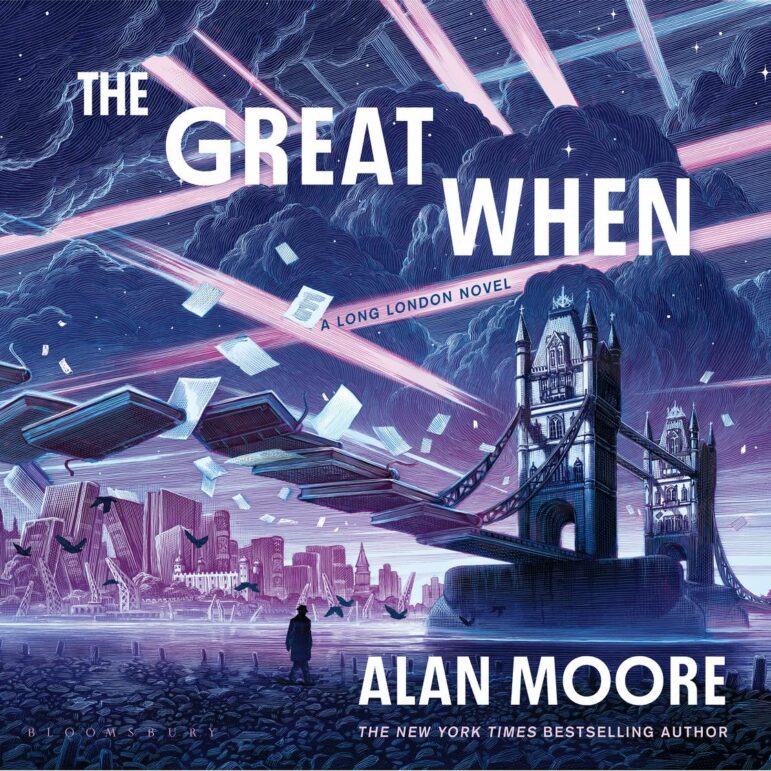
The Great When by Alan Moore [Bloomsbury]
The setting is London, 1948, a city battered by war and economic depression. Our hero is Dennis Knuckleyard, a gawky 18-year-old who lives in fear of his landlady, employer, and maternal figure, the terrifying “Coffin Ada,” so named for the legend that she’s got at least one buried in the garden behind her used bookshop. Dennis, an orphan, has no money and no prospects. But Ada has an eye for investments, and so she sends Dennis out to collect a box of rare Arthur Machen volumes, figuring that they’ll eventually be worth something. But along with the Machens, Dennis brings home a book that categorically should not exist – a book that belongs not to the city Dennis knows, but somewhere much stranger, “Long London,” the city we think of when we think we are thinking about the real London.
Almost any novel with a nervous teenage boy as the hero will turn out to be a Bildungsroman to some extent, and The Great When is no different. As Dennis attempts to rid himself of his troublesome MacGuffin, he encounters a wide assortment of strange and dangerous characters – and many of the worst belong to our side of the divide. He is placed in situations where he has little to rely on but his own ingenuity and moral judgement, and by the end, he is forced to grow up a little.
There are two things that make The Great When stand out, though. First is that Moore makes the conscious decision to portray Long London as a disorienting and unpleasant place to visit. The book resists the usual urge to portray the Otherworld as a charming and romantic place to spend a holiday. Human beings are not made to confront their own abstractions and prejudices manifest, and events in that reality can ripple out and cause incredible harm to the real world. Some people manage to touch Long London and bring back truth and beauty – artists, writers, magickians – but some bring back altogether more awful things, like the concept of serial killers.
Those artists and magickians belong to the other major feature of the book: Moore’s incurable urge to ground his fantasies in history. Much of the book’s cast is made up of real people active in postwar London, some of whom will be familiar to anyone with a grounding in the British occult scene. I mentioned above that the book follows the Hero’s Journey pattern, more or less. What’s delightful is that our supernatural mentor figure here is none other than Austin Osman Spare, the occultist painter. Kenneth and Steffi Grant also appear, along with cameos by Aliester Crowley and Dion Fortune.
But these magickians are hardly the only notable historical figures in the tale. Almost everyone Dennis encounters in his sojourn has a Wikipedia page – the horse-tipster-cum-oracle Prince Monolulu, gay nightclub proprietor and mystic “Ironfoot” Jack Neave, and terrifying Jewish gangster Jack Spot all play major parts in the novel. I had never heard of Jack Spot before reading the book, and took him to be simply a suitable fictional antagonist. But then I read about the actual gangster’s biography, and was astonished to find just how many events in Spot’s life Moore drew into the preternatural tapestry of his setting, such as folding a vision of one of Long London’s godlike “arcana” into a street fight against Oswald Mosley’s Blackshirts during Spot’s youth. The same attention to detail can be found throughout the whole novel; there’s no end to delightful Easter eggs for the interested reader.
The major flaw of the book is, unfortunately, in its approach to women. There are only two female characters of note in the book – the aforementioned Coffin Ada, and Grace, a working girl who befriends Dennis and offers him shelter from his troubles (and immediately becomes the object of his unrequited desires.) It’s not that Ada or Grace are offensive in themselves – I enjoyed reading both of them – but it did annoy me that the two female presences were a harridan and a prostitute. Grace’s profession is discussed in its context, and it’s hard to argue that many girls weren’t put into similar circumstances as a result of the war and the postwar depression. But still – it’s another book where the heroine just so happens to be a prostitute. Even this might not have struck so sour if there were more women, and more visions of women’s lives, in the supporting roles. (One imagines Lady Freida Harris could have made a great counterpoint to Spare.)
Even with that fault acknowledged, The Great When is worth seeking out. It succeeds on multiple levels – as a thrilling piece of adventure fiction, as an assortment of historical and occult trivia, and as a consideration of the way ideas influence the material world. Moore claims that this is just the first in a quintet of further novels concerning Long London; I will be eagerly waiting for each of them.
This review was based on the audiobook, performed by Kobna Holdbrook-Smith.
The Wild Hunt is not responsible for links to external content.
To join a conversation on this post:
Visit our The Wild Hunt subreddit! Point your favorite browser to https://www.reddit.com/r/The_Wild_Hunt_News/, then click “JOIN”. Make sure to click the bell, too, to be notified of new articles posted to our subreddit.