

Recently I happened to be in Portland, Oregon. I wish I could claim I visited on some Pagan pilgrimage, but no – I was there to see a concert, and while The Beths are amazing, their only Pagan connection that I know of is a song called “Mars, the God of War.”
But the day after the show, my partner and I decided to visit the Portland Art Museum, and in the entry foyer we found an installation that immediately captivated me. Shaped like an octagon decorated with images of outstretched arms clad in white and blue, the structure beckons visitors to come inside, a space set apart from not just the rest of the museum, but the rest of the world.

Myers, Christopher, American, (b. 1974)Let the Mermaids Flirt with Me2022stained glass lightboxes and tent42 3/4 x 42 3/4 x 5 in. FrameCredit line: Collection of the Jordan Schnitzer Family Foundation© Christopher Myers 2022. Courtesy of the artist and James Cohan, New York. Photo by Dan Bradica. [courtesy Portland Art Museum]
The installation is called Let the Mermaids Flirt With Me, a creation of the artist Christopher Myers. Originally exhibited in Miami in 2022, Let the Mermaids Flirt With Me is a suite of brilliant stained glass images, all of which feature the connections between Black life and the element of water. Between the boxes of light, Myers has placed cans of gasoline, oars, life jackets, and piles of votive candles. These touches turn the enclosure into a shrine and immerse the viewer into the totality of the space.
Some of these paintings in light elevate everyday scenes to revelations, like “Uncapping,” a portrait of ecstatic figures ringing a man opening a fire hydrant to relieve a blazing summer heat. Others are more explicitly mythological. The centerpiece of the collection, framed in the center of the entryway, is an astounding portrait of a Black mermaid, her body coiled about by twin snakes; around them curve the lines of underwater currents and plants.
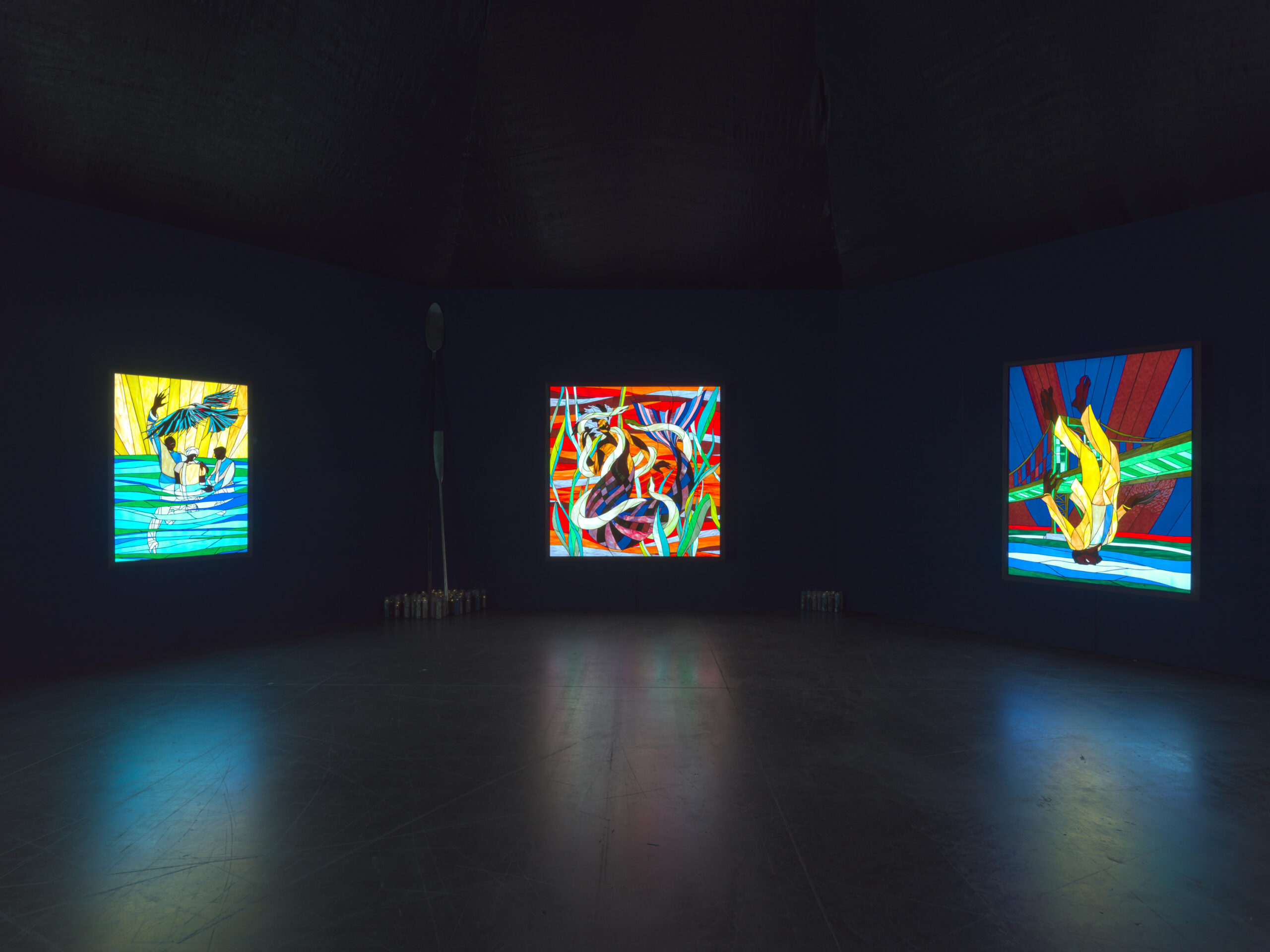
Three stained glass images from Christopher Myers’s Let the Mermaids Flirt With Me (2022): “Baptism,” “Nala Damajanti as Mami Wata as Cymbee,” and “Suicide’s Note” [courtesy Portland Art Museum]
The piece, which Myers titles “Nala Damajanti as Mami Wata as Cymbee,” reflects the shifting syncrentic nature of image and myth. As the James Cohan Gallery’s notes on the piece say:
Mami Wata or, La Sirene, is a water spirit venerated in West, Central, and Southern Africa and in the African diaspora in the Americas. For Myers, the figure of Mami Wata exemplifies the accumulative, syncretic way in which spirituality and mythology iconography travel throughout diasporic communities. In the late 19th century, a European image of the snake-charming sideshow performer Nala Damajanti was reproduced in India, and this chromolithograph circulated in religious communities in West Africa and other parts of the diaspora. In different places, this image came to symbolize Mami Wata, Erzulie, Yemanja, and a great number of water spirits. There is a web of connections centering around this image as it was reproduced, re-edited, and rewritten. Across these translations and transformations remains a reverence for–and a wariness of water– the chthonic, and the oceans that connect all these diasporas.
Myers’s work displays water in all its complexity to Black identity. Water is the mythic setting for a goddess and a quotidian feature of street life in Myers’s native New York; it is also the site of West African migrants crossing the open sea; of the complicated rite of Christian baptism; and the “calm, cool face of the river ask[ing] for a kiss” from the eternally suspended subject of the harrowing “Suicide’s Note,” named for the Langston Hughes poem.
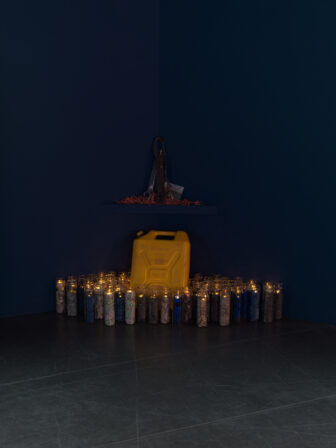
Gas can and votive candles in Christopher Myers’s Let the Mermaids Flirt With Me (2022) [courtesty Portland Art Museum]
Let the Mermaids Flirt with Me is the centerpiece of the Portland Art Museum’s current exhibition, Global Icons, Local Spotlight: Contemporary Art from the Collections of Jordan D. Schnitzer. Schnitzer is a Portland native and one of the world’s most powerful art collectors, and the exhibition is framed as a gift to his community. “Instead of having to travel to New York City to go to the Museum of Modern Art or the Whitney,” he says, “all you have to do is visit the Portland Art Museum to see exceptional artwork by some of today’s leading artists.”
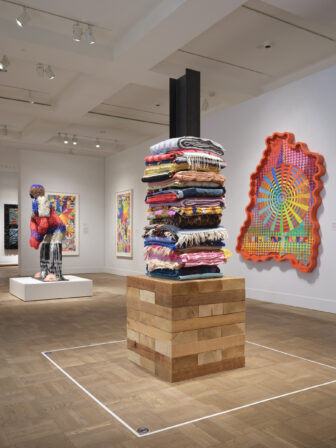
Works by Indigenous artists on display in the Global Icons, Local Spotlight exhibition [courtesy Portland Art Museum]
While many of the artists on display are familiar names like Andy Warhol, Jeff Koonz, and Jenny Holzer, the most impressive art on display belongs to Schnitzer’s collection of work by Black and Indigenous artists. Indigenous artists fill the opening room of the exhibition, just past Myers’s installation, and include mesmerizing pieces like “SPIRIT AND MATTER,” a vibrant painting on elk hide that is both abstract and exacting, created by Jeffrey Gibson of the Mississippi Band of Choctaw Indians and Cherokee.
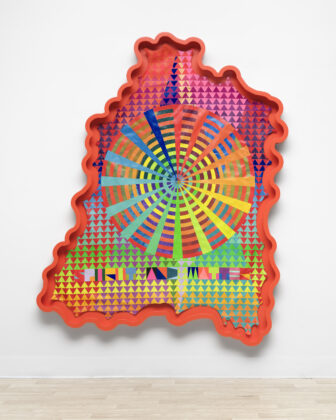
Gibson, Jeffrey, Native American, Mississippi Band of Choctaw Indians and Cherokee, (b. 1972) SPIRIT AND MATTER, 2023, acrylic paint on elk hide inset in custom wood frame, 90 x 72 1/2 x 5 in. frame; Credit line: Collection of the Jordan Schnitzer Family Foundation© Jeffrey Gibson Photography Credit: Aaron Wessling
Many of the artworks in Global Icons, Local Spotlight delight in their three-dimensionality, with pieces like a bicycle cart festooned with mirrors and a chaise lounge with a nest of ceramic birds twined above it sitting out among the visitors on the gallery floor. But the piece that has stuck with me in the days since I visited is a bit more traditional, a sculpture flanked by two paintings that together form another small installation.
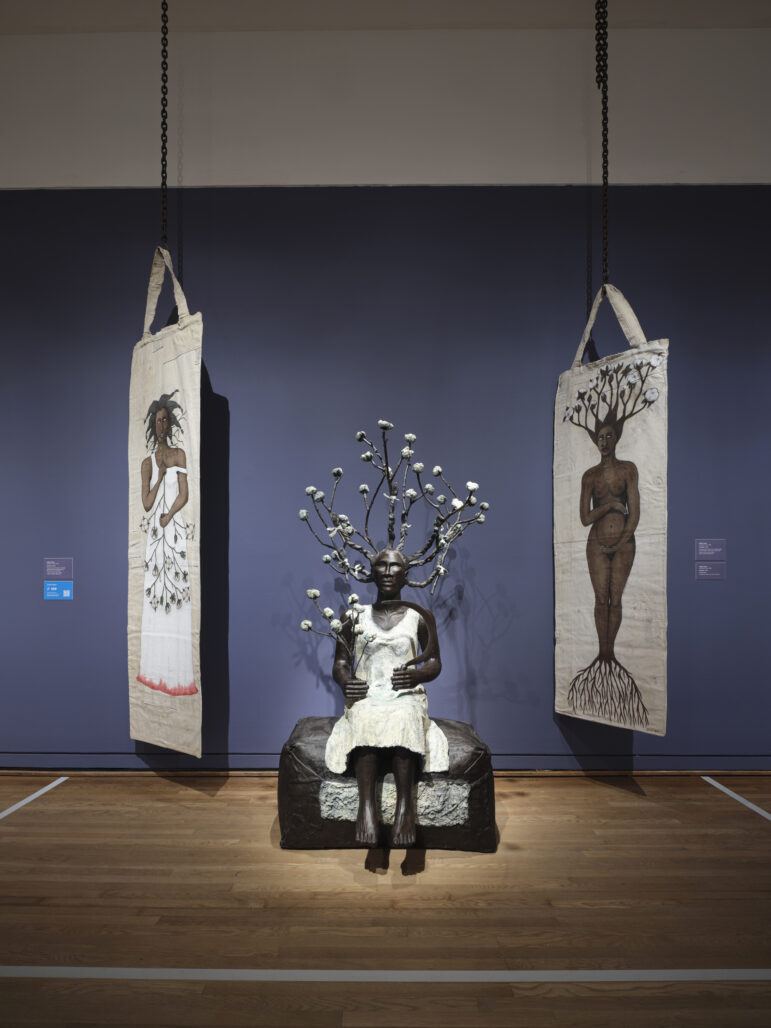
Saar, Alison, American, (b. 1956); Uproot, 2022, charcoal and acrylic on vintage cotton picking bag, found hooks and chain; Grow’d, 2019, bronze; Plucked, 2022, charcoal and acrylic on vintage cotton picking bag, found hooks and chain. Credit line: Collection of the Jordan Schnitzer Family Foundation ©Alison Saar. Courtesy of L.A. Louver, Venice, CA. Photography Credit:Aaron Wessling
The triptych by Alison Saar – two paintings on vintage cotton picking bags titled “Uproot” and “Plucked,” and a bronze sculpture titled “Grow’d” – consider the Black female body and its relationship to the earth in ways that I found relentlessly compelling. The Black body and the black earth are melded into one, Saar’s subject’s hair twining upward to bloom into flowers, feet growing downwards into roots. But while mythologized, this connection is hardly romanticized; in her chosen materials of cotton bags, chains, and hooks, Saar foregrounds the material realities of Black agricultural labor in the American South. The earth is a site of exploitation and toil – and also sacred. What’s remarkable is how Saar manages to portray all of these complicated relationships at once without diminishing any of their nuances.
Although Global Icons, Local Spotlight is not an exhibition with explicitly Pagan themes, I found there was plenty for a person with my sensibilities to appreciate within its halls, especially in the work of Black and Indigenous artists. It’s well worth a visit for anyone who happens to be in Portland.
Global Icons, Local Spotlight will be on display at the Portland Museum of Art through January 11, 2026.
The Wild Hunt is not responsible for links to external content.
To join a conversation on this post:
Visit our The Wild Hunt subreddit! Point your favorite browser to https://www.reddit.com/r/The_Wild_Hunt_News/, then click “JOIN”. Make sure to click the bell, too, to be notified of new articles posted to our subreddit.