
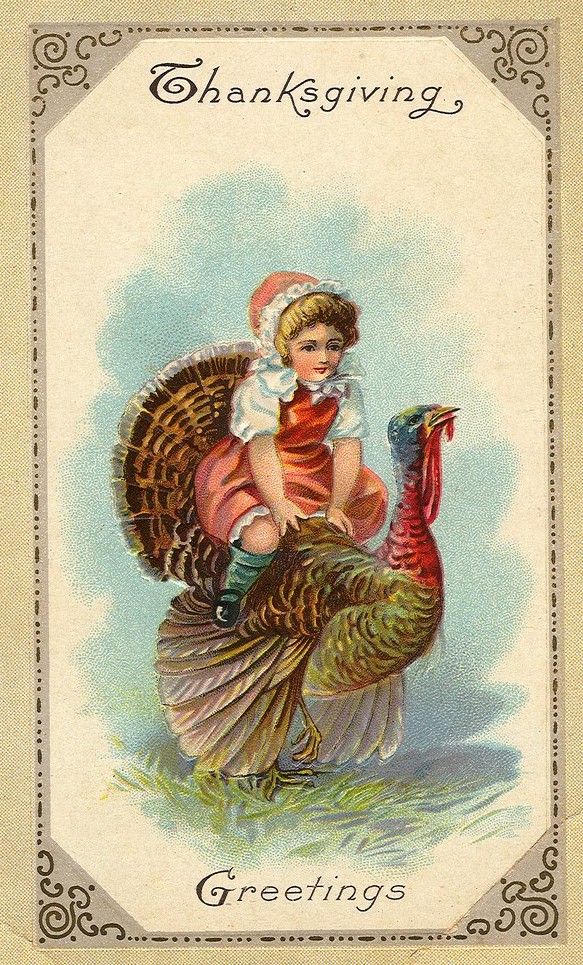
 TWH – Today is Thanksgiving, a holiday celebrated in the United States and some U.S. territories. Several other countries and cultures also observe their own thanksgiving or harvest-gratitude festivals—each with distinct histories and traditions, including Canada, which marks the occasion in October.
Today, Thanksgiving functions largely as a cultural or secular holiday, though historically some of its antecedents and proclamations included religious thanksgiving or prayer. It clearly originated as a harvest festival. Early European settlers in North America brought with them these Old World harvest customs, which later blended into the evolving colonial narrative that Americans now recognize as “Thanksgiving.”
Sarah Josepha Hale campaigned for more than thirty years to establish an annual national Thanksgiving holiday. After her decades of advocacy, the modern holiday took shape during the Civil War, when President Abraham Lincoln proclaimed a national day of unity and gratitude in 1863. Congress later formalized the holiday in 1941, setting its permanent date as the fourth Thursday in November.
The story commonly told of the “first Thanksgiving,” though not a national holiday, was a 1621 harvest celebration shared by English settlers and the Wampanoag people, who had helped the newcomers survive by teaching them to grow crops and adapt to the land. This narrative of a harmonious, communal event has been challenged by historians. While the gathering did take place, it was neither seen as historically significant at the time nor reflective of the peaceful unity later mythologized in American culture. Instead, it was a moment of uneasy diplomacy during an era marked by escalating violence, disease, and displacement that would soon devastate the Wampanoag Nation and other Indigenous communities in North America.
Indeed, the day carries a painful legacy for Native Americans and First Nations communities. Since 1970, the United American Indians of New England (UAINE) have marked Thanksgiving as a National Day of Mourning, gathering on Cole’s Hill in Plymouth, Massachusetts, to honor Indigenous ancestors and protest the genocide, land theft, and oppression that followed European colonization.
For many Indigenous Americans, this observance challenges the comforting myth of a harmonious feast between Pilgrims and Native peoples, a narrative that has long obscured the violence and dispossession that shaped the continent. The Day of Mourning commemorates the millions of Indigenous lives lost, highlights ongoing struggles for rights and recognition, and strengthens solidarity among Native communities. It underscores that colonization is not a distant historical event, but an ongoing reality affecting Indigenous peoples today.
The familiar Thanksgiving story taught to most Americans reflects a stark gap between national mythology and the lived history of Indigenous nations. This sanitized narrative, shaped by colonial revisionism, has long erased the experiences and resilience of Native peoples across North America.
As a national holiday in the United States, many stores, U.S. markets, and government offices are closed today, though not everyone has the day off. Many restaurant and retail employees are still expected to work, as are health-care professionals, first responders, law-enforcement officers, military personnel, TSA agents, flight crews, and other essential workers. Let us remember them and their vital service with gratitude.
Despite the many challenges facing our world, assaults on religious freedom, the rise of autocracy, the ongoing Russian invasion of Ukraine, inflation, immigration crackdowns, mass shootings, the ongoing climate crisis, and the deep uncertainty they create, we have also witnessed extraordinary acts of compassion and courage.
Countless people have stepped forward to help refugees and neighbors, to offer shelter, to protect one another, and to uphold the values of hospitality, duty, and perseverance.
We are especially grateful for you—our readers and supporters—who make our mission possible. Thank you for reading The Wild Hunt and for your generosity in sustaining our work and our commitment to bringing news and perspectives through a Pagan lens.
We wish everyone a moment of peace and a brush with gratitude today.
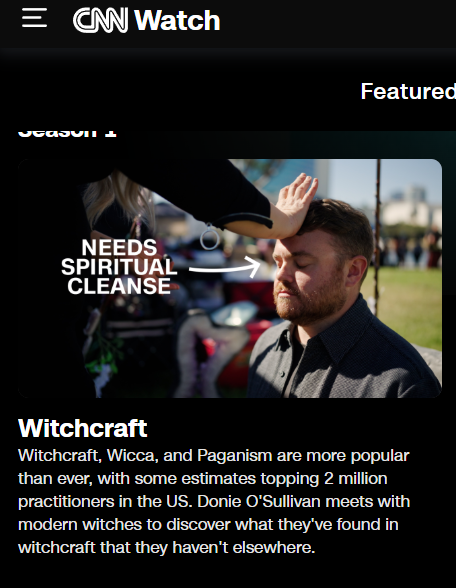
The first installment of the series is titled “Witchcraft” and notes “Witchcraft, Wicca, and Paganism are more popular than ever, with some estimates topping 2 million practitioners in the US. Donie O’Sullivan meets with modern witches to discover what they’ve found in witchcraft that they haven’t elsewhere.” By accounts, the recording took place at LA Pagan Pride and includes members from the Pagan community.
The series remains behind a CNN paywall and is available only to subscribers. The series is available on the CNN website.

Events and Announcements
More Events at our new Events Calendar
Tarot of the Week by Star Bustamonte
 Deck: Dark Side of Tarot, artwork by Corrado Roi and Pamela Coleman Smith, text by Sasha Graham, published by Lo Scarabeo.
Card: Ace of Wands
This week is apt to offer some abject lessons in limits; what is possible and what is not; as well as the consequences for pushing boundaries beyond what can be accommodated. The law, rules, regulations, and other formal, well-established systems for creating and maintaining order are liable to figure prominently. Taking a systematic approach to problem-solving and advancing a cause or project is likely to be in the spotlight.
In contrast, a world without restraint or any semblance of order has the potential to be a hotbed of continually erupting chaos. Those who flaunt their ability to disrupt the rules of order to suit their own agendas may succeed in the interim, but are unlikely to maintain positions of leadership long-term. The counteraction to such behavior is demonstrating personal accountability and integrity, and both encouraging and enabling others to do the same.
The Wild Hunt is not responsible for links to external content.
To join a conversation on this post:
Visit our The Wild Hunt subreddit! Point your favorite browser to https://www.reddit.com/r/The_Wild_Hunt_News/, then click “JOIN”. Make sure to click the bell, too, to be notified of new articles posted to our subreddit.