

Uncovering the Past
TRØNDELAG, Norway – A metal detectorist’s casual sweep across a coastal field in Trøndelag has opened one of the most intriguing archaeological mysteries in recent Viking Age research. What began as the discovery of a single oval brooch or buckle quickly became far more interesting: the grave of a Viking woman buried with distinctive jewellery and carefully positioned items, including ritual elements involving objects from the sea that are entirely unknown in pre-Christian Norway. Two scallop shells, placed deliberately across her mouth, and small bird bones likely from wings found along the grave have left archaeologists with more questions than answers.
The sequence began earlier this year when detectorist Roy Søreng uncovered an oval brooch at Val in Bjugn, an ornament typical of women’s dress in the Viking Age. Recognizing its significance, he alerted landowner Arve Innstrand and contacted archaeologists. Their quiet excavation soon revealed a fully articulated human skeleton and a burial assemblage unlike any previously seen in the region.
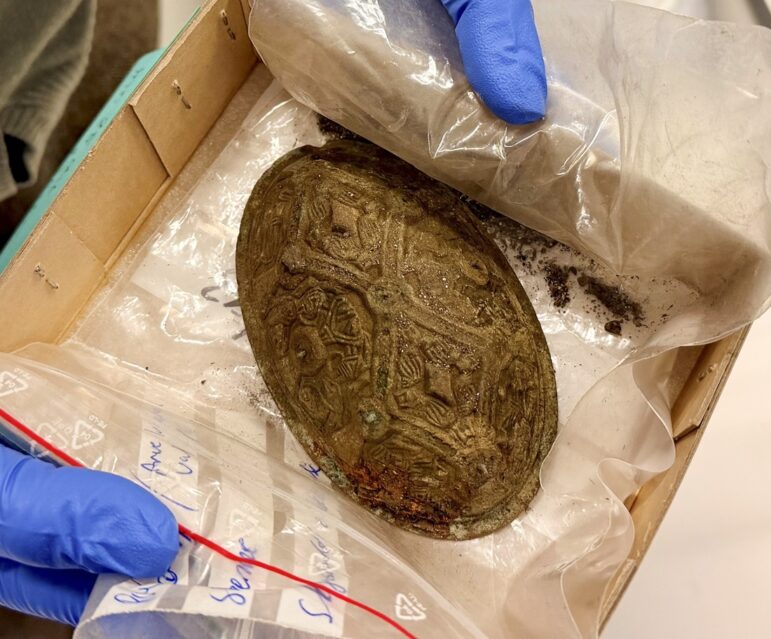
The bowl buckle is among the finds from the grave. [Photo Credit: Raymond Sauvage, NTNU Science Museum; Courtesy – CC BY-SA 4.0]
“The grave contains what we believe is a woman, buried with a typical Viking Age outfit and jewelry dating to the ninth century,” said senior engineer and project leader Raymond Sauvage of Norwegian University of Science and Technology’s University Museum (NTNU) in a statement. The two oval brooches had once fastened the straps of her outer dress, while a smaller ring brooch closed the neck of her underdress. Based on these items, Sauvage noted, “This indicates that she was a free and likely married woman, perhaps the mistress of the farm.”
But jewelry alone is not what makes the burial extraordinary. The scallop shell enigma raises the real questions.
“The most striking feature is two scallop shells placed by the mouth of the deceased,” Sauvage explained. “This is a practice previously unknown from pre-Christian graves in Norway.” The shells were positioned with the curved sides outward and the straight edges upward, partially covering her jaw as if sealing, shielding, or symbolically marking her mouth.
In a world where Viking funerary practices varied widely, cremations, chamber burials, ship graves, the placement of objects was rarely accidental. Yet scallop shells have no known role in Norse ritual. Their presence here is unprecedented.
Great Atlantic scallops are common along Norway’s coast, but collecting them in the Viking Age required diving. Whether the shells were gathered from the seafloor or from natural wash-ups remains uncertain. Sauvage told researchers that the shells bear no obvious modifications, such as drilled holes, that would suggest they were part of a crafted object. Their purpose appears symbolic, though the meaning is elusive.

Across cultures, scallops have long held associations with transition and spiritual journeys. Scallop motifs appear on fourth-century Roman coffins and were later linked to medieval Christian pilgrimage, especially the cult of St. James. But this burial predates widespread Christian influence in the region by more than a century. “It is likely that the scallop shells had a symbolic meaning intended to be communicated to those witnessing the burial,” Sauvage said. “Unfortunately, it is difficult to guess what this meaning could have been.”
Adding to the puzzle were “small bird bones, probably from wings,” found along the grave. Wings as symbols of spirit, passage, protection, or flight appear in many ancient cultures, though they are not documented in Viking Age graves in this way. Whether the bones were offerings, remnants of a ritual act, or intended to imbue the deceased with metaphorical “wings” remains entirely speculative.
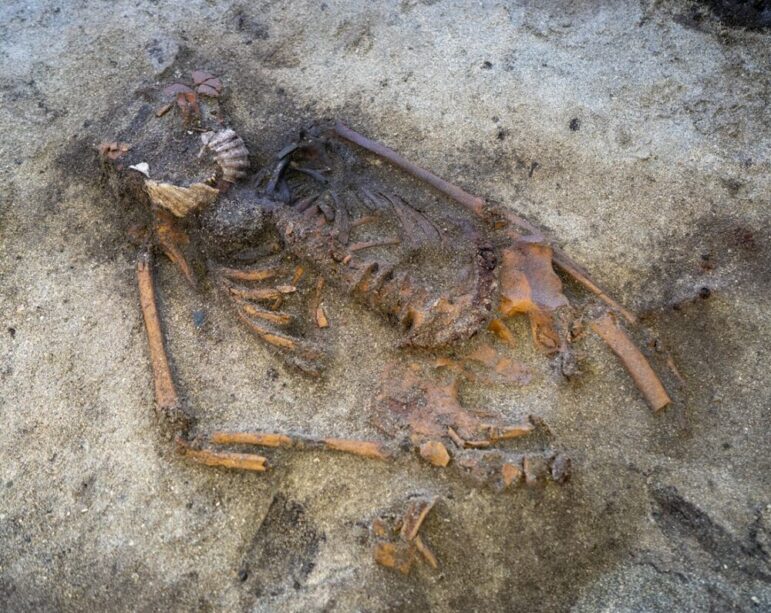
The burial remains of a Viking Age woman with two large scallop shells on her mouth. [Photo Credit: Ellen Grav/NTNU University Museum; Courtesy – CC BY-SA 4.0 ]
This burial is not alone. Earlier this year, archaeologists uncovered an exceptionally well-preserved eighth-century skeleton in the same field. The newly discovered grave is likely “one to three generations younger,” according to field manager Hanne Bryn, suggesting a longstanding burial ground tied to a particular household or lineage.
The second find came just in time. “During the inspection, we quickly realized that we were facing a new skeleton grave that was in acute danger of being damaged by the next plowing,” Bryn said. Emergency funding from the Norwegian Directorate for Cultural Heritage allowed archaeologists to perform a full safeguard excavation before the site was disturbed.
The Norwegian Agency for Cultural Heritage is also excited. Director General Hanna Geiran emphasized the importance of the find: “It is very unusual to have such a well-preserved skeleton in old graves. This discovery has great cultural heritage value.”
The team will now begin detailed analyses. “We will examine the skeleton, conserve the objects, and take samples for dating and DNA analysis,” Sauvage said. One goal is to determine whether the scallop-shell woman is related to the earlier burial, offering insight into family structures and generational continuity on the farmstead.
Researchers will investigate stature, age, sex-specific traits, signs of disease, and any evidence of lifestyle or trauma. But the symbolic logic of the grave goods, the scallop shells, the bird bones, the deliberate placement, may remain the most tantalizing question.
The Wild Hunt is not responsible for links to external content.
To join a conversation on this post:
Visit our The Wild Hunt subreddit! Point your favorite browser to https://www.reddit.com/r/The_Wild_Hunt_News/, then click “JOIN”. Make sure to click the bell, too, to be notified of new articles posted to our subreddit.