
Equinox Blessings from The Wild Hunt!
Meteorological autumn began on September 1, covering the months of September, October, and November—or, as we call them in South Florida: Heatember, Hotober, and PossiblyFall. For most, though, the new season truly begins with the equinox.
The September equinox in 2025 occurs on September 22 at 18:19 UTC (2:19 p.m. EDT, 1:19 p.m. CDT, 11:19 a.m. PDT). On this day, nearly everyone around the world experiences a day and night of roughly equal length, though not perfectly so.
Equinoxes happen when the Earth’s axis tilts neither toward nor away from the Sun, placing the Sun directly above the “celestial equator,” the extension of Earth’s equator onto the celestial sphere. Because of Earth’s 23.44-degree tilt, this moment balances light and dark before the hemispheres diverge once again, toward longer nights in the north and lengthening days in the south.
These moments are thresholds, signaling the close of one season more than the full arrival of the next. In the north, days will shorten, the air will cool, and colors will deepen. As an Irish proverb says: “Autumn days come quickly, like the running of a hound on the moor.” In the south, light and warmth surge back, with blossoms and longer days heralding summer.
Astrologically, the Sun enters Libra, the scales of balance held by Themis, Titaness of divine justice and cosmic order. Libra is the only zodiac sign represented not by a creature but by an ideal.
In Pagan traditions, the equinox is the second of three harvest festivals, framed by Lughnasadh and Samhain. Wiccans often call it Harvest Home or Mabon; Druids similarly call it Alban Elfed; some Heathens, Winter Finding; and others, simply Mid-Harvest. The Greek name is Phthinopohriní Isimæría; in Old English, efnniht.
In much of the north, pumpkin spice has already swept in, as certain a sign of autumn as falling leaves. Albert Camus wrote: “Autumn is a second spring when every leaf is a flower.”
In early Modern English, the season was sometimes called backend, the “back end” of the year. The term appears in northern English, Scots, and Irish dialects, used by poets like Robert Burns in the 18th century and persisting regionally well into the 20th. Today, of course, “backend” usually belongs to business and tech, but once it meant autumn.
Whatever name it carries, Fall, Harvest Home, Mabon, Alban Elfed, Mid-Harvest, or Spring for our southern kin, may this September equinox bring balance, gratitude, and renewal.
Announcement
 The Wild Hunt’s fiscal sponsor for non-profit status has announced that it will no longer use Flipcause to process donations. As a result, we’ve updated our site with a new donation platform, Mazlo (links below). For those currently giving through Flipcause, please note that the service will end on October 1.
This change comes at a challenging time. Our operating costs have risen significantly, and we are still recovering from the recent cyberattack. Your support is more vital than ever.
We cannot exist without our donors. We believe everyone deserves access to fair, thoughtful, and inclusive reporting on religion. That’s why The Wild Hunt will never put up a paywall. Every article, column, and story is available (no paywall- freely and fully) because our mission is to make this work accessible to all, not just those who can afford it.
But accessibility comes with real costs. From reporters and editors to columnists and technical staff, it takes a dedicated team to keep TWH running. If you value our work and are in a position to help, we invite you to become a donor.
Every contribution, no matter the size, makes a difference—and because we are a nonprofit, 100% of your gift directly supports our mission: delivering accurate, engaging, and meaningful coverage of religion that deepens understanding and sparks conversation.
Tax Deductible Donation | PayPal Donations | Join our Patreon
We are proud to be one of the most widely read news sources in modern Paganism, with reporters and columnists dedicated to telling the stories that matter to our family of faiths, stories you won’t find anywhere else.
As always, thank you for reading and for being part of our community!
Update on Fae’s Closet attack

Events Happening This Weekend!


More Events at our new Events Calendar
Tarot of the Week by Star Bustamonte
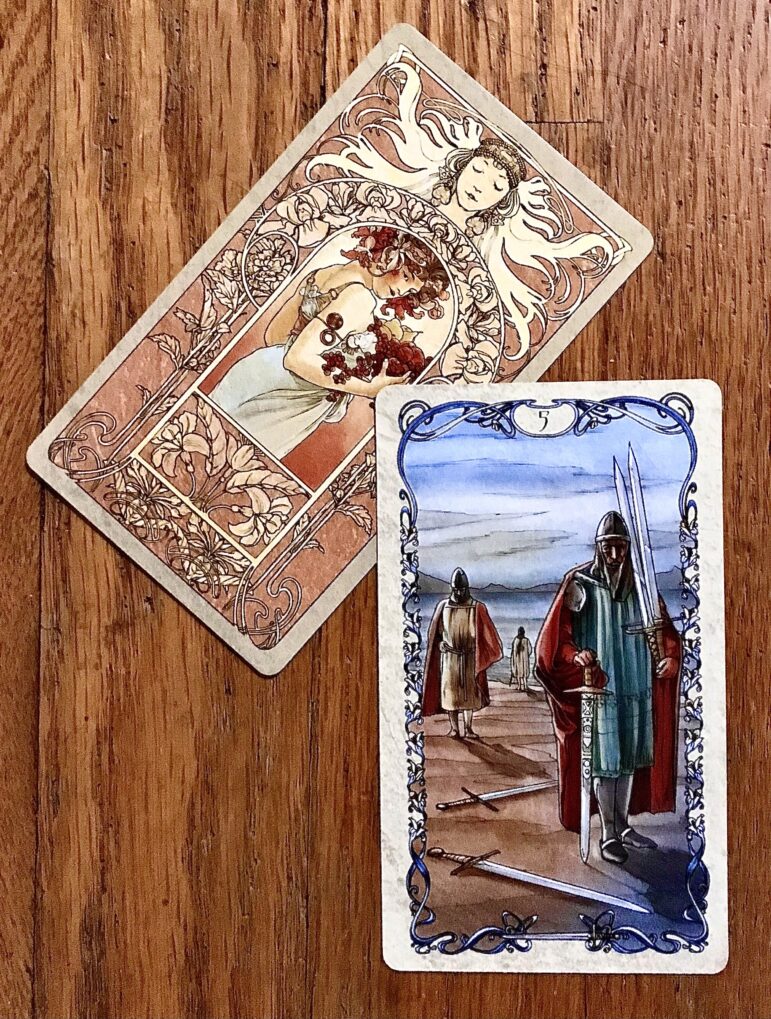 Deck: Tarot Mucha, artwork by Guilia F. Massaglia, text by Lunaea Weatherstone, published by Lo Scarabeo.
Card: Five (5) Of Swords
The week ahead holds both the potential for more discord and the realization that most serious conflicts frequently have no actual winner—often everyone loses something, even the “winner.” The key note for this week is to pick one’s battles with care and weigh whether it is truly worth the effort to engage.
Contrarily, it is quite possible this week to be in a no-win situation or on the losing side of a disagreement. Walking away and letting it go is likely the best approach, particularly if the source of conflict attempts to re-engage a fight by targeting past wounds. The best advice here is not to take the bait, move on, and focus on what is truly important.

The Wild Hunt is not responsible for links to external content.
To join a conversation on this post:
Visit our The Wild Hunt subreddit! Point your favorite browser to https://www.reddit.com/r/The_Wild_Hunt_News/, then click “JOIN”. Make sure to click the bell, too, to be notified of new articles posted to our subreddit.