Archives For Japan

Before we move too far into the future, let’s pause a moment to talk about Halloween. Not the spiritual vigil of Samhain or seasonal harvest celebrations.  Let’s discuss the wholly secular, American and Canadian holiday of Halloween, complete with candy, costumes and PVC pumpkins.

Vintage Halloween Pumpkin Men

Vintage Plastic Halloween Pumpkin Men by riptheskull

It’s fair to say that Halloween has a somewhat uneasy place in the family of North American holidays.  On the one hand, we, as Pagans, fully embrace the festivities. It is the one calendar event that openly clings to its Pagan origins. When else can you buy a pentacle in TJ Maxx?   But, on the other hand, the celebration mocks its own spiritual roots, something that we hold very dear.

We aren’t alone in our unsettled attempts to navigate through the Halloween season.  American religious and community leaders repeatedly attempt to ban the holiday.  Why?  The list is endless including concerns over the overindulgence in candy, the potential dangers of trick-or-treating, the increased popularity of over-sexualized or violently graphic costumes and, of course, its Pagan origins. But the majority of folks really just want an excuse to party. Halloween provides a unique canvas that can only be topped by the decadent bacchanalia that is Mardi Gras. (The Atlantic, 10-30-12)

Japanese McDonalds Costumes

Ronald McDonalds Girls
Photo courtesy of Japan-Talk.com

More recently, the Halloween debate has been getting larger – much larger. Over the past two decades, our secular holiday has been spreading across the globe, seizing the imaginations of youth cultures on every continent. The holiday has hitched a ride with missionaries, English language teachers and ex-pats. It’s being promoted by imported American cultural commodities like internationally-based Theme Parks, McDonald’s stores, Coca Cola products and Hollywood movies.  And, of course, the ever-increasing accessibility to the internet only fuels the proverbial fire.

In some regions, Halloween has been readily incorporated into long-established fall cultural traditions. In the U.K. and the Republic of Ireland, Halloween finds itself at its ancestral birthplace. Today, the newly-imported version has mixed with surviving local customs associated with, among others, Guy Fawkes Day.  As noted by English writer, Chris Bitcher:

“Trick or treat has now actually become a bona fide tradition in the UK ….Fireworks were our autumnal treat of choice and for a good little while we fought off any competitor to it. But then we gave that up and decided to embrace both.” (Your Canterbury)

Disneyland Honk Kong on Halloween

Disneyland Honk Kong
During Halloween

Across the globe in China, Hong Kong and Japan, people have been enthusiastically adopting the holiday. Lisa Morton, award-winning writer of Trick or Treat: The History of Halloween, and noted Halloween authority, attributes this acceptance to the presence of two Disney Theme Parks  (Tokyo and Hong Kong), Hollywood horror movies and a fascination with American pop-culture. During my own discussion with her, Lisa added, “In Japan, there is a love of festivals and affection for costuming or “cosplay,” which is associated with anime and manga.”  In mainland China, Halloween is slowly replacing Yue Laan or “ Hungry Ghost Festivals,” during which people appease and entertain ancestral ghosts.  To fuel and solidify this cultural shift, China will be getting its very own “Haunted Mansion” at Shanghai Disneyland in 2015.

On the contrary, in continental Europe, Halloween has been receiving a less than welcome reception. In Oct 2012, the Polish Archbishop Andzej Dzięga, was quoted on Polskie Radio, as saying, “This kind of fun, tempting children [with] candy, poses the real possibility of great spiritual damage, even destroying spiritual life.” He warned against the “promotion of paganism” and a “culture of death.”  In 2003, CNN.com reported that France’s Catholics are trying everything to fend off a Halloween celebration they say is an “ungodly U.S. import.”

More recently, in Russia, the war over Halloween rages on. ABC Online reports that one Russian Education Ministry official called the holiday, a destructive influence “on young people’s morals and mental health.” The Moscow city schools banned Halloween celebrations claiming that they were concerned about, “rituals of Satanically-oriented religious sects and… the promotion of the cult of death.”  In the same article, an unamed Russian psychologist warned:

Halloween poses a great danger to children and their mental health, suggesting it could make young people more likely to commit suicide.”(ABC Online)

Despite this heavily Christian rhetoric, the resistance is not entirely about religion.  In our discussion, Lisa explained that, “While it is difficult to fully separate the expression of nationalism from religious tradition, many European countries, like France and Slovenia, have strong anti-American undercurrents.”  Religious fervor may, in fact, be serving nationalist interests.  Lisa said, in the end, she “believes the protests are far more about nationalism than religion.”

This is expressed in an article by Paul Wood, an Englishman living in Bucharest:

Just as the North American grey squirrel has made the red squirrel almost extinct so has the North American Hallowe’en taken over with extraordinary swiftness, extinguishing older, weaker traditions. This too is life, I suppose, but it is part of the process by which the whole world is becoming plastic. (Romania Insider)

Despite the rejection, Halloween is still growing, albeit very slowly, deep within European youth cultures.  In Italy, Halloween is called La Notte delle Streghe or “Night of the Witches.”  In Romania, home of the Carpathian Mountains, the local economy is profiting from world’s fascination with Count Dracula. What a better way to spend Halloween than in Transylvania on a “real Dracula Halloween tour” complete with a four-course dinner and prizes!

Now, let’s move into the Southern Hemisphere where Halloween faces a new obstacle. Simply put, the harvest-based holiday does not apply. In this part of the world, October 31st marks the middle of Spring, not Fall.  Over the summer, I was reminded of this fact when wishing an Australian friend, “Joyous Lughnasah.” She responded with an equally joyful, “Happy Imbolc.”

2671887 eeda9c5cIn the Southern Hemisphere, traditional festivals continue to be celebrated in accordance with appropriate seasonal shifts with no noticeable attempt to transplant Halloween to May.  However, youth cultures have been showing a small amount of interest in an October-based Halloween celebration, particularly in the English-speaking countries of Australia, South Africa and New Zealand.  If for no other reason, the Northern holiday offers a chance to party and dabble in the macabre – even if it’s completely devoid of its seasonal aspects.

What about the Americas?  As noted above, the countries in the Southern Hemisphere do not recognize Halloween chiefly due to geographical complications.  However, the closer you get to the U.S., the more our secular Halloween has influenced local October traditions.  In Costa Rica, for example, locals “have taken this “foreign” holiday and used it to revive an ancient Costa Rican custom: Dia de la Mascarada Tradicional Costarricense or Masquerade Day,” reports the Costa Rican News.

Closer to home, in Mexico, the famous and mystical celebration of Dias de los Muertos is, now, often called Dias de las Brujas or “Day of the Witches.”  Halloween practices have been woven in to this largely religious holiday.  As expected, there has been backlash from Mexican nationalists and religious leaders.  However, Mexico is just too close to the U.S. to prevent the blending of two very similar October holidays. And that continues to happen in both directions.

Just as Halloween has infiltrated Mexican culture, elements of Dias de los Muertos are now showing up within U.S. Halloween celebrations.  In an interview, Lisa Morton explained:

Last year I saw my first piece of major Dias de los Muertos American retailing – the Russell Stover candy company released several themed candy bars… That’s probably a sign that Dias de los Muertos is starting to be accepted into the American mainstream. It’s certainly very popular in those areas of the U.S. with large Latino populations.  More people seem to be joining in large-scale Dias de los Muertos celebrations in America every year.

Dias de los Muertos Candy

Dias de los Muertos Candy
Photo Courtesy of Lisa Morton

There are some areas of the world in which Halloween has yet to find a home for reasons already listed. These areas include the Islamic Middle East, the heavily Christian areas of sub-Saharan Africa, Israel, India and parts of South East Asia.  I’ll go out on a limb and add Antarctica to that list – just to complete the geography lesson.

What does all this mean for Pagans? First of all, in every article for or against Halloween, a discourse emerges surrounding the origins the holiday.  In many of these reports, the author includes a reasonable account of Halloween’s Celtic origins and Samhain-based traditions. Modern Pagan language is, unwittingly, hitching a ride on Halloween’s broomstick.

With the growing public interest in Halloween, we may find ourselves more able to openly join in the global conversation and, at the same time, deal with our own reservations. Maybe we should embrace the evolving holiday, “seize the spotlight” and become the stewards of Halloween worldwide?  After all, the U.S. media loves interviewing witches in October.  Or, we could completely renounce the secular holiday and its derogatory effigies. We could join others in protest with slogans like “We’re a culture. Not a costume.”

Regardless of our personal feelings about the secular celebration, Halloween continues to gain popularity worldwide, year after year.  As a result, every October when the veil thins, a brand-new door opens for us providing a unique opportunity for a teachable moment.  Now, we can say that both the ancestors and the world are listening.


Trick or Treat: The History of Halloween

Note about Lisa Morton: Trick or Treat:  A History of Halloween. This book is an historical and cultural survay of Halloween’s evolution from early Celtic traditions and lore through the ages and across the globe. It is a good read for history junkies, like myself, or students of comparative culture. Within her detailed work, Lisa did reach out to consult Wiccans, world-wide, and gave a decent nod to the modern-day Pagan spiritual celebrations of Samhain or Halloween. 

There are lots of articles and essays of interest to modern Pagans out there, sometimes more than I can write about in-depth in any given week. So The Wild Hunt must unleash the hounds in order to round them all up.

That’s it for now! Feel free to discuss any of these links in the comments, some of them I may expand into longer posts as needed.

This Sunday, March 11th, will be the one year anniversary of a massive earthquake and tsunami that brought death, destruction, and nuclear chaos to Japan. A tragedy that the island nation is still trying to recover from. A few days after the disaster began, I explored the religious angle to stories of Japanese citizens dealing with tragedy, and how Western journalists seemed uncertain of how to talk about the spiritual dimensions outside of a Christian context.

Rescue workers in front of Shinto shrine. Photo: Reuters/Damir Sagolj

Rescue workers in front of Shinto shrine. Photo: Reuters/Damir Sagolj

“As things progress, we can hope that a larger sense of the importance of ancestor worship, tradition, the divine within nature, and the multiplicity of spiritual beings within Japanese culture will shine through in future aftermath coverage. In this disaster there is a rare opportunity to understand how a culture outside the Christian context grapples with universal questions and problems. Religion journalists should rise to this occasion, and minority faiths in the West should ask for the true diversity of faith in our world be accurately and fairly covered.”

In my article, I criticized the Religion News Service’s coverage for being disproportionately focused on Christian reactions to the tragedy in a land where Christianity is a tiny minority, while religions like Shinto and Buddhism dominate. So I’m pleased to see RNS covering Shinto plans to commemorate this anniversary.

“Shinto priests throughout Japan are preparing to hold commemoration ceremonies on March 11 to mark the one-year anniversary of the earthquake and tsunami that killed an estimated 20,000 people. The Association of Shinto Shrines has issued a suggested prayer to be read during the ceremonies. That prayer, according to the Rev. Masafumi Nakanishi, a Shinto priest, describes the calamity, pleads that there be no more disasters and asks that people live peacefully. [...]  Nakanishi said many of the shrines that were spared last year were built just beyond the tsunami’s reach, crediting Shinto ancestors with their safe placement. Many of the surviving shrines were used for disaster relief efforts, with some serving as shelters following the earthquake and tsunami and others serving as collection sites for donations to assist the victims.”

CNN did a feature on one of the shrines that survived in April of last year, I’ve embedded it below.

The RNS piece also quotes Georgetown professor Kevin M. Doak, who says that “the Japanese have a kind of innate, intuitive empathy” which “may be due to Shinto as much as to anything else.” Another insight into the minds of those who’ve been shaped by Shinto, and this recent tragedy, comes from MSNBC.com. In that piece, Kuni Takahashi reports on rebuilding plans and interviews Masanori Sato, the son of a Shinto priest.

“At first I didn’t have a clue where to start, but I slowly began to see things clearly after moving out of the evacuation center into temporary housing,” Sato said recently. “I felt myself settling down a bit. I want to put our village together again. The land has changed but the people are not all gone. We are talking about reviving our community just like it used to be – including both good things and bad things [...] Being a tsunami survivor changed my way of thinking. I guess I learned from it. I realized how important the community is to help each other. I was too selfish before.”

Both of these looks into how Shinto adherents deal with immense tragedy are welcome, though I still wish more time was spent unpacking how Japanese culture, and traditional Japanese religion, shapes views of the earthquake and tsunami. For example, a recent AFP report mentions how this tragedy has created scores of “ghosts,” and notes that “Shinto priests have been called upon to console the souls of the dead and ease their passage into the next world before they purify the places their bodies were found.” Yet no further detail is given into how this process happens, or how the role of Shinto priests have changed in the wake of the tsunami. So much more is here to be said, and heard. I hope those who cover the religion beat rise to the occasion and continually move beyond their comfort zones to hear the voices of religious men and women who may operate outside a context they understand.

For many modern Pagans, we feel a natural affinity with our Shinto cousins. Last year we saw Peter Dybing lead an initiative that raised $30,000 dollars for Japan earthquake assistance, a new landmark in our ability to collectively give. I hope that our community will also observe March 11th as a day of prayer and commemoration. That we ask our gods, the spirits, the land itself, to spare Japan from further disasters, and people live peacefully.

Top Story: The Maetreum of Cybele, Magna Mater, who recently scored a major judicial win in their ongoing tax battle with the Town of Catskill, New York, is seeing the fight extended further as Catskill appeals the decision to let the case go forward.

As we reported in February, Judge Pulver’s decision was a big victory for the self-described witches of the Maetreum, who argue that the town treated them differently from other religious groups when it placed their Palenville property on the tax rolls [...] Despite the appeal, Judge Pulver, who held a preliminary conference in the case yesterday, has set a date for a bench trial. Pulver will hear evidence in the case and rule on it himself on July 20.”

Here’s a statement from the Maetreum of Cybele on the town’s appeal.

“We learned this past weekend that the Town of Catskill appealed the Judge’s decision to the New York Appellate Court. We believe this is their last ditch effort to avoid having to legally grant our exemption for 2011 as the deadline for them to decide on that is fast approaching and the decision left no grounds for denial since the Board of Assessment Review refused the invitation to tour our property last year meaning they have no direct knowledge of how we use our property, literally the only wiggle room they had.”

This is an issue that Catskill is going to fight to the bitter end, and is breaking their budget in the process. While they continue to fight for pennies from the Maetreum, mega-retailer Wal-Mart seems to have no trouble getting a big tax break. I guess it’s about priorities.

Heathens Gather Near Paganistan: PNC-Minnesota interviews Brody Derks of  Volkshof  Kindred about Heathenry and the upcoming Northern Folk Gathering near the Twin Cities in June.

“June 10-12, we have this event, the Northern Folk Gathering, it used to be called the Midwest Thing, but we have changed the name. Registration includes three days and two nights of cabin camping. We have open activities, and a Saturday night feast. It is at St Croix State Park at the boot camp. This is just outside the Twin Cities. We having folk coming in from Kansas, Michigan, and other parts of the country.

It has a few different aspects. It is a gathering of tribes. The Chieftains do gather and and have meetings. We are part of an alliance of people, tribes, of the Midwest. We come together and make decisions that influence the road that Heathenry takes in the Midwest. There is also a lot of workshops, information about Anglo-Saxon cultureKari Tauring will be presenting song and Stav. There will also be events for the children. We have plenty of children centered events, and we very much welcome children.”

Derks also talks about why they don’t use the term “Pagan,” and his time as president of the University of Minnesota Pagan Society.

Analyzing Satanism’s (Alleged) Rise: TheoFantastique interviews Jesper Aagaard Peterson, a Research Fellow at the Dept. of Archaeology and Religious Studies, Norwegian University of Science and Technology, who studies modern Satanism, about the recent rise in exorcisms and claims of explosive growth among Satanic groups.

“Regarding the rise of Satanism, that depends on how you define it. The article you mention calls it a “surge” and a “revival”. It is true that the 1990s and early 2000s saw an increase of interest in Satanism alongside Witchcraft, Neopaganism, and other religious currents with roots in esotericism and occultism. This has to do with the general re-enchantment of the West in the past 50 years (an enchantment that never really went away, actually, but that is another story), which has developed in dialogue with popular media. It is also true that Satanism is more visible and more accessible because of the Internet, and that it flourishes on the de-regulated arenas the Internet provides. On the other hand, membership figures are hard to come by, and should be seen in relation to degrees of affiliation – a majority of witches or Satanists are tourists or dabblers, and only a small minority affiliate with a group and/or develop a long-term engagement. It is likely that more people are attracted to Satanism than before, and they are more visible today, but actual members still amount to thousands and not millions. In any case, where I differ from the article’s conclusion is in the effect of mediated religion on susceptible youth. Watching a movie, accessing a website or participating in a discussion forum does not automatically make you a Satanist, and it certainly does not make you possessed.”

The conversation here was sparked by a Daily Telegraph article about a six-day conference being held at the Regina Apostolorum Pontifical University in Rome. According to organizers and exorcists there’s been a “revival” of Satanism and that “the rise of Satanism has been dangerously underestimated in recent years.” For all my exorcism-revival coverage, click here.

The Shrine That Survived: CNN reports on Buddhist/Shinto shrine at Otsuchi that survived the tsunami and a fire.

Stories about indigenous faith traditions from Japan in the wake of the earthquake and tsunami have been somewhat rare, so I’m glad to see this story emerge. Strangely, this story was posted to CNN’s Belief Blog for a short time, but was then removed. I’m not saying there were any nefarious motives, but I do wonder why that happened. Internal turf battle? Editorial decision? As for whether this was divine intervention, I’ll leave that up to you to decide.

Reconstructed and Engaged: Over at Patheos.com, the PNC’s own Cara Schulz writes about Hellenismos and why a reconstructed ancient religion makes the most sense to her.

“But this is how we see it – why reinvent the wheel when you can put some air in the one you’re given and get back on the spiritual path? There were reasons why our ancestors interacted with deities in the way that they did. Because it worked. It’s spiritually fulfilling. It makes sense. It allows for a deeper connection with deities and the world around you. It has meaning and depth and beauty. It is timeless. It vibrates in our very souls. But the key is to regularly engage in rituals, observances and practices. To adhere as close to what the ancients did, in order to learn from their wisdom and experience, and then to translate that into a slightly more modern form that is still ‘true’ to its origins.”

Cara also links to a video of a wedding ceremony conducted by Hellenic Pagans in Greece. Showing how ancient traditions give a depth of meaning to these important milestones of life.

That’s all I have for now, have a great day!

The initiative started by Peter Dybing for the Pagan community to raise 30,000 dollars for Doctors Without Borders/Médecins Sans Frontières has reached and surpassed its goal! Here’s a statement from Peter Dybing on this achievement.

Today the Pagan Japan Relief Project prevailed in its effort to raise $30,000.00 for Doctors Without Borders. This achievement belongs to the entire community. While there are many examples of individuals and organizations that established efforts in support of this project, it is the community as a whole that has spoken; declaring it’s allegiance to the principle that we are one human family.

Already First Giving has distributed funds to Doctors Without Borders in support of their relief efforts. As little as $3.00 purchased a blanket for those without shelter. The small sum of $5.00 obtained medications for individuals unable to afford them. Today there are survivors receiving critical care as a result of this effort.

This project also represents an important moment in Pagan history. Working together across intrafaith boundaries this community has demonstrated the maturation that has occurred over the past few decades. We have established that we are an effective and unified religious community that can respond to world events, take action when necessary and work together in support of achievable goals. Gone is the quietly whispered sentiment that Pagans do not work together or that Pagans do not give to charity.

Pagans from all over the country gave from the heart in support of this effort. About a week ago I received an email from a community member who was attempting to figure out how to make the FirstGiving site charge their ATM card $5.00 as that was the balance in their account. It is this ethic of giving all that we can that has so impressed me. Many community members have given multiple times to the effort. We should all be proud of these incredible expressions of intent, compassion, self-sacrifice, and determination to make a difference. Collectively, we have manifested change in the world and our community all at once.

As facilitator of this project it has been my privilege to witness our community pull together in this effort. Humbled is the only word I can think of that expresses my feelings about this effort. Humbled viewing this achievement humbled to be a member of this community and humbled to be allowed to play a small part in this historic response.

Pagans we are strong, we are focused, we are effective, we have proven that there are no limits on what this community can accomplish and we deserve to be Proud.

In Service and Gratitude,
Peter Dybing

In addition, here’s a short statement from Selena Fox of Circle Sanctuary, who was instrumental in spreading the word and making contacts within the Pagan community for this to happen.

“The combined efforts of Pagans of many paths & places in giving, in expressing support, and in networking has not only raised money to help one of the international organizations engaged in relief efforts in Japan, but it has raised consciousness that Pagans can work together for the greater good.”

That the Pagan community has been able to collectively raise over $30,000 dollars, much more if you could count donations to other initiatives and organizations that Pagans have been involved in, is a monumental achievement. My personal thanks to all of you who became a part of this effort, and not only helped the people of Japan and a very worthy organization, but also showed that we can collectively pull together to accomplish great things. To the people of Japan, the Pagan community stands in solidarity with you at this time of crisis and tragedy.

Pagan Community Notes is a companion to my usual Pagan News of Note, a series more focused on news originating from within the Pagan community. I want to reinforce the idea that what happens to and within our organizations, groups, and events is news, and news-worthy. My hope is that more individuals, especially those working within Pagan organizations, get into the habit of sharing their news with the world. So lets get started!

Pagan Japan Relief Project Reaches Finish Line: The initiative started by Peter Dybing for the Pagan community to raise 30,000 dollars for Doctors Without Borders/Médecins Sans Frontières has almost reached its conclusion! As of this writing, there is less than 1,400 dollars left to raise, and the hope is that this goal will be reached by the end of the weekend.

“When disaster strikes, it means that the Earth is finding Her own balance. But it is our job to feel compassion, lend aid, and support our fellow creatures that they may survive this terrible time and regain wholeness. And while we do this, let us also remember that it is this life that matters – the next will take care of itself. So as we come to the aid of our fellow beings on Mother Earth, let us live as though each day is our last, and let every day be a blessing.”Rev. Kirk Thomas ADF Archdruid

Today, there is a joint Patheos and Pagan Newswire Collective (via PNC-Minnesota) article up interviewing various Pagan leaders about the initiative, and why the success of this project is so important. If you haven’t donated yet, and wish to show that serious fundraising for worthy causes can happen among our interconnected communities, please head to the Pagan Japan Relief project FirstGiving page. I’m hoping that before Monday I’ll be able to post about our collective success in meeting our fundraising goal!

Paganicon Opens Today: The first ever Paganicon conference near Minneapolis, Minnesota starts today, and PNC-Minnesota has interviewed Elysia Gallo from Llewellyn Worldwide, one of the sponsors of the event, and Guest of Honor John Michael Greer.

“There are two ways you can take a talk about Paganism and the future. One is what is going to be the future of Paganism, the other is how is Paganism going to deal with the broader future, that is breathing down our necks at this point. I will be talking about both. We are moving into a future that a lot of people are going to find very challenging, especially if they have bought into the attitude, that “Our ancestors were stupid. We are smart, and we are going to go zooming off to the stars.   We know the truth, and no one else has ever done so.”

Stay tuned to PNC-Minnesota for more updates from the conference.

Independent Pagan Film Shooting: Morrighan Films in Canada is shooting a new film “99% made by Pagans” entitled “Our Pagan Heart.” After a small article ran in a local paper about one of the actors, film producer Laurie Stewart contacted me with a short synopsis and some stills from the production in progress.

Still from the film.

“Our Pagan Heart is an independent film, being shot over the course of a year.   It follows a village outside of time (neither truly Norse nor quite Mad Max) over the nine sabbats followed by my Druid group.  We added the ritual for Fallen Warriors at Remebrance Day (Veterans Day) because so many of us are military, ex-military or base rats.  Each 10-12 minute episode not only tries to show the reason for the sabbat, but also to explore one of the nine virtues of Celtic-Norse tradition.

As the villagers face challenges ranging from the death of their only healer, to a radical change in leadership and the resulting change in priorities, we see the heart of our faith.  What does it mean to live these virtues, these beliefs, the result of believing in ever-present, personally committed Gods who touch every aspect of your life.  There are real struggles for meaning, real questioning of their faith in the face of devastating loss.”

You can find more film stills and information, here. Between “Our Pagan Heart,” “Dark of Moon,” “Tarology,” and other independent film productions with Pagan and occult themes, it almost seems like a small grass-roots industry is emerging. It could be a trend worth exploring as it develops.

In Solidarity with Madison: Pagan singer-songwriter Sharon Knight, a member of the excellent band Pandemonaeon, recently participated in a gathering of Oakland, California musicians to record a song showing solidarity with the Madison, Wisconsin labor protesters.

“This week I joined a group of my fellow musicians to create a music video in support of the protesters in Madison, Wisconsin. The song, “Madison”, was written by my friend Mark Vickness of Glass House, and spoken word artist PC Munoz. It was produced start to finish at EMB Studios, the studio Winter and I share with Paul Nordin. I was proud and honored to be a part of this project and thought I’d share it with you all here. Enjoy and may it bring you hope and good cheer!”

Thanks to Sharon for sharing this with the Pagan community. For more on Pagan participation in the Wisconsin labor protests, click here.

Health Updates: I have an update on the condition of Pagan chaplain Patrick McCollum, who underwent surgery on Wednesday. I spoke with him on the phone yesterday, and while he’s (understandably) experiencing some pain, is mobile, alert, and active. He says that there won’t be word on test results regarding what was eating the tissue in his jaw until early April. He also expressed his thanks to everyone who has been sending prayers and energy his way. Meanwhile, Selena Fox has an update on Circle member Ed Francis, who recently suffered a stroke.

“Ed Francis is doing better & has begun speech, physical, and occupational rehabilitation at a hospital in St. Louis. Please continue to send healing to him & support to his partner Linda & other caregivers. Share words of encouragement for his rehab at this Healing page. Thanks much!”

Circle has also set up a healing page for Patrick McCollum as well. Please continue to send both your healing thoughts and prayers for their swift recoveries.

Theologies of Justice: In a quick final note, I’d like to point my readers to an essay just posted by T. Thorn Coyle about developing and acting on “(poly)theologies of justice and connection.”

“If everything is holy – imbued with divine power – how do we relate to that holiness? We pay attention. We find connection. We give back. One definition of sacred is “set apart and dedicated to a deity.” How do Heathens act in ways that are dedicated to Thor or Ing? How do Thelemites act in concert with the energy of Nuit? How do Celtic Reconstructionists honor the ever abundant cauldron of the Dagda? I could go on, but the implications of these questions should be clear: we bring everything in our lives into alignment with our worship and our practice. We can give food to the hungry as an act of devotion to the Dagda. We can offer protection to the weak, in Thor’s honor. And we can remember: Nuit is everywhere, the circumference of all that lives.”

There’s a lot there, so I hope you’ll read the entire essay, and use it to spark discussions on your blogs, social networks, and within your communities. As modern Pagans start to act within the world in an increasingly prominent and public manner, how our theologies drive and inspire our actions is something that we’ll need to hold close to our thoughts.

That’s all I have for now, have a great day!

There are lots of articles and essays of interest to modern Pagans out there, sometimes more than I can write about in-depth in any given week. So The Wild Hunt must unleash the hounds in order to round them all up. Before I begin, let me just remind everyone that the Pagan Japan Relief project, an initiative to raise 30,000 dollars for Doctors Without Borders/Médecins Sans Frontières is just over 3,000 dollars from its final goal! That the Pagan community has been able to collectively raise nearly 27,000 dollars already is a monumental achievement, but lets do a final push, spread the word, and prove that serious fundraising for worthy causes can happen among our interconnected communities. For more background on this initiative, and why it’s important, check out Peter Dybing’s blog.

Now then, unleash the hounds!

That’s it for now! Feel free to discuss any of these links in the comments, some of these I may expand into longer posts as needed.

The Peter Dybing-initiated drive to raise money from within the Pagan community for Doctors Without Borders’ work in Japan has now raised nearly 22,000 dollars! Dybing has just released a special video message about the Pagan Japan Relief project in honor of this remarkable achievement.

I urge you to head over to Dybing’s blog where he has posted an interview with with Eric Ouannes, General Director, MSF Japan, in addition to messages of support from several Pagan organizations and individuals. If you’ve been considering making a donation, and would like that donation to be counted as part of a joint Pagan community effort, it’s not too late to give now.

You can find all my previous coverage of this issue, here.

For some time now I’ve been writing and warning about the Christian Neo-Pentecostal movement known as the “Third Wave” or “New Apostolic Reformation”. Guided by World Prayer Center co-founder and “Convening Apostle” C. Peter Wagner, this small group of Christians helped nurture the career of Sarah Palin, and have been slowly climbing into positions of influence among the ranks of ultra-conservative politicians. So who cares if yet another iteration of the Religious Right supplants an older version? The problem with this version is that they have an almost singular obsession with spiritual warfare and destroying any faith they see as non-Christian. This includes bragging about giving a Wiccan cancer through group prayer and fighting all agents of the global-level demon they call the “Queen of Heaven”.

“Atop the hierarchy of demon spirits are the ‘territorial demons’, and squatting near the apex, over Mount Everest, is a purported global-level demon spirit called ‘The Queen of Heaven’ that prevents, according to Peter Wagner, prayers of Catholics, Muslims, and adherents to other supposedly illegitimate forms of religious belief, from reaching God.”

As you might imagine, a group so focused on cheering the destruction of non-Christian faiths may not be able to resist crowing about the current crisis and tragedy in Japan, a country where Christianity is a tiny minority. First, Ed Brayton of Dispatches From the Culture Wars points to NAR leader Chuck Pierce, who claims his “strategic prayer gathering” has sparked a course of prophetic actions that caused (through God) the earthquakes in Japan.

We declared, “Awake, O north wind! Awaken the north wind, and cause this garden that has been enclosed by the enemy to open up so that these seeds of harvest will come forth.”

We also shared that it will be heard on the news that the nation of Japan is surrounded by wind. This will be a sign that harvest will sweep that nation. At that time I also encouraged the leadership to establish schools of the prophets both on Hokkaido Island (the far north) and Okinawa (the far south) to keep the wind of God blowing and to neutralize the demonic forces that are influencing and holding Japan in captivity.

If you think what this group is doing sounds like malefic magic, I’d be hard-pressed to argue with you. At the end of his missive, one of Pierce’s followers shares the hope that Japan will become the “Land of the Risen Son”. They are ready and waiting to exploit this tragedy for all it’s worth.

Meanwhile, Bartholomew’s Notes on Religion zeros in on NAR prophet(ess) Cindy Jacobs, who previously gained our attention when she gloried in the destruction of Haiti, and is now blaming Shinto for the destruction and horror the citizens of Japan are now facing.

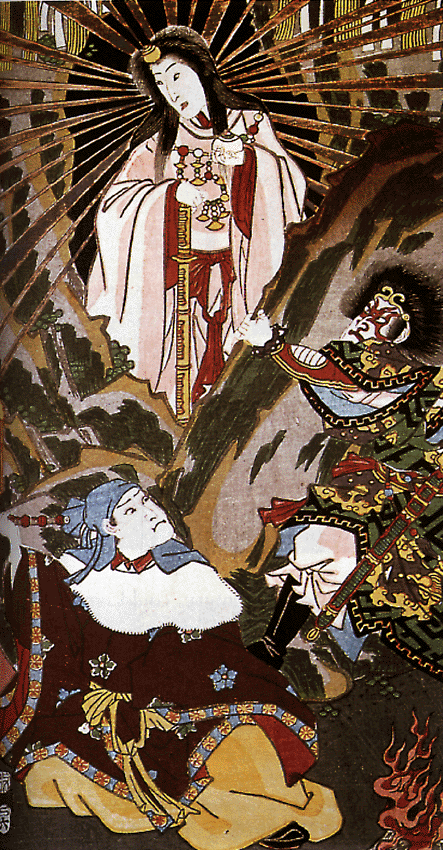
“However, of recent years, this link with Amaterasu and sun worship was reinstated in a ceremony in which the new Emperor once again participated and “spent the night with the goddess” after eating the sacred rice. I believe this is one major reason that Japan has gone downhill economically in such a drastic way. [...] this island, Hokkaido, looks like the head of a dragon with the body being the rest of Japan. The people of Asia have worshipped the dragon for 5,000 years. If one looks at the place where the earthquake took place, it looks like the soft underbelly of most vulnerable part of the dragon. Let’s pray that the deep idolatry and the worship of hundreds of idols under the guise of Shintoism, Buddhism, and allegiances to being “sons of the dragon” will be broken and thousands will turn to the Lord.”

Jacobs tries to couch her bizarre anti-Shinto and ultimately anti-Japan rant in concern for the Japanese people, but it’s clear what the priorities are here, the “breaking” of non-Christian religion and the successful “turning” of people to Christianity. When Jacobs isn’t busy finding the bright side in mass tragedy and death, she shares a stage with Virginia’s Republican attorney general, burns indigenous art, and casts out homosexual spirits. Oh, and did you know that the repeal of “Don’t Ask, Don’t Tell” was what killed on those birds recently?

Again, this would all be sad and laughable, a delusion rightly mocked and shunned by the civilized world, were it not for the political clout and influence this movement, and its allies, are currently trying to grasp. Many of us would like to believe that those who disagree with us on various issue are, at heart, decent people with different philosophies about the world. In most cases this is true, but any group that would welcome mass death and destruction as a method to changing minds is spiritually, emotionally, and mentally bankrupt. That this “Third Wave” and other anti-Pagan ideologues like David Barton are given unprecedented access to lawmakers and people of influence is frightening. Any politician who associates with them, who doesn’t condemn and distance themselves from them, are to be held as suspect by anyone who values pluralism and secular democracy.

While I’m on the subject of Japan, and its struggles, I would like to remind everyone that the Pagan Community is holding a fundraiser for the work Doctors Without Borders is doing there. There is a goal of $30,000 and we’ve almost hit $20,000! Let’s send a message of hope and solidarity to counteract the hatred and fear. Let’s send a message that the true spirit of Japan will never die, and will certainly not bend to these vultures who pretend to preach the word of Christ.

A few quick news notes to start your morning.

Pagan Japan Relief Project a Success: As of this writing, the Peter Dybing-initiated drive to raise money from within the Pagan community for Doctors Without Borders’ work in Japan has raised nearly $10,000 in three days. Here’s a message from Dybing about the drive that was posted yesterday.

“Pagans from all over the country have donated and stepped forward to endorse the project. We received donations from individuals as well as organizations. To all those who stepped forward THANK YOU. We still have been unable to generate significant numbers of small donations. It continues to be the goal of this project to engage the entire Pagan community in a unified effort. If you are concerned that you do not have the funds to donate consider just a few dollars. Each of us can only do so much in these tough economic times. What is important is participation not the donation amount.”

The Pagan Japan Relief Project is working towards a goal of $30,000, and it looks like this target may be reached sooner than anticipated. Major figures within modern Paganism like Selena Fox, Thorn Coyle, and Starhawk have already been spreading the word on Facebook, and Peter Dybing says that statements from well known Pagans about this effort will published today. This is a hugely positive cooperative effort, one that we can all take pride in. So continue to spread the word, and be sure to read about the work Doctors Without Borders is doing on the ground in Japan.

You can find all The Wild Hunt’s coverage on this issue, here.

ADDENDUM: Please see this update on the Pagan Japan Relief Project from PNC-Minnesota.

More Pagan Voices From Madison: Nels Linde at PNC-Minnesota has posted more interviews with Pagans taking part in protests against anti-union initiatives enacted by Wisconsin Governor Scott Walker and state Republican lawmakers.

“I’m a teacher and I’m here because I am very passionate about what is wrong with our democracy today. I am a Druid, I have been practicing for about 12 years now, with a group out of the Twin cities. It is very powerful to be here today because the energy is just so intense. There is so much pride and hope. People are coming together, it brings tears. I have already signed my petition to recall my Senator, Sheila Harsdorf, and also for Walker. I am involved in some local community protests, next in Hudson on the bridge, Sunday. I have been through all the emotions, you know, shock, anger, and despair. I’ve cried. You start with one group and target, demonize them and once they are taken out, there is another group. Most Walker supporters do not like non-Christians, so it is very, very scary.”

Nels has been doing amazing and essential work covering Pagan involvement in these protests, and I urge everyone to head over to PNC-Minnesota and catch up on his reports. Here’s his installment on Saturday’s events. More is promised on Thursday.

You can find The Wild Hunt’s previous coverage on this issue, here.

Checking In With Treadwell’s: In a final note, the Guardian interviews Christina Oakley Harrington, proprietor of the well-regarded esoteric bookstore Treadwell’s, about her shop and the unique spirit of London that makes its success possible.

“London is a place for unusual people who need to find other unusual people. Cities are where misfits always go. If you can’t manage in the village with the curtain-twitchers – if you can’t live like that because you’re gay, or you’re massively artistic, or because you have to talk to angels and demons and spirits … Where else are you going to go to find others who might be like you? You go to London. Could Treadwell’s exist anywhere outside of London? No.”

Treadwell’s recently moved to a larger space, the very building where Mary Wollestonecraft wrote Vindication of the Rights of Women. Congratulations to Christina and Treadwell’s on their continued good press!

That’s all I have time for at the moment, have a great day!