

In the northern hemisphere, tonight marks the festival of Samhain, considered the holiest day of the year by many modern Pagan traditions. Meanwhile, in the southern hemisphere, many Pagans are celebrating Samhain’s springtime counterpart, the sabbat of Beltane. Among modern Pagans, both sabbats are thought to be times when the veil between the worlds grows thin – especially Samhain, when those who have passed on are thought to be close at hand for the night.
The name Samhain is Irish, and refers to the historic festival that began the winter season. In Patrick Dineen’s 1927 dictionary of Irish, he describes the holiday as follows: “All-Hallowtide, the feast of the dead in pagan and Christian times, signalising the close of harvest and the initiation of the winter season lasting till May, during which troops (esp. the fiann) were quartered, the fairies (aos sídhe) were imagined as particularly active at this season, from it the half-year is reckoned.”

Fionn mac Cumhaill fights against Aillen mac Miona at the Hill of Tara; illustration by Beatrice Elvery for Violet Russell’s Heroes of the Dawn,1914 [public domain]
In Irish mythology, Samhain is a time of great importance; when momentous events occur, they more than likely appear at Samhain. The idea that tonight is a moment where we can more easily touch the Otherworld likely comes from stories like the one in Macgnímartha Finn (The Boyhood Deeds of Fionn Mac Cumhaill), in which the young hero comes to the Feast of Tara, which is held at Samhain. In Marie Heaney’s Over Nine Waves: A Book of Irish Legends, Conn of the Hundred Battles, High King of Ireland, is presiding over the feast and describes a peculiar problem that has been plaguing it:
‘Men of Ireland,’ he said, ‘tomorrow is the solemn day of Samhain when the doors of the Otherworld stand open and the Tuatha De Danaan come out and mix with mortals. Aillen Mac Miona, one of those Ever Young, will come to Tara as he has come for the last nine years and he will burn it down. He will lull us to sleep with his enchanted music and then, when we are asleep and powerless, he will send out a blast of fire from his throat and set Tara alight. If anyone here can preserve Tara from the man of the Sidhe, I will give that person his rightful heritage, however big or small it may be.’
The young Fionn takes up the challenge. Through the aid of a magic spear given to him by Fiacha, an old friend of Fionn’s father Cumhaill, Fionn manages to resist the sleep-song of Aillen by pressing the weapon to his forehead. The hero redirects the flames from Aillen’s attack with his cloak, creating a hill and glen at Tara named the Hill of Fire and the Glen of the Cloak, and then chases Aillen down and slays him before he can escape back into the Otherworld. For this act, Fionn claims leadership of the Fianna warrior band, which had once belonged to his father, and establishes himself as the great hero of his age.
Many other Irish myths take place at Samhain besides Fionn’s exploit. Often great battles begin at the festival, such as the invasion of Ulster that marks the main action of the epic Táin Bó Cúailnge (“The Cattle Raid of Cuailnge”).
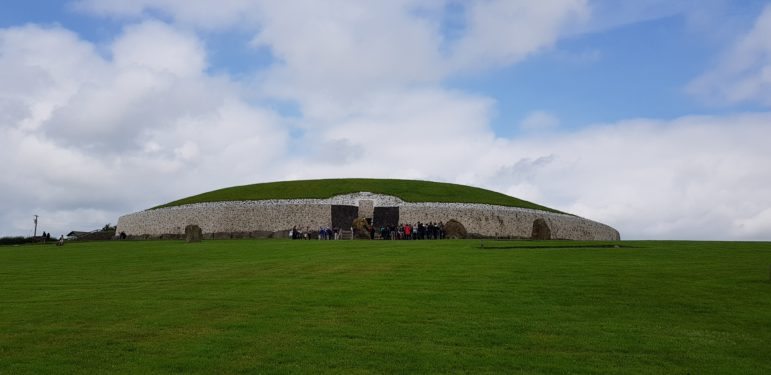
Newgrange – Image credit: Conorohara – WikiCommons
It is also the day that Óengus, son of the Dagda and the goddess of the River Boyne, Boann, takes kingship of the famous mound at Newgrange from his stepfather, Elcmar, by means of a legalistic sleight of hand. Fearing for his life, Elcmar promises Óengus that he can rule Newgrange for láa ocus aidche, an ambiguous phrase that could mean one day and night or perhaps “day and night” and in the sense of “all time, forever.” For as the Dagda says, “Óengus is to argue that the land is his by right in return for having spared Elcmar – that he requested the kingship of day and night and that it is in days and nights that the world passes.”
That the day and night in question is Samhain should be no surprise, for this turns out to be the night of all nights and the day of all days.
May your Samhain (or Beltane) night be blessed, and may your encounters with the Otherworld be friendly and enlightening.
So mote it be!
The Wild Hunt is not responsible for links to external content.
To join a conversation on this post:
Visit our The Wild Hunt subreddit! Point your favorite browser to https://www.reddit.com/r/The_Wild_Hunt_News/, then click “JOIN”. Make sure to click the bell, too, to be notified of new articles posted to our subreddit.