

Last Halloween, I suggested three horror novels “with elements of interest to Pagan readers.” This year, on the eve of All Hallows’ Eve, I’d like to recommend four horror films to the same audience.
All these movies deal with themes of religion and folklore, but they do so in very different ways. Each one is the type of film that sticks with you, stands up to repeat viewings, and opens many paths for reflection and discussion.
I offer this trigger warning in all seriousness: if you have a serious negative reaction to depictions of violence and abuse (child, clergy, disabled, domestic, educator, elder, emotional, relative, religious, ritual, sexual), please do not watch these films. This is horror, and these movies contain horrifying action and imagery.
The four films purposely offer less of the corporate Hollywood jump scare and more of the indie and European determined gut-punch to the emotions and sensibility. They deal with deeply disturbing content, so be sensible in your decision whether or not to watch them.
The Devils (1971)
This amazing historical horror film was written, produced, and directed by the English iconoclast Ken Russell. My first experience with his work was watching his film of The Who’s rock opera Tommy (1975) when I was probably several years too young. It freaked me right out, despite the fact that I was a young fanatic about the band and the album. You may know him for his freak-out music film Lisztomania (1975) or his bizarro horror movies Altered States (1980) and The Lair of the White Worm (1988).
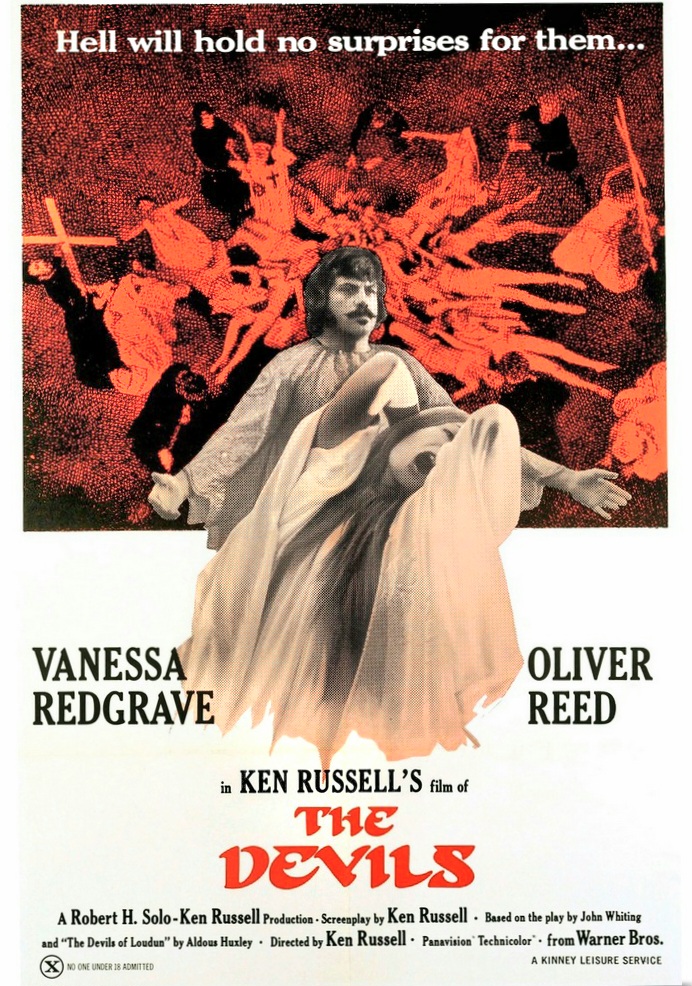
The Devils poster [Russo]
The Devils takes place in mid-17th-century France, at the conclusion of the bloody conflict between the Protestant Huguenot rebels and the Catholic forces of King Louis XIII. Only the city of Loudon, where Protestants and Catholics live together peacefully, is allowed to keep its walled fortifications after Cardinal Richelieu convinces the ruler to demolish such defenses everywhere else to prevent the entrenchment of any future Protestant rebellions.
Loudon is led by the Catholic priest Father Urbain Grandier, who is both widely popular and wildly lusted after by women of the town, whether unmarried virgins, middle-class wives, or cloistered nuns. He lives large and gladly partakes of the pleasures of the flesh, waxing eloquent to justify his own actions when he casually discards and ruins the honor of his young student/mistress when she becomes pregnant.
The townspeople rally around Grandier when Baron Jean de Laubardemont arrives with massive machines to tear down the walls of Loudon, despite the king’s past assurances. The baron seeks a way to discredit and destroy Grandier and finds it in Sister Jeanne des Anges, the hunchbacked abbess of the local convent who has become emotionally and sexually obsessed with Grandier.
The baron brings in the witch-hunter Father Pierre Barre, who begins a very public and extremely disturbing program of exorcisms on not just the abbess but also on all of the nuns under her care. The women are violently abused and sexually assaulted, and they are threatened with execution unless they testify that Satan has possessed them all through his servant Grandier, who himself is soon put on trial for his life.
In an act of supreme irony, none of the nuns have actually had any contact with the lustful Grandier during his days of dalliance. By the time the exorcisms begin, he has fallen in love, set aside his dissolute ways, and married his true love. He officiates his own secret wedding, expounding a detailed personal theology of love, marriage, and the role of the clergy that, of course, runs completely counter to Catholic teachings and canon law.
As the film progresses, it becomes clear that the devils of its title are neither the hypersexual priest nor the nuns who are soon writhing around nakedly in public and committing sacrilegious sex acts with sacred objects, but are instead the corrupt and sadistic government officials, the power-hungry church leaders, and the townspeople who turn on Grandier in their thirst for bloody entertainment.
Vanessa Redgrave is a gloriously shocking mess as the obsessed abbess, and Oliver Reed is an absolute revelation as Grandier. In an extremely prolific career marred by extreme alcoholism and insane binges – including time spent as the drinking buddy of The Who’s notorious party animal Keith Moon – this film stands out as a pinnacle of his artistic genius. He speaks volumes with his eyes (and his glorious moustache), and his reading of every line has a hypnotic gravity that enwraps the audience and pulls us into his world and worldview.
For Pagan viewers, the film’s fundamental questions will resonate deeply. How does personal religiosity intersect with institutionalized religion? How are sex and love understood in relation to theology? What is the role of the clergy in public life? How do we respond when oppressive religious views direct government actions? What do we do when the leaders of our own religious organizations turn against us? Despite being released 55 years ago – and being based on an Aldous Huxley historical novel from nearly 75 years ago – the film seems incredibly timely today.
Originally given an X rating in the US and UK, heavily edited in other countries, and even completely banned in some jurisdictions, the film has been notoriously hard to find. You might still be able to see it like I did, in the 4K restored director’s cut that opened in US cinemas on October 16.
Messiah of Evil (1974)
This film recently leapt into my personal top 10 list of favorite horror films. It was written, produced, and directed by the husband-and-wife team of Willard Huyck and Gloria Katz, the pair who wrote American Graffiti (1973), Indiana Jones and the Temple of Doom (1984), and Howard the Duck (1986), in addition to working on the script of the original Star Wars (1977). This odd little low-budget horror film is nothing like any of those major Hollywood releases.
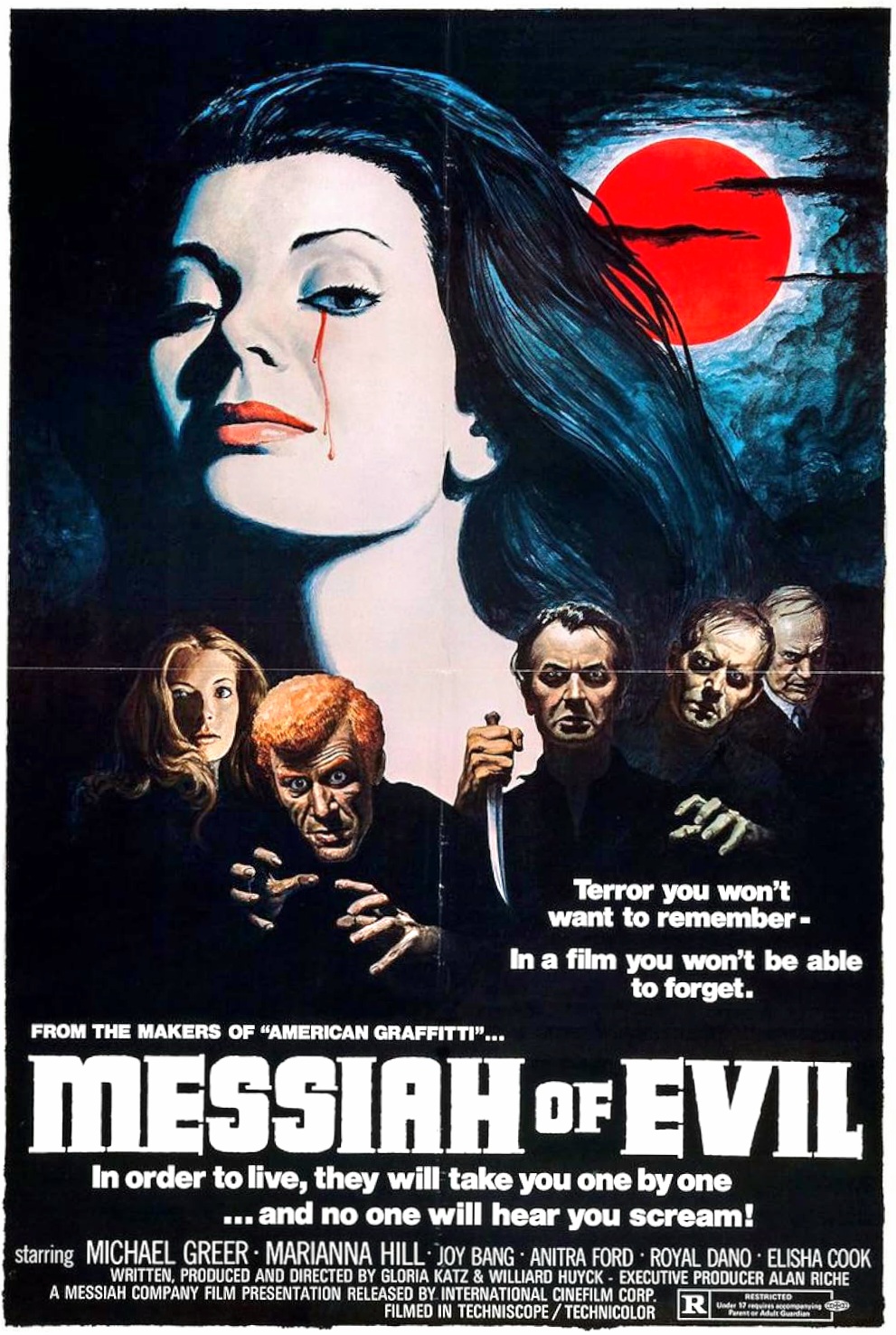
Messiah of Evil poster [V/M]
I’m a huge fan of George A. Romero, and this movie is one of a host of films released in the 1970s and 1980s that were marketed as sequels to his masterpiece Night of the Living Dead (1968) due to an unfortunate glitch that resulted in it not being copyrighted. Indeed, some showings of the 1974 film retitled it Return of the Living Dead, a decade before Romero’s former partner Dan O’Bannon released the much better-known film of the same title.
Messiah of Evil feels very much like a Romero zombie film as filmed in southern California instead of his beloved Pittsburgh. It has the same sense of impending doom, of paranoid fear in the face of a transformed community, and of odd bedfellows being thrown together for survival. It also reflects Romero’s determined focus on social critique of American culture, including in a haunting scene set in a Ralph’s grocery store that prefigures the shopping mall setting of Dawn of the Dead (1978) by several years. It also has an incredibly claustrophobic scene taking place in a cinema that predates the similarly meta Italian splatter classic Demons (1985) by over a decade.
The film follows a young woman named Arletty Lang who arrives in a tiny oceanside town named Point Dune (which sounds an awful lot like “doom” whenever its name is spoken) to search for her missing father, a loner artist whose house on the beach has walls covered in disturbing murals of mundane town locations filled with blank-eyed citizens who stare directly at the viewer.
Her inquiries lead her to a motel room where a distinctly Jerry Cornelius type figure named Thom (accompanied by two female traveling companions) is interviewing Charlie, a local homeless alcoholic who testifies about a disease of cannibalism taking over the town when the moon turned red a hundred years before. Charlie later tells Arletty that she must burn her father instead of burying him. Anyone who’s ever seen a zombie film knows what this means.
The strangely transformed denizens of the town are not quite the shambling dead of Romero’s films. They can speak, they supplement their cannibal diet with meat products from the butcher section of the grocery store, and they gather together around nighttime beach bonfires to stare at the moon and await the emergence of something or someone from the sea.
That last clause should tell you that Lovecraftian elements have creeped into the story, again weirdly transposed to southern California. There is indeed a growing sense that something deeply wrong is hovering beneath the surface of the town and of the water, waiting for its moment to emerge. I can’t go much farther without spoiling the film, but I can say that there are suggestions of the Great Awakening of religious revivals in America and of a new religion that turns away from Christianity to old gods and old ways.
It is these final elements that will be of most interest to today’s Pagans, since they address a history that many of us participate in. We practice what academics call new religious movements, yet many of us claim that these relatively recent religions are connected to ancient practices. This film can be interpreted as a metaphor for the panicked response of mainstream American Christians to finding out that their neighbors – and even their family members – have joined a new religious movement that, in their limited understanding, is strange and terrifying.
Those who are familiar with Greek mythology will find it interesting that the film’s framing story portrays Arletty as the Cassandra of this strange variation on the zombie outbreak, as the final girl escapee who seeks to warn the world of the coming apocalypse but whose warning is disbelieved and dismissed. As with many horror films of this era, there are moments of beautiful melancholy amid the bloody terror.
Messiah of Evil is currently free to watch (with ads) on Tubi, Pluto, and Plex.
Martin (1977)
This is not only my favorite film written and directed by George A. Romero, it just may be my favorite horror movie. As a very young kid, I picked up the novelization of the movie when I was browsing a big table of discounted paperbacks in the lower level of Marshall Field’s (R.I.P.), while my parents were looking for a fondue pot or whatever. The black and white photo section in the middle had pictures that definitely disturbed me, but in that particular way that compelled me to keep flipping through them. When I finally screwed up the courage to rent the VHS tape a couple of decades later, I found the film hypnotic and dreamlike. I still do.
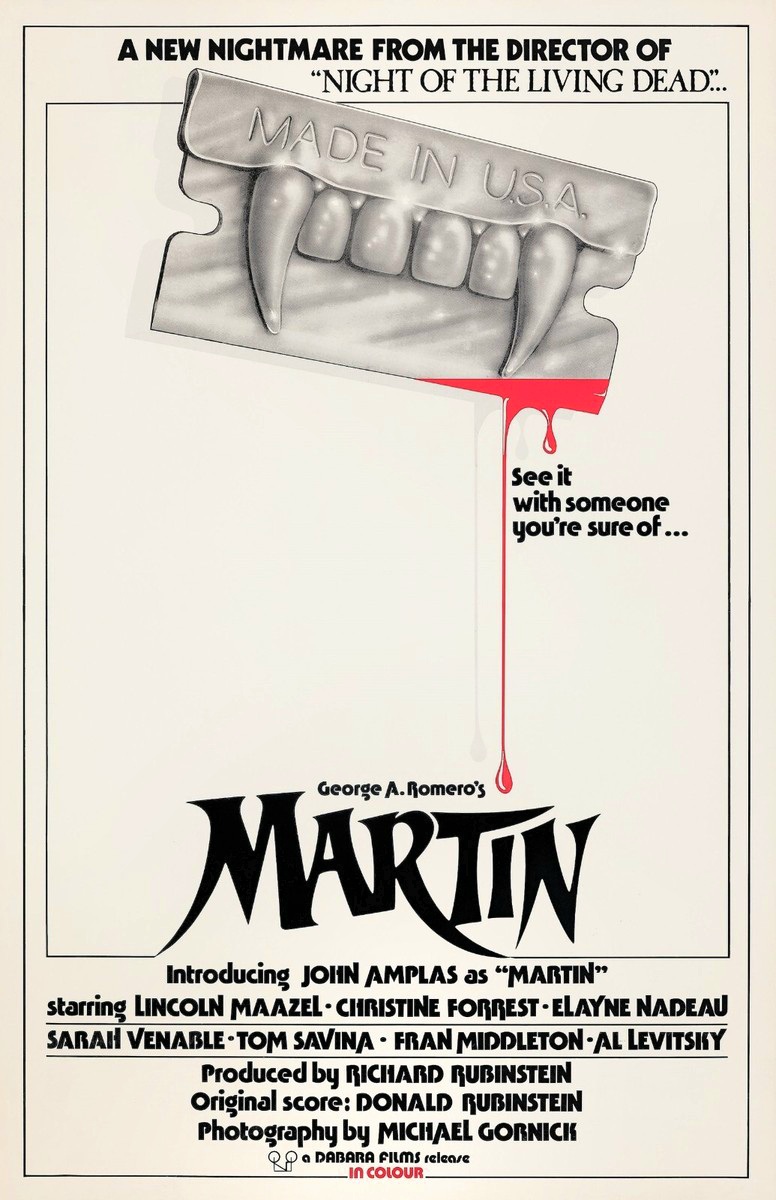
Martin poster [Laurel]
Martin is a 19-year-old who arrives in Pittsburgh (of course) to live with his elderly cousin, Tata Cuda. We first meet Martin on a passenger train, where he stalks, drugs, sexually assaults, and slices a woman before drinking her blood and leaving her to bleed out. Here is the central problem of the film.
Both Martin and his cousin believe him to be much-older European vampire who merely appears to be an American teenager. While the conservative Lithuanian Catholic Cuda turns to methods from old world folklore – garlic, crucifixes, exorcisms, etc. – Martin himself goes about his business in a very modern way. He drugs his victims rather than hypnotizing them, he rapes them rather than seducing them, and he makes careful incisions rather than biting their necks with monstrous fangs.
The film seems both like a frozen moment in time – its 1970s setting is just so amazingly 1970s – and incredibly of our current moment. In a prefiguration of today’s incels taking to social media to stumblingly expound their insane rationalizations for their violent misogyny, Martin becomes a regular on-air caller to a local radio talk show, explaining his blood-drinking in pseudoscientific terms, attempting to justify his sexual assaults, and insisting there’s no magic involved with any of it.
This is the problem of the film. Is Martin really an undead vampire compelled to drink human blood in order to survive, or is he a deluded teenager who imagines himself a vampire and compulsively acts on his fantasies? Have his years growing up as an American teenager in an extremely conservative and extremely religious immigrant community revealed a family curse of vampirism or primed him to act on his disturbing sexual urges?
From its shocking opening to its shocking ending, the film refuses to provide an answer. Martin is plagued by flashbacks to early 20th century Lithuania, an ethereal love, and raging mobs chasing him by torchlight, but there is no way for the viewer to know if these are memories or fantasies. Cuda’s adult granddaughter Christina is the voice of common sense, denouncing all the vampire mumbo jumbo and encouraging Martin to live a normal life free from the oppressive weight of tradition. But she doesn’t know about his rapes and killings.
Romero is one of the great directors of the 20th century in any genre, and this movie may be his masterpiece. He himself said it was his favorite of all his films. His special effects guru Tom Savini plays Christina’s boyfriend, and John Amplas – who plays the title character – went on to appear in Romero’s Dawn of the Dead (1978), Knightriders (1981), Creepshow (1982), and Day of the Dead (1985). As in all of the director’s films, Martin is about much more than simply providing frights.
Those of us who grew up as American children of immigrants recognize the dynamic between Martin and Cuda. We feel the tension of the arguments around the dinner table. We emotionally understand the weight of tradition, expectation, and judgment that is placed upon us by the older generations.
The film can cause an almost PTSD-like response. It gives me flashbacks to a nighttime visit to an elderly great-aunt in Canada who led me from a dark front room, up creaky wooden stairs, and into a hall closet she had turned into a Catholic shrine, where she had me kiss a crucifix even as my parents were rushing up behind us to whisk me away.
The film also raises questions for modern Pagans about our beliefs and practices. Are we really replicating the old ways in an ethical way? How can we say that we’re “honoring our ancestors” when our older relatives may find what we do awful and maybe even evil? What does it mean to skip over a thousand years or more of Christian ancestors and say, no, they don’t really count, we’re honoring these other ones?
There is also the issue of tradition as an oppressive force, as something that drags down the younger generation in the prejudices of the older. Today’s Pagans pick and choose what supposedly ancient traditions we choose to honor. By doing so, are we really honoring them, or are we creating new religions out of whole cloth?
These aren’t easy questions, and this isn’t an easy film to watch. It’s not a fun fright-fest. Martin is not a role-model. He’s a rapist and murderer consumed by his own obsessions. Like all the best artists, Romero holds up a mirror and dares us to look.
Martin is now streaming on Tubi.
The Church (1989)
If you’re not familiar with Italian horror films of the 1970s and 1980s, this is a doozy of a place to start.
In 1985, Lamberto Bava directed Demons, a bizarre gore explosion co-written and produced by the legendary Dario Argento, who was already a living legend for his films Deep Red (1975), Suspiria (1977), Inferno (1980), Tenebre (1982), Phenomena (1985), and many other intense films in the horror and giallo genres. It was followed by Demons 2 (1986), again a collaboration of Bava and Argento. The plots of the two films don’t matter right now, because what was originally meant to be the third film in the series was repeatedly reconceived and rewritten, finally resulting in The Church, a film made by replacement director Michele Soavi that really has nothing to do with the first two movies. Welcome to Italian horror!

The Church poster [ADC]
The Church begins with a group of Teutonic Knights charging through a forest in medieval Germany, seeking what they believe to be a secret community of devil worshipers. The people they find paradoxically live both in a secluded secret grotto and a bustling commercial town (Italian horror!), and they are completely massacred down to the last trampled baby by the merciless knights (Italian horror!), who roughly dump all the corpses into a giant mass grave pit. The attendant priest tells the knights that the evil dead will return unless they are deeply buried and an enormous cathedral is built over their corpses to imprison them for eternity.
To be clear, at the conclusion of the prologue, the knights are portrayed as the real evil, as bloodthirsty fanatics willing to murder an entire town because of a rumor of devil worship. The victims are portrayed as helpless, nonviolent, innocent victims incapable of even defending themselves as they are brutally butchered. The priest who denounces them as undead evil and demands the church be built appears as a depraved nutjob. But this is Italian horror of the 1980s, so please don’t expect a coherent plot. That’s not why we watch.
The action skips ahead to late 1980s Hamburg, Germany, where a new church librarian named Evan arrives (late) for his first day on the job, immediately causing sparks with the restoration artist Lisa (looking very much like a young Isabella Rosselini) and friction with the elderly and irascible bishop. The real action is in the catacombs beneath the church, where Lisa finds an ancient parchment and Evan finds the mysterious stone it references. In a scene that borrows some creepily ethereal lighting effects from The Keep (1983), Evan opens a portal to the evil that has been patiently waiting centuries to escape.
And here’s where the nature of the genre (Italian horror!) really kicks in. The innocent townie victims of the prologue are now bloodthirsty demons from Hell who not only cause the people trapped in the locked church (with only the one door, because why not?) to have horrific hallucinations before horribly killing them but also apparently want to break free and destroy the entire world. There is also a goat-headed Satanic beast with seven eyes who seems determined to father the Anti-Christ. Maybe? His freakish scenes are never explained by any of the characters.
The Teutonic Knights and the priest who were the villains of the prologue are replaced by a heroic African-British priest who shoots arrows like Hawkeye and the sacristan’s brave young daughter (Asia Argento, daughter of Dario Argento and actress/writer Daria Nicolodi), who also seems to be a reincarnation of one of the prologue’s villager victims. These two take over the plot as Evan and Lisa fade to the background. This flip-flopping of victims and villains and the virtual disappearance of central protagonists halfway through the film is typical of the genre (Italian horror!).
You may be wondering why I would recommend such a self-contradictory mess of a film. Let me explain.
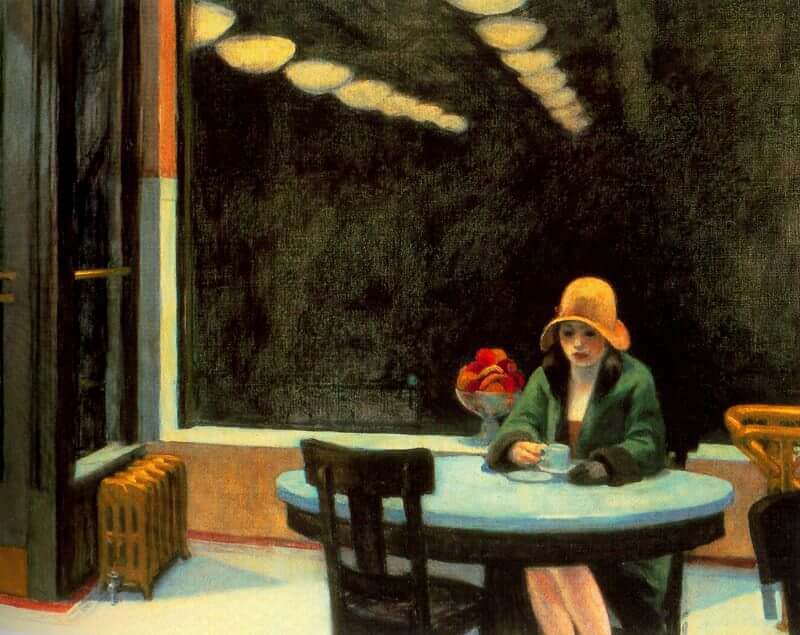
Sometimes, Italian horror can be tightly constructed, meticulously plotted, and perfectly filmed. Argento’s Deep Red (1975) originally had a script of over 500 pages that was eventually edited down to 321. Every scene is invested with meaning, every shot is a gorgeous work of art, and the soundtrack by the prog rock band Goblin is absolutely exquisite. The tiniest details are a delight, like a background character seen for only a split-second who has been styled to reproduce the subject of a 1927 painting by Edward Hopper. You can watch the film repeatedly and continue to notice brilliant details.
On the other hand, Italian horror can be a glorious disaster. Lucio Fulci’s The Beyond (1981) was filmed in New Orleans without a script. Using only a three-page treatment, and without being able to communicate directly with his English-speaking stars, Fulci basically made the film up as he went – even adding a big zombie shootout under pressure from German distributors (again due to the popularity of zombie films in the wake of Romero’s Night of the Living Dead). And yet the result is a gloriously macabre film full of poetically horrifying imagery – especially the theologically terrifying powerful final scene – that lives on inside the viewer long after the film is over.
This second type of Italian horror is, in some ways, closer to abstract art or poetry than it is to plot-driven film or narrative novel. As a fellow horror nerd once told me about this genre, you have to stop worrying about the plot details and treat it as an experience.
The Church isn’t quite the work of mysterious genius that The Beyond is, but it has elements that will appeal to and/or repulse Pagan viewers. We may see ourselves and our ancient pagan models as the victims and the heroes of the story, but both medieval Christian chroniclers and a goodly proportion of today’s Christian Americans see them and us as the monsters. The Church shows both sides of the equation. Nobody portrays the Catholic Church (pro and con) quite like Italian filmmakers, but the ambivalent portrayal of religious outsiders is dizzying and disorienting, including in the film’s final postlude to the horrors that have taken place within the church. Also, if absolutely insane film representations of Satanic witch-cult rituals are your thing, this movie will not disappoint.
The film may not make sense in the way that we demand from mainstream Hollywood cinema, and its theology may be extremely wonky, but it definitely takes you on a journey to the unexpected, even as it continually flips, mirrors, and reverses its own portrayals of its participants. Life isn’t logical, and the Italians are gifted at reflecting life.
The Church is streaming on Tubi.
Horror as Art
As I said at the beginning of this column, watch these movies at your own risk. They are willfully sacrilegious, full of intensely violent imagery, and graphically portray abuse and assault.
If you’re a fan of today’s horror films, they may seem tame or even corny to you. If you come to them without any experience of the genre, they may be overwhelming.
In any case, if they sound interesting, I do believe that they can lead to reflection, reevaluation, debate, and discussion.
That’s a pretty good result for any work of art.
The Wild Hunt is not responsible for links to external content.
To join a conversation on this post:
Visit our The Wild Hunt subreddit! Point your favorite browser to https://www.reddit.com/r/The_Wild_Hunt_News/, then click “JOIN”. Make sure to click the bell, too, to be notified of new articles posted to our subreddit.