

Dario Argento’s 1977 horror film Suspiria has witches in it. Technically. But blink and you’ll miss them.
Suzy Bannion (Jessica Harper) is a fish out of water: a young American ballet dancer, who has come to study in West Germany with a famous teacher at a well-known school. Arriving in a storm, she shows up just in time to see another young woman run raving into the night. What follows is supposedly about dance, but almost no dancing happens. What befalls the beautiful women of the film as they are artfully cut to ribbons and stabbed in unctuous close-ups is supposedly the fault of witches, but we never see the Craft that causes the trouble.
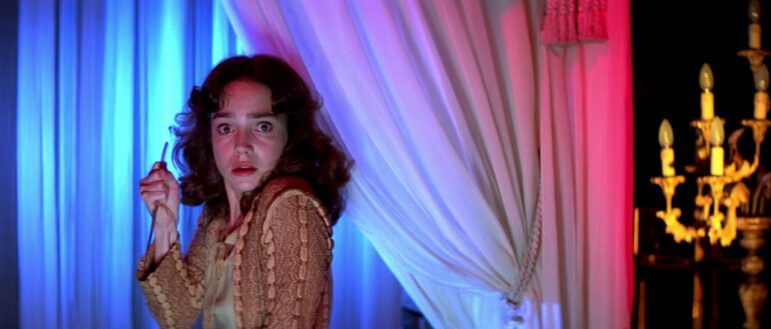
Suzy Bannion (Jessica Harper) in Dario Argento’s “Suspiria” (1977) [Produzioni Atlas Consorziate]
The original Suspiria relies on atmospheric and artistic choices to frighten the viewer. Color-drenched interiors swing from royal blue to blood red, interrupted by geometric patterns and neon gore. Close-ups of rubbery wounds and fetishistic loops of penetrating and diddling objects are interwoven with the withering glances of well-dressed older women to make one feel like a pervert who has been caught at their naughty business. Inexplicable gestures of control fill the screen, like Suzy being forced to drink from the mouth of a huge glass pitcher, or all the students herded into a giant sheet-tented dormitory to sleep together.
When it comes to the actual witchcraft, undertaken to prolong the power and lives of the elders, we see almost nothing. Suzy makes her way down a very long hallway inscribed with mysterious words, some of them in Hebrew. Tetragrammaton, martyrs, Elohim. At the end of it, we hear a discussion of spellwork, but never see any happen. All this is underpinned by an excellent creepy score by Goblin, and laid out in painstaking exposition by the ever-freaky blue-eyed Udo Kier in the role of a helpful academic. Ultimately, Suspiria (1977) has beautiful lighting and excellent color grading, with lots to show and almost nothing to say.
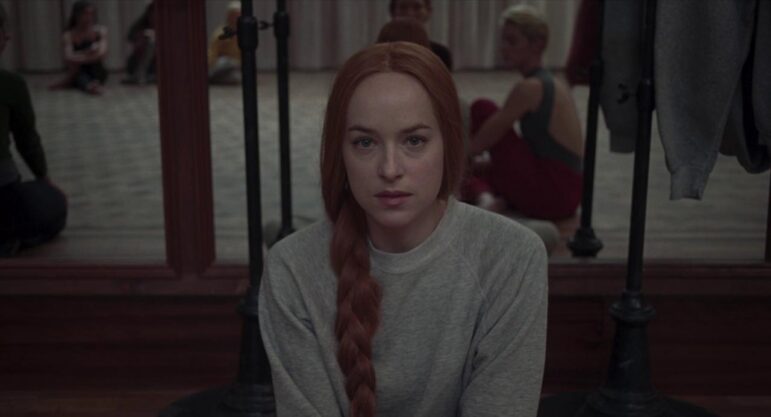
Susie Bannion [Dakota Fanning] in Luca Guadagnino’s “Suspiria” (2018) [Amazon Studios]
Luca Guadagnino’s 2018 remake by the same name does the exact opposite in most respects from its progenitor. In muted colors, this Suspiria shows us Cold War West Germany, torn apart by poverty, terrorism, and political upheaval amidst the Red Army Faction bombings and the shadow of a world war that hasn’t receded in 30 years. From the word go, a rambling dance student named Patricia (Chloë Grace Moretz) tells her therapist (a delightfully disguised Tilda Swinton in drag) that the women she’s been studying with are witches: sie sind Hexen.
From there, the gorgeous and strange Thom Yorke score guides us through the same story: Suzy Bannion (Dakota Johnson) has come to study dance and escape her Mennonite Ohio home. She and Madame Blanc (a credited Tilda Swinton in dance drag) enjoy an immediate intimacy of gaze and electric connection: this girl is the real thing. And the real thing is what real witches need.
Making explicit what Argento keeps implicit, Guadagnino stresses the struggle for control and headship in this dance-coven, even going so far as letting the audience eavesdrop on the voting process. The set is a hall of mirrors and the girls and women are doubled against one another, never sure how to make eye contact with the genuine article rather than the reflection. This mirroring effect shows up in the action as well: Johnson’s dancing is echoed in another room, the body of poor Soviet Olga (Elena Fokina) doubling her own as it’s being gruesomely folded and contorted on itself. The political situation in West Germany is mirrored inside the school, belabored by some obvious work in the script: “It’s all a mess, isn’t it? The one out there, the one in here? The one that’s coming.” This made me look closely at the way the film indicates microcosm to macrocosm: when we say that what we do between the worlds reverberates through all worlds, does the reverse ring true, as well?
The magic in this version of the film is very much about dance. Principals Johnson and an underutilized Mia Goth trained to dance for the film and manage the starveling and sensuous movement and perpetual soreness of professional dancers, backed by a chorus of other Isadora Duncans without lines. Choreographer Damien Jalet leans beautifully into the ways that dance can be strange and unsettling. Swinton as Blanc points out that after the war, dance must not be beautiful or cheerful, maybe ever again. Jalet fills the order in distinctly Pagan fashion: even the rehearsals are hypnotic, bizarre, and ritualistic every time.
The witches of this Suspiria don’t just do ritual, they also use magic. Confronted with cops at the door, the witches hypnotize and immobilize them. The old women cackle over their guns and penises, totally at ease with their power and ability to disarm a threat. Only Dr. Klemperer, Swinton’s old psychiatrist, manages to do the work of a detective. Curiously, the witches overlook him, possibly because his advanced age makes him less of a threat. The police refuse to speak to the old man, even after he points out to one of them that in another life, the policeman was a soldier, one of the men to liberate Klemperer out of the camp where he was being held in Poland during the war.
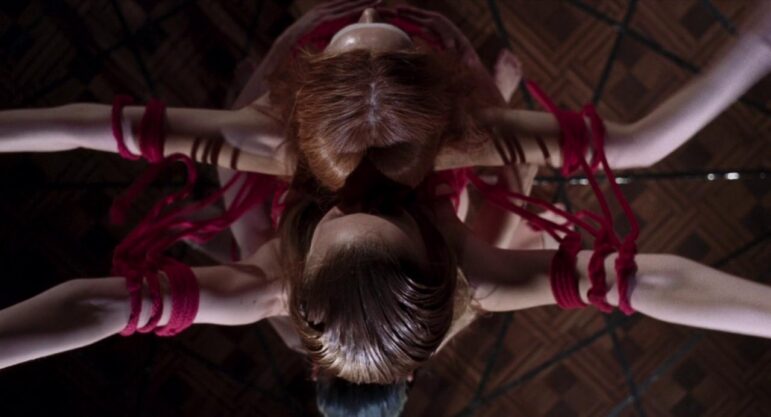
The Volk dance in Luca Guadagnino’s Suspiria (2018) [Amazon Studios]
It is here that the 2018 Suspiria loses its way. In an effort either to distract the viewer from the strangeness of the central coven or to gesture at a greater sense of the world, the climax of the film becomes about Klemperer’s past and terrible loss during the Holocaust. Even as the final ritual rolls out in a dance performance called Volk, gorgeous and witchy with the dancers in red yarn webbing that looks like literal lines of blood, it is Klemperer who acts, who objects, who tries to interfere. As Suzy approaches her destiny as a witch and a dancer, it is to him that she addresses her power.
Madame Blanc tells her student that, “Movement is never mute. It is a language. A series of energetic shapes written in the air like sentences. Like poems. Like prayers.”
“Spells,” answers Suzy, who knows only too well that a prayer is a spell and Volk is both the German word for people and a term inextricably linked to the Nazi regime that turned the rivers of Europe red for the sake of its own blood, its own folk. Curiously, the future of the coven is set aside at the denouement in favor of the old doctor’s guilt and shame at what he himself has lost.
The remake of Suspiria has more to say than the original, but the 1977 film comes from the Europe that its remake only pretends to represent. The silent gore of the original doesn’t engage with the history or the blood, only hinting at the Third Reich’s interest in the occult before refusing any connection. The second iteration of the story relies too heavily on that commonality to stay on target, and in the end it’s just as diffuse in message, just as reliant on the spectacle to do the talking.
Ultimately, film is a visual medium. And the sighs matter.
Suspiria (1977) is available on Tubi. Suspiria (2018) is available on AppleTV.
The Wild Hunt is not responsible for links to external content.
To join a conversation on this post:
Visit our The Wild Hunt subreddit! Point your favorite browser to https://www.reddit.com/r/The_Wild_Hunt_News/, then click “JOIN”. Make sure to click the bell, too, to be notified of new articles posted to our subreddit.