
LONDON — The Evangelical Alliance in the U.K. has released a pamphlet, Spiritual Christianity, specifically targeting Pagans and those in the “New Age” sets of spiritual practices.
“This booklet is a short, practical guide that attempts to define what New Age spirituality is, while unpacking the cultural moment we are living in, and offering a biblical perspective on what we are seeing,” writes EAUK. “At the end, we suggest some pastoral and evangelistic responses. Along the way you will read real stories of spiritually curious people who have found Jesus.”

Released September 3, Spiritual Curiosity: A Christian Guide to Understanding the World of Crystals, Manifesting, Tarot and Sharing Faith in This Moment is a 36-page resource intended to help Christians understand and evangelize people exploring spiritual practices outside Christianity. The pamphlet has been growing in traction within conservative Christian circles.
EAUK notes that growing interest in tarot, crystals, astrology, Witchcraft, manifesting, and other forms of alternative spirituality is presenting evangelical Christians with both an opportunity and a spiritual danger.
The EAUK also notes that many people are exploring multiple forms of spirituality. “The question for many people is no longer whether God exists,” they write. “The question now is – which god?”
The guide addresses a broad assortment of beliefs and practices, including astrology, angel numbers, chakras, crystals, karma, manifesting, mediums, psychics, psychedelics, tarot, and “WitchTok.” It also acknowledges that people engaging in these practices may not identify themselves as New Age practitioners and may instead simply describe themselves as spiritual.
That distinction is important. The practices grouped together under the “New Age” label can emerge from substantially different religious, cultural, and historical traditions. Tarot reading, contemporary Witchcraft, astrology, Spiritualism, psychedelic spirituality, and practices involving crystals may overlap for some practitioners, but they do not constitute a single religious system.
For the Evangelical Alliance, however, the common issue is theological rather than taxonomic. The guide interprets these practices through an explicitly evangelical Christian framework.
“Regardless of where someone falls on that spectrum, though, we see these practices as dangerous and opposed to the way of Jesus,” it states.
The Alliance argues that Christianity recognizes a spiritual realm but does not regard that realm as neutral. Drawing upon biblical passages traditionally used to condemn divination and communication with spirits, the guide warns Christians against incorporating alternative spiritual practices into their own faith.
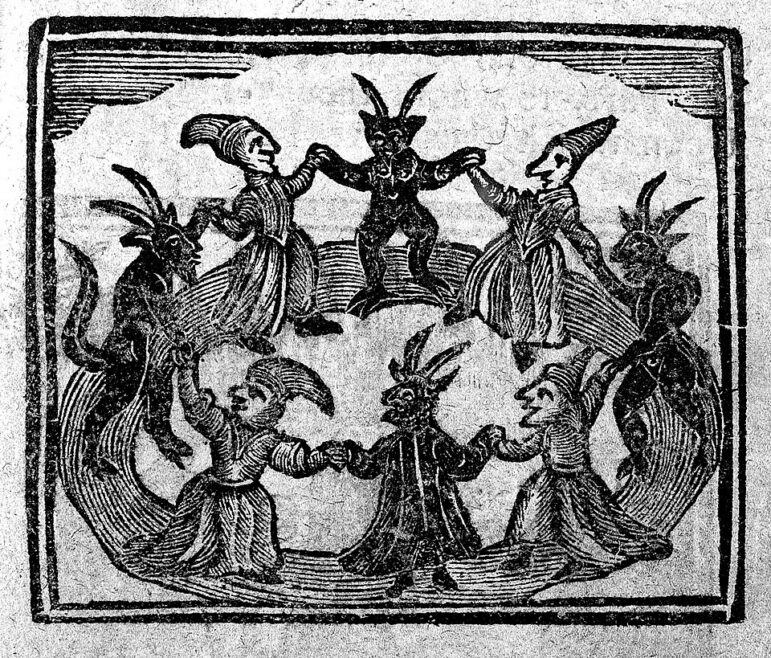
The History of Witches and Wizards, 1720 [public domain
“You cannot hold Christ in one hand and New Age practices in the other,” the guide says.
At the same time, Spiritual Curiosity notably discourages Christians from responding to practitioners primarily with fear or hostility. Instead, it presents contemporary spiritual interest as an opportunity for evangelism.
Katherine Brown, co-lead of the Alliance’s Being Human initiative, pointed to psychic nights at pubs, celebrity discussions of manifestation, and Ariana Grande describing herself as “a literal witch” as evidence that spiritual language has become increasingly visible in mainstream culture.
“Rather than being fearful as Christians, we should be confident that we have good news and a better story to offer a searching and spiritually open culture,” Brown said.
That combination of pastoral engagement and theological rejection becomes more pronounced in some Christian responses to the publication.
Writing in Premier Christianity on October 2, former New Age practitioner Laura Maxwell praised the guide while adopting substantially stronger language about Witchcraft and alternative spirituality. Maxwell describes practices including astrology, divination, tarot, energy healing, spirit guides, meditation, yoga, and crystals as potentially “demonic-empowered” and argues that Christians should be prepared to provide deliverance ministry to converts from Witchcraft and New Age practices.
Maxwell recounts accounts of alleged demonic manifestations and writes that former Witches and New Age practitioners may experience spiritual attacks during conversion. She also criticizes churches she believes are insufficiently prepared to respond to such experiences. Those assertions are Maxwell’s interpretation and should not be confused with independent evidence concerning Pagan or Witchcraft practices.
The distinction illustrates an important tension within the larger Christian conversation. Spiritual Curiosity encourages Christians to listen respectfully to spiritually curious people while simultaneously beginning from the premise that their spiritual practices are fundamentally mistaken and potentially dangerous.
What makes the guide notable is its specificity. Spiritual Curiosity is not simply a general invitation to Christianity. It is an evangelistic toolkit designed to help Christians engage people exploring a recognizable constellation of practices including tarot, astrology, crystals, manifestation, psychic practices, and Witchcraft, that increasingly occupy space outside traditional religious institutions.
The guide is significant for another reason. It offers a window into how at least one major evangelical organization is interpreting the renewed public visibility of alternative spirituality, and how some conservative Christian organizations may be preparing to respond.
Perhaps most notable is what the Evangelical Alliance does not do: dismiss modern Witchcraft and related practices as marginal remnants destined to disappear in an increasingly secular society. Instead, the organization recognizes that spiritual curiosity remains culturally potent and that significant numbers of people are looking beyond conventional Christianity for spiritual meaning.
For Pagan communities, that recognition is worth watching. The Evangelical Alliance sees the same spiritual landscape that Pagans, Witches, and other minority religious communities have watched developing for years. Where they differ, of course, is in what they believe should happen next.
The Wild Hunt is not responsible for links to external content.
To join a conversation on this post:
Visit our The Wild Hunt subreddit! Point your favorite browser to https://www.reddit.com/r/The_Wild_Hunt_News/, then click “JOIN”. Make sure to click the bell, too, to be notified of new articles posted to our subreddit.