


The statue of Apollo Citharoedus by the Greek sculptor Leonidas Drosis (1836-1882) in the gardens of the Academy of Athens on October 25, 2019. [Wikimedia Commons, George E. Koronaios, CC 4.0]
GORTYNA, Crete — La Brújula Verde reports that the discovery of hundreds of mouse remains at the sanctuary of Apollo in Gortyna may provide evidence that the Cretan sanctuary underwent a significant change in religious dedication during antiquity.
Researchers from the Italian School of Archaeology at Athens and the University of Padua examined animal remains recovered from sediments associated with a votive deposit inside a seventh-century B.C. structure. Their analysis identified the remains of more than 450 house mice (Mus musculus). The unusually large concentration and archaeological context led researchers to conclude that the animals were deliberately deposited rather than accumulating naturally.
The discovery may illuminate an earlier phase of worship at a sanctuary historically associated with Apollo Pythios, the form of Apollo connected with Delphi, prophecy, purification, and the myth of the god’s defeat of the Python. Archaeologists suggest that the mouse deposit instead points toward an earlier association with Apollo Smintheus, an ancient manifestation of the god closely connected with mice, agricultural protection, and epidemic disease.
Apollo’s association with mice was complex. In the Iliad, Apollo Smintheus sends a plague against the Greek army after the priest Chryses appeals to him, while elsewhere the god could be invoked for protection against rodents, disease, and agricultural destruction. Ancient literary and material evidence similarly connects mice with sanctuaries of Apollo Smintheus.
Researchers propose that the Gortyna sanctuary’s religious emphasis may therefore have evolved alongside the community itself. An earlier cult concerned with agriculture, rodents, and protection may gradually have given way to Apollo Pythios and the prestigious religious traditions associated with Delphi as Gortyna developed into an increasingly important Cretan center.

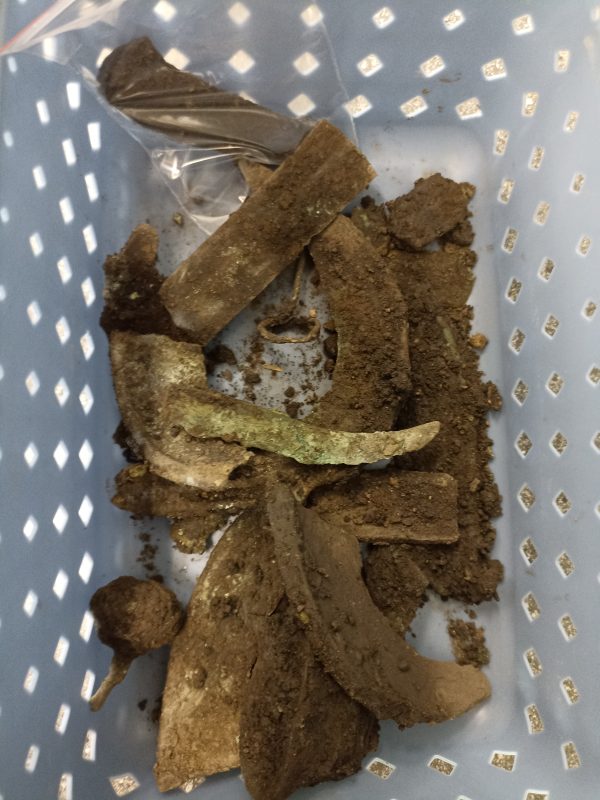
The Kojetín Bronze Age recovery. The image shows items before expert and conservationist examination. Photo Credit: Olomouc Archaeological Centre.
KOJETÍN, Czech Republic — Archaeologists have discovered a collection of Bronze Age objects near Kojetín in the Czech Republic that may have been deliberately deposited in a wetland as part of a ritual offering more than 3,000 years ago, according to a news release from the Archaeological Centre Olomouc.
The discovery was made by archaeologists from the Archaeological Center Olomouc while monitoring construction associated with the modernization of the Brno–Přerov railway. Previous excavations had revealed an extensive prehistoric settlement in the area, prompting researchers to use metal detectors alongside conventional archaeological methods. The bronze objects were discovered in late May in an area that had recently flooded.
Researchers identified the assemblage as a fragment hoard associated with the Urnfield culture of the Late Bronze Age. It includes nine bronze sickles, eight of which had been bent, part of a sword blade, fragments of ornaments, three bronze ingots, two unfinished objects, and additional pieces of bronze. Analysis indicates that many of the objects had been used before their deposition. Some also appear to have been intentionally damaged: the sword fragment was apparently broken with a heavy blow, while several sickles were deliberately bent.
The combination of deliberate damage and the location of the deposit has led archaeologists to suggest that the objects were not simply scrap metal hidden for later recovery. Instead, they may have been placed intentionally in what was then a wetland as part of a ritual practice. Depositing valuable metal objects in rivers, lakes, marshes, and other watery environments is documented at Bronze Age sites across Europe and has frequently been interpreted as ceremonial or votive activity.
The artifacts are undergoing conservation and further study. Researchers hope additional analysis will clarify why the objects were damaged before deposition and what the hoard may reveal about the ritual practices of Bronze Age communities in central Moravia.
DERBYSHIRE, England — A standing stone long thought to be an isolated monument has been revealed as part of a much larger Bronze Age ceremonial landscape dating back approximately 3,700 years, Forestry England reports.
The discovery at Farley Moor began with George Bird, a 24-year-old archaeology student who questioned whether the roughly six-foot-tall standing stone in Farley Wood was really alone. Bird documented unusual stones in the surrounding landscape and brought his observations to Forestry England. Subsequent excavations conducted with archaeologists from the British television program Time Team confirmed his suspicions.
Researchers found evidence that the known standing stone formed part of an oval arrangement that once included at least five other standing stones. The monument measured approximately 82 by 75 feet. Radiocarbon dating places activity at the site around 1700 B.C., during the Bronze Age.
The excavations also uncovered evidence of a ceremonial platform constructed above a natural spring. Significantly, researchers determined that the platform predates the standing stone, suggesting that the location may have been used for ritual purposes over hundreds of years before the stone monument was erected.
The spring feeds Bentley Brook, which eventually flows into the River Derwent. Archaeologists believe the placement of the platform directly above the water source indicates that water played an important role in the ritual significance of the site.
Lawrence Shaw, Forestry England’s lead historic environment advisor, described the discovery as evidence of a considerably more complex ceremonial landscape than previously recognized. Archaeologists say the findings also demonstrate that Bronze Age ritual activity extended well beyond famous monumental sites such as Stonehenge.
Dr Derek Pitman, Associate Professor of Archaeology and Anthropology at Bournemouth University, said:
“It’s a dream come true to get to work on such a significant prehistoric monument. The scale of activity that likely existed in that landscape highlights the impact of Bronze Age ritual life far beyond headline sites like Stonehenge. This project also showcases the value of investigating sites that have been hidden in the nation’s forests for the last few decades and implies a wealth of archaeology still waiting to be explored.”
Forestry England plans to protect the site, while archaeologists intend to conduct additional investigations to determine when ritual activity at Farley Moor began and how extensive the ceremonial landscape may have been.
The Wild Hunt is not responsible for links to external content.
To join a conversation on this post:
Visit our The Wild Hunt subreddit! Point your favorite browser to https://www.reddit.com/r/The_Wild_Hunt_News/, then click “JOIN”. Make sure to click the bell, too, to be notified of new articles posted to our subreddit.