

A few years ago, I raised concerns about the trad-wife movement. My concern was never with women choosing to be homemakers. Rather, it was with idealizing a single model of human flourishing—one that depends on the subordination of women to achieve an imagined ideal society.
Today we are seeing a parallel development from the male side: the hypermasculinization of religion through the revival of “Muscular Christianity,” and the growing conflation of warrior culture with religious identity. Increasingly, this has become a defining current within the American far right, reflected even in the flood of AI-generated images depicting a muscular Donald Trump alongside an equally muscular Jesus.
One of the most visible proponents of this trend is Pastor Dale James Partridge, an American Reformed Christian theologian and author who currently serves as the lead teaching pastor at King’s Way Reformed Church in Prescott, Arizona. He is the president of a digital ministry dedicated to biblical literacy, and the founder of Reformation Seminary, an institution focused on training house church pastors. Through these ministries, he hosts the Real Christianity podcast and has authored several books, including The Manliness of Christ and A Cover for Glory.
He is one of the proponents of “Muscular Christianity”, a philosophical movement that links physical strength, athletic duty, and traditional masculinity with Christian faith and moral character. Originating in Victorian England during the mid-19th century, it arose as a response to what critics viewed as the over-intellectualization and “effeminacy” of the modern church. Early proponents, such as writers Charles Kingsley and Thomas Hughes, argued that a robust physical body was essential for defending the weak, advancing the empire, and effectively doing God’s work on Earth.
Partridge’s theology overlaps with broader currents within Christian nationalism, emphasizing traditional gender roles, hierarchy, and a rejection of modern liberal democracy. During the 2024 presidential election, Partridge drew widespread attention and controversy by tweeting that “in a Christian marriage, a wife should vote according to her husband’s direction”—a stance that critics highlighted as an extreme extension of the anti-feminist rhetoric prominent among certain segments of Trump’s male base.
He has argued that America cannot return to the constitutional arrangements of the founding era and has suggested that avoiding civil war will require “some degree of balkanization.”
Figures such as Partridge can often articulate ideas that remain outside the political mainstream but nonetheless influence conversations within Christian nationalist circles.
On July 7, those ideas were on full display during an episode of Partridge’s American Glory podcast. He advocated replacing the existing constitutional system of the United States so that Christian nationalists can form a white ethnostate that will be ruled by a king.
“I think the only form of government that possesses both the biblical legitimacy and the concentrated authority to enact these kinds of sweeping structural changes that are necessary to restore America’s Christian identity is a constitutional monarchy,” Partridge said. “Because that’s basically impossible in our current situation, I believe that we need some degree of balkanization in the United States.”
“We need an honest recognition that a single sprawling republic that we have right now can no longer hold together a people who do not share the same general ancestry, the Christian faith, the culture, vision of what it means to have a good life,” he continued. “If we could balkanize, I would love to see a constitutional monarchy. I’d love to see a 90 percent ethnostate. I’d love to see a new constitution that eliminates a lot of the stuff from the 14th, 15th, 16th, 19th Amendments.”
The constitutional amendments Partridge identified are significant. The Fourteenth Amendment guarantees birthright citizenship and equal protection of the laws. The Fifteenth prohibits denying the right to vote on the basis of race. The Sixteenth authorizes the federal income tax, and the Nineteenth guarantees women the right to vote.
The Trump administration’s recent challenge on birthright citizenship was a specific challenge to the 14th Amendment. While overturned, 3 Justices found the rejection of birthright citizenship plausible.
“I would frame all of our governing documents in far more explicitly Christian language,” Partridge continued. “I would also require that any monarch appointed over a people share their ethnicity—that’s important—and be able to demonstrate a credible evidence of regeneration; I don’t know what that would look like. And I would probably call for a clear right of resistance clause against any monarch who openly abandons the Christian faith.”
Partridge said that the “mission” for Christian nationalists is to seek to polarize the nation and “awaken Americans to the hard reality that long-term peace is impossible under the current demographics… They’re realistic solutions because the radical idea would be civil war. And so it is a moderate thing to deport, mass deport. It is a moderate thing to balkanize instead of having the bloodshed of civil war.”
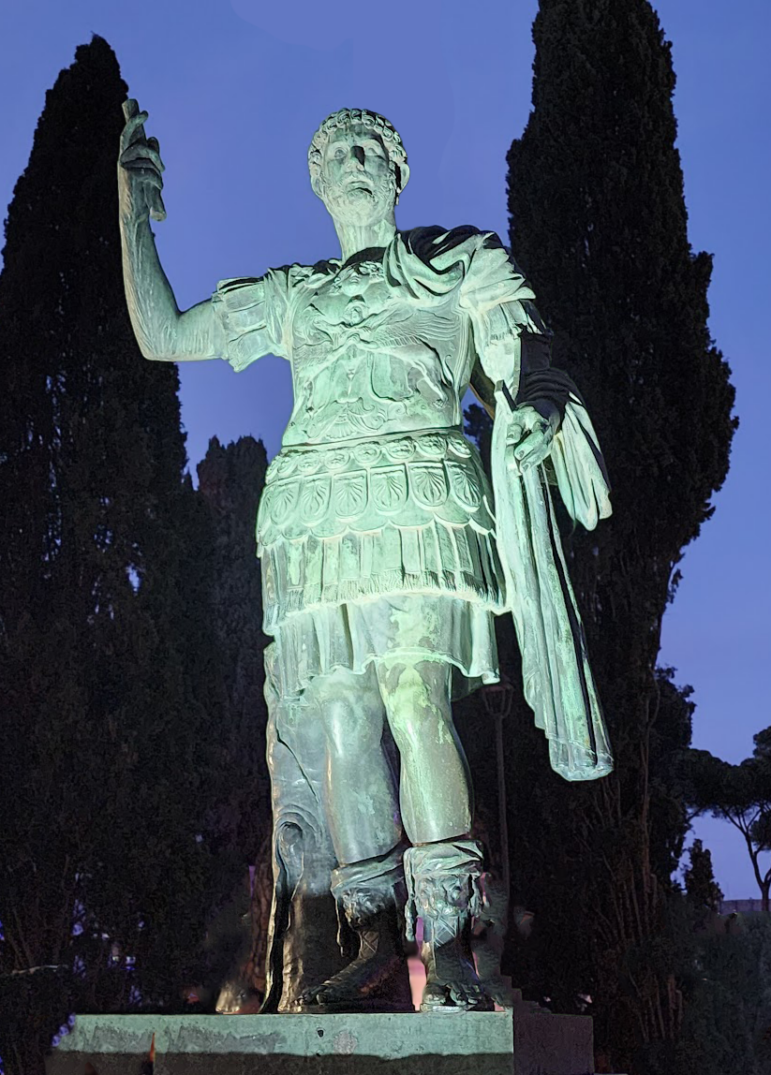
A statue of Hadrian (r. 117–138 CE), emperor, soldier, and builder. [MJTM
But this editorial is about more than Partridge. It is about what happens whenever any religion mistakes one virtue for the whole of virtue.
A society that prizes warriors above all else eventually begins to treat every disagreement as a battle, every compromise as surrender, and every act of care as weakness. Modern Paganism offers a useful contrast. Our stories and deities present a wider range of archetypes, not because there are no gendered figures, but because there are many ways to embody masculinity, femininity, and the many expressions that exist between and beyond them. Even within the same deity, apparent contradictions often coexist.
Paganism resists collapsing all human virtue into a single archetype. Odin, for example, seeks wisdom as often as victory. Even the Morrígan embodies sovereignty and prophecy alongside warfare. Our stories rarely reduce virtue to a single ideal because human life itself refuses such simplification.
Nature itself doesn’t privilege one mode of being. There are seasons for the hunt, seasons for planting, seasons for harvest, seasons for mourning, and seasons for rest. A culture that celebrates only warriors forgets that most of life is not lived on a battlefield. It is lived around the hearth, in the workshop, in the temple, in the classroom, in the forest, and at the bedside of those who need healing.
Masculinity itself is not the problem. The problem is elevating one expression of masculinity into a religious ideal against which all others are judged.
In that context, the opposite of the warrior isn’t weakness. The opposite of the warrior is the citizen.
Citizens build institutions. They raise children. They preserve forests. They settle disputes. They compose music. They teach apprentices. They comfort the dying. They write constitutions. They tend shrines and hearths. They plant trees whose shade they will never sit beneath.
Warriors are indispensable at certain moments of crisis.
But civilizations are sustained by citizens.
The Wild Hunt is not responsible for links to external content.
To join a conversation on this post:
Visit our The Wild Hunt subreddit! Point your favorite browser to https://www.reddit.com/r/The_Wild_Hunt_News/, then click “JOIN”. Make sure to click the bell, too, to be notified of new articles posted to our subreddit.