

The winds of October are upon us. We stand as a nation and as individuals at a precipice: do we follow the way of erasure or do embrace a path of existence as a living work of kintsugi? This is a time for awareness of ourselves as humans who are imperfect, incomplete, and yet idealistic with hope for the future. Americans, similar to the art of Kintsugi are optimists, with a perpetual “can-do” attitude in many situations. We do not give up. We fight and we keep fighting. We are firm believers that there is always a way to make it through the darkness of the night.
During the sacred space between the balance of the autumnal equinox and the continued thinning of the veil until Samhain, often we are blessed with visitations or feelings of closeness to our ancestors – parents, and for some, grandparents or even great-grandparents. These moments allow us, for a few moments at least, to be close to those we have lost recently or a long time ago.
Our ancestors and ancients bring a spirit of survival and an awareness of how to approach current and future life situations.
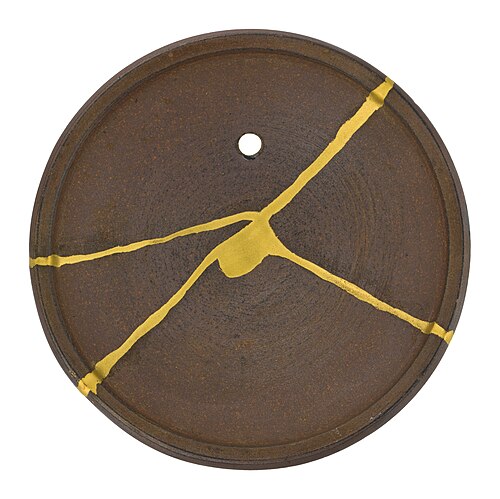
Kintsugi on broken Kyūsu [D-Kuru, Wikimedia Commons, CC 4.0]
Using the philosophy and practice of Kintsugi, we are never fully broken as vessels because the flaws, the breaks that appear in our shell or visage are filled by a lacquer. The highlighted cracks in gold, platinum, or silver do not detract from the overall expression of a piece but emphasize and highlight its beauty. The artist Thomas Iser even applies this to the human body, painting Kintsugi-inspired designs on himself. Unlike ceramic pieces, as humans our emotional fissures run deep, sometimes appearing like crevices in our personality or narrow clefts when when dig in and take a stand on issues that matter to us, which means filling the spaces with emotional lacquer is a challenge.
Emotional Fractures
We hide our pain, our neediness, and our trauma behind a wall of unblemished perfection. We do not have a safe space among the many public events that fill the news: an unwanted never-ending military conflict that is only occasionally actually called by the correct term “war,” the choices we make when filling the gas tank for needed transportation to work or medical appointments means that we have less to spend on basic food and groceries.
The realization that package downsizing combined with increased transportation costs due to a rise in diesel prices means that perhaps we might have beans for dinner more often instead of beef or chicken or fish. The food that nourishes our bodies is a type of medicine; however, the prices of prescription medicine are at a level where the combination means hard choices: gas, groceries, or required drugs to combat illness – which do we choose? When a run to the grocery store costs a hundred dollars now, as opposed to perhaps fifty or even thirty dollars seven months ago, at the end of February when the war started, we either make more money, go with less, or go without.
What tips us over emotionally is the combination of rising costs in all areas: fuel for our cars, food for our bellies, medicine for our bodies, and shelter for our lives. There is an emotional toll when the rental prices and mortgage rates rise. We choose to emotionally seal our fractures with what can protect us – as best as we can.
Too many people are in pain emotionally from going without. We are living in some ways in a time reminiscent of the Great Depression – a time our great-grandparents, grandparents, or parents lived through and survived. During the pandemic, a similar occurrence happened with a return of the 21st century version of victory gardens.
Now we are separated by a two decades old social media fabric built on the premise of bringing people together socially and therefore, emotionally. Formerly reliable means of societal comfort using face-to-face or in-person practices have been mostly discarded in favor of the digital landscape. Texting, voice notes, and social media tools have replaced the habit of speaking directly by phone, visiting at each others homes just because, or spending time together for no purpose except to be with each other.
When the cracks appear, we are further apart as human beings. Each sore spot flares up with emotional divisions in how we view life, and we are lonelier than ever. We use distraction to avoid facing our true selves.
When we acknowledge our flaws, smooth the cracks of our emotional pain with a balm of self-compassion, we become stronger and more beautiful in our resilience. During this time, we can share space our beloved dead, ancestors and ancients who feel so close as the veils thin to heal our wounds and deep emotional fissures that sometimes we do not know how to resolve on our own.
Kinetic Weakness
Another level we have as humans is the presence of fear and anxiety. In a world where these two emotions are as prevalent as oxygen in the air, how we choose to deal with our anxiety and our fears matter. Within our interconnected energetic ecosystem, fear is associated with the kidneys, the tiny workhorses that control so much in our bodies. Both fear and anxiety are our human response to a perceived threat. What we ingest, in the form of social media, news of all types, and our communications with others can increase or decrease the level of anxiety or fear that we have in our bodies and our energy fields.
In a world where our bodies are currency, the means by which we fuel our lives, being aware of our internal anxiety is important. Choosing to care for those areas with kinesthetic practices rather than options which distract from pain resulting from fear is a must, yet not often done before we suffer damage.
It is the emotional fractures, resulting from social distance, societal pressures due to rising costs, and an increase in staying out of bodies rather than tuning into our bodies that results in kinetic weakness. We are afraid of so much, and rightly so. A quick scan or look at the news highlights concerns with the environmental impact with the rise of data centers, local and state government political divisions over health care, transportation, economic job losses, and food costs, and a rising divide between the very wealthy and a shrinking middle class.
Fear leads to less connection, more loneliness, and fewer children as the choice to expand one’s family becomes less affordable both financially and emotionally. When we choose to stop, even for a moment, and breathe, we release the trap we find ourselves in when fear holds us in its grip.
We heal through meditative practices such as engaging fully in rest – not the rapid snatches of a few hours because we are too busy to slow down, but actually having conscious effort for deep sleep, full rest, and stretching our bodies through movement, like Qigong. In short, we mend the connection between our mental and emotional self and our physical self.
We scan our bodies to loosen what feels tight in ourselves which means we need to stop what is causing stress and anxiety. When we know we feel uptight, we can take a moment to consciously lower our shoulders to release the tension that locks into our bodies. When we deepen our breathing, we internalize calm and release tension.
In the stillness, we can remember our selves and our ancestors. We can ground. We can sit by the fire and just be.

Fireplace – © Vyacheslav Argenberg, CC BY 4.0 <https://creativecommons.org/licenses/by/4.0>, via Wikimedia Commons
Ancestral Connection
As the weather cools, the leaves change colors, and start to fall, we feel the veil thinning. We welcome our ancestors into our homes, our practices, and our lives. We celebrate with them and rejoice at their presence in our lives. Just as the kidneys address fear in the interconnected energetic ecosystem, our vessels are connected via our ancestors. Intergenerational trauma passes from generation to generation through cracks and fear inherited from loved ones who lived long ago.
Many of us may have inherited severe trauma from family members no longer living who survived war, domestic abuse, or systemic oppression. In many ways, the damage is so deep that it cannot be contained within one generation.
Children and relatives of those who served and survived World War I, World War II, the Korean War, the Vietnam War, and later wars in the Middle East know the heartache of living with survivors who carry the invisible scars of post-traumatic stress disorder. Multiple or prolonged military deployments, sexual assault or sexual harassment during military service, exposure to being in a war zone or experiencing the death of other service members can be common causes of PTSD. Loved ones may notice that those who return are no changed: they may appear withdrawn, have difficulty sleeping, have flashbacks to the traumatic events, and no longer appear to have an interest in what they enjoyed prior to deployment. As survivors if their fellow soldiers died, they may feel, but never speak openly of the guilt or shame they feel.
While there are treatments, many military veterans do not seek care. While the U.S. Department of Veterans Affairs(VA) health care page does have a listing on its website, it is located more towards the bottom of the page under More Information and Resources, after the VA health copay rates.
If you are a veteran, know that Veterans Affairs does provide information to help by using the Veterans Crisis Line, regardless of status: Call 988 and select 1; start a confidential chat; text 838255; and for users needing TTY – call 711 then 988.
Patterns of domestic abuse, including intimate partner violence and violence against family members including one’s own children, parents, or siblings. Family by blood or family by choice does not matter – the connection is what is important. Dorothy Allison‘s “River of Names” is a work that in its rawness describes generational domestic abuse in the form of violence, sexual abuse, and physical altercations passed off as so common that it is a river. While this piece is a hard read, it is a reminder that what we observe in our families is often transmitted from generation to generation in silence. Survivors do not speak of it – it just is.
For those who are suffering from domestic abuse or know of others who have been recipients of domestic violence, there is help. In the United States, you can call 1-800-799-SAFE (7233) or text “START” to 88788. You can also go to the website, hit the chat link and chat live there. There is also a compassionate AI Chat, named Ruth, for those who are unable to reach a live person when needed.
As the child of formerly enslaved people who have served in the military as far back as the Civil War, I know that trauma borne by my ancestors six or seven generations back has flowed into relatives. A friend who adopted twins who had been in foster care for the first several years of their lives noted how the environment and the abuse suffered early on then appeared later on in the children as emotional outbursts, and difficulty with socialization in school for years.
For many Black people descended from formerly enslaved people, Dr. Joy DeGruy posits a theory, Post-Traumatic Slave Syndrome, as a method of transmission of system oppression including among other areas, vacant esteem and internalized racism. Just as Post-Traumatic Stress Disorder occurs with others who have survived war and domestic abuse, it also happens as result of generational trauma due to systemic oppression. Tell a child, a youngling whose personality, and identity is malleable that they are less than due to their heritage, the color of their skin, their social or economic class, and you have set a pattern that is difficult to change or break. One aspect of vacant esteem found within the community is one of appearance of success: using material compensation and wealth markers to compensate for the fragile internal value as the internalized sense of worthlessness is passed through the lived experiences of current and previous generations.
In the memoir Soft by Sherrie Fernandez-Williams, there is a scene where a sixth-grade Black schoolteacher shames and holds back the narrator, who is bright and on the precipice of finding her voice as a writer educationally. While a breakthrough occurs when the primary teacher goes on jury duty, when the narrator writes well under a white male teacher, the primary teacher’s return allowed an opportunity for the narrator to continue her academic ascent to die. In a system where tracking is common, the narrator who should have been in 7A ended with students expected to go to college ends up in 7C. This scene exemplifies the concept of intra-racial sabotage, tearing down those who could be successful because of what it might mean for the group as a whole.
Of these three areas, the deepest is the role of intergenerational trauma whether through war, domestic abuse or systemic oppression which has one connection at this time of year: our ancestors.
The turning of the page to the start of October is a visual and mental reminder of the importance of healing our full selves from our emotional fractures, through the physical in our kinetic weaknesses, and connecting with our beloved dead through a deepening of our ancestral connection. We turn inward in many ways in grief, in joy, in remembrance, and in healing at this time of the year. We embrace our internal growth at this time of year which is the start of the hidden healing we all enjoy as a benefit of our time with our ancestors.
We look to those we have loved and have lost, parents, grandparents, great-grandparents, mentors, other family members, and friends who remind us that the spirit of survival is important. As we breathe in the calm of the time of the thinning veil, we embrace the peace of our ancestors and their place in our lives.
The Wild Hunt is not responsible for links to external content.
To join a conversation on this post:
Visit our The Wild Hunt subreddit! Point your favorite browser to https://www.reddit.com/r/The_Wild_Hunt_News/, then click “JOIN”. Make sure to click the bell, too, to be notified of new articles posted to our subreddit.