
MEXICO CITY — The government of Mexico has launched what officials describe as the most extensive consultation process in the nation’s history on Indigenous rights, seeking input from 16,728 Indigenous and Afro-Mexican communities before submitting a landmark General Law on the Rights of Indigenous and Afro-Mexican Peoples to Congress later this year.
At her Monday morning press conference, President Claudia Sheinbaum signed the official announcement initiating the consultation process, fulfilling a key step in implementing the constitutional reforms adopted in 2024 that significantly expanded the legal recognition and protections afforded to Indigenous and Afro-Mexican peoples.

Mexican President Claudia Sheinbaum Pardo, PhD, during “La Mañanera” the governmental morning conference [Credit: Eneas CC BY 4.0]
The proposed legislation is intended to transform the constitutional principles adopted in October 2024 into a comprehensive legal framework governing Indigenous rights. Before it reaches Congress, however, the government says it will seek direct input from the communities the law is designed to serve.
“The time has come” to consult those who are the holders of these rights, said presidential legal adviser Luisa María Alcalde, announcing that members of 69 Indigenous peoples, along with Afro-Mexican communities across the country, will participate in the process. The government plans to submit the final bill to Congress on Oct. 12, recognized in Mexico since 2021 as the Day of the Pluricultural Nation.

Logo de la Presidencia de la República (2024-2030)
The legislation will build upon the sweeping constitutional amendment that took effect on Oct. 1, 2024. That reform recognized Indigenous and Afro-Mexican peoples as subjects of public law with their own legal personality and patrimony, affirming their authority to govern according to their own normative, cultural systems, resolve internal disputes within constitutional limits, and exercise greater autonomy over community affairs.
The constitutional changes have also strengthened access to justice by requiring culturally and linguistically appropriate legal assistance, including interpreters, translators, specialized attorneys, and experts in Indigenous rights. Equally significant was the constitutional guarantee of free, prior, and informed consultation before legislative or administrative actions that could affect Indigenous communities or their territories.
While many of these protections were previously reflected in international human rights law and decisions of Mexican and Inter-American courts, the constitutional reform elevated them into Mexico’s highest legal authority, creating stronger mechanisms for their enforcement.
The reforms carry broad implications beyond Indigenous governance. Future energy, mining, infrastructure, and other development projects will be expected to comply with strengthened consultation requirements and respect Indigenous self-determination, potentially reshaping how major projects proceed in traditionally Indigenous territories.
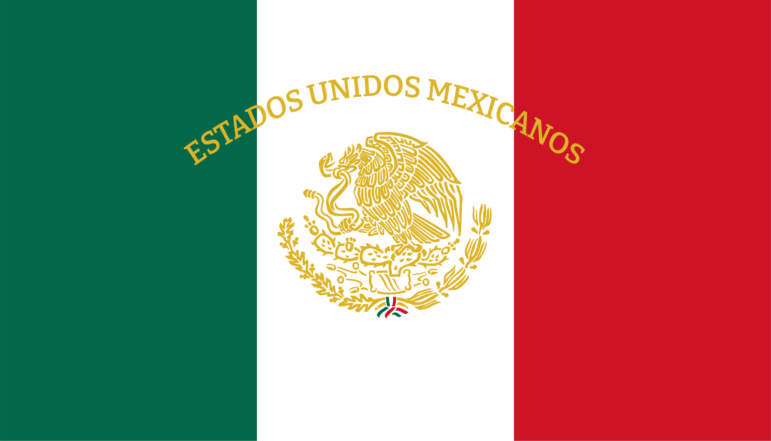
Mexican Presidential Standard [public domain]
Adelfo Regino Montes, head of the National Institute of Indigenous Peoples (INPI), described the constitutional reform as the foundation of the proposed law.
He said the legislation seeks to “promote, protect, guarantee and implement” the rights of Indigenous and Afro-Mexican peoples as legal subjects capable of exercising autonomy while participating fully in national public life.
According to Regino Montes, the law would apply to approximately 25.8 million Indigenous and Afro-Mexican people, about 20.5 percent of Mexico’s population, living in 16,728 recognized communities, including 16,232 Indigenous communities and 496 Afro-Mexican communities.
The proposed legislation is organized into eight sections addressing subjects including Indigenous peoples as legal entities, self-determination and autonomy, the rights of Afro-Mexican communities, protections for Indigenous and Afro-Mexican women and girls, and safeguards for migrants, elders, and persons with disabilities.
One section establishes detailed procedures governing future consultations with Indigenous and Afro-Mexican communities.
“The idea is that now we will have a legal framework to guarantee the right to consultation for our peoples and communities,” Regino Montes said.
The emphasis on consultation follows criticism of previous government consultation processes. In 2019, the Mexico office of the Office of the United Nations High Commissioner for Human Rights concluded that consultations surrounding the controversial Maya Train project emphasized potential benefits while failing to adequately present possible adverse impacts to affected Indigenous communities.
Officials said the draft legislation itself emerged from 148 working meetings involving 35 federal agencies and included consultation with Mexico’s Supreme Court on matters relating to justice.
The consultation process will unfold in five stages. Following Monday’s formal announcement, communities will receive informational materials between July 1 and Aug. 6. Community deliberations, conducted according to each community’s own traditional decision-making systems, will occur from Aug. 7 through Sept. 13 and include 82 regional consultation assemblies.
Government officials will then review recommendations and revise the bill before submitting it to Congress on Oct. 12.
If approved, the legislation would represent the first comprehensive Indigenous rights law enacted since the establishment of the modern Mexican state more than two centuries ago, providing statutory protections to accompany the constitutional reforms already in force. The consultation marks a significant step toward legal recognition of collective rights, self-governance, and meaningful participation in decisions affecting Indigenous and Afro-Mexican communities’ lands, cultures, and futures.
The Wild Hunt is not responsible for links to external content.
To join a conversation on this post:
Visit our The Wild Hunt subreddit! Point your favorite browser to https://www.reddit.com/r/The_Wild_Hunt_News/, then click “JOIN”. Make sure to click the bell, too, to be notified of new articles posted to our subreddit.