
LONDON – A recently discovered war horn dating from the Iron Age may be connected to Boudicca, the famous Iceni chieftain whose revolt against the Roman occupation is legendary. The carnyx – war horn – is a long trumpet with a straight vertical section and a bell in the shape of an animal, often that of a boar, and is the first entire example to be discovered in the UK, out of only 3 examples. It was found with other unique items, including a boar’s head battle standard made from bronze.
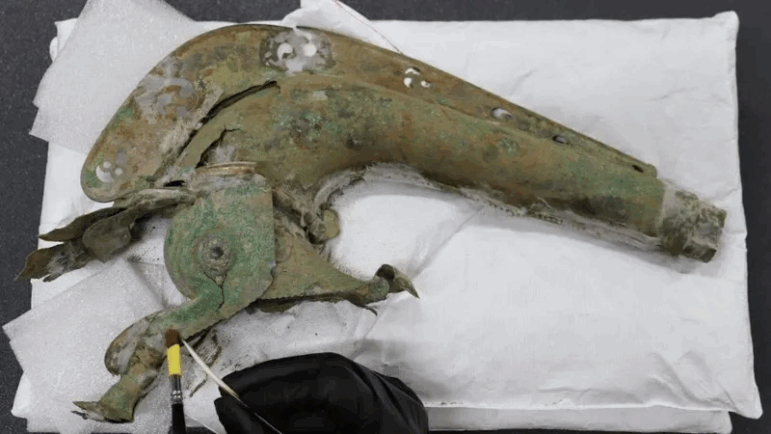
The carnyx shaped like a boar’s head, would have topped a long, thin pole. via Norfolk Museum Service
The hoard, which was discovered in Norfolk, was buried around 1 CE and is close to Iceni territory. Diodorus Siculus wrote of these war trumpets that they “are of a peculiar barbarian kind; they [the tribespeople] blow into them and produce a harsh sound which suits the tumult of war,” and there is a depiction of three of these trumpets on the Gundestrap cauldron. Some etymologists believe that there is a connection between the word ‘carnyx’ and Cernunnos, the name of the god whom some hold to be depicted on the cauldron: these words derive from the word for ‘antler.’
The length of these trumpets allowed them to rise above the heads of the troops and be heard; they are extremely loud. The first one discovered in Britain was found in Lincolnshire, and the second (the Deskford Carnyx) in Scotland but others have been found in France and on the Continent. It is, however, rare to find an intact carnyx.
CEO of Pre-Construct Archaeology, in charge of the dig (which was conducted ahead of a housing estate development) told the Guardian that it was
“a once-in-a-lifetime, once-in-a-career find. I’ve been doing archaeology for over 40 years and I’ve never seen anything like this. We are absolutely within the heartland of the Iceni – whether it was they who buried the hoard or not, we just don’t know. [But] almost certainly the items were buried in the first century AD, and that brings us closer to the Iceni and to Boudicca. They are of such quality that … any important people from the Iceni and other groups would have known these objects.”
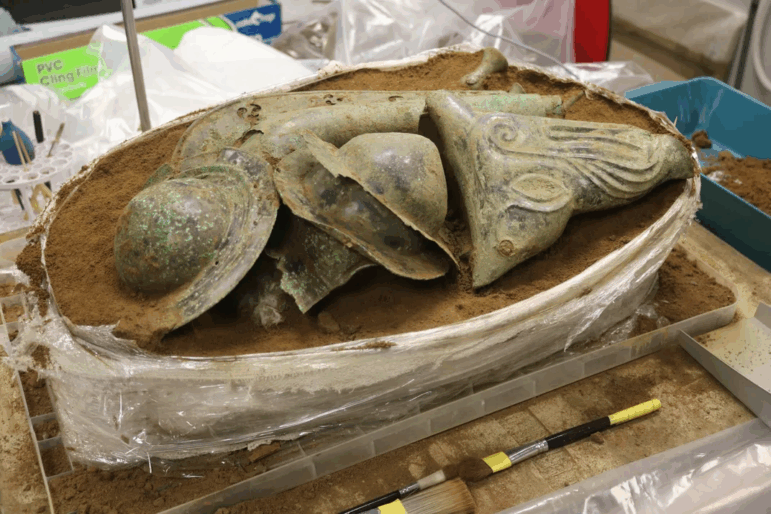
The hoard was excavated with in a block of soil . via Norfolk Museum Service
Curator at the National Museum of Scotland, Fraser Hunter also spoke to the Guardian, noting that the find will:
“add enormously to our understanding of the Iron Age world. I’ve looked at carnyces from around Europe, and the full research and conservation of these incredibly fragile remains will reshape our view of sound and music in the Iron Age…the whole of the bell and the head are relatively complete – and it’s the only one that’s ever been found where they haven’t taken the ears off. It’s got these great big flappy ears which are wonderful, and they’re still in place. Objects like this remind us how little we know about so many different aspects of our past. These objects had names, people thought they were imbued by power. They may even have thought that they were alive at certain times in their existence – and all of the stories that go with them are lost.”
Boudicca is a significant figure in British history, and in contemporary Pagan lore. She was the widow of Prasutagus, the leader of the Iceni tribe, who occupied lands in what is now Norfolk. She is said to have led to a major, but unsuccessful, revolt against the country’s Roman occupiers around 61 AD after the abuse of her daughters and herself, burning a number of Roman settlements – including Londinium – to the ground. Historians believe that around 60 – 70,000 people died, possibly more, on both sides. The Romans fought back under Governor Gaius Suetonius Paulinus and defeated the tribes.
Boudicca’s period intersects with contemporary Paganism insofar as Boudicca is said to have worshipped the Celtic deity Andraste, whom Roman historian Cassius Dio depicts as a victory goddess of the Iceni. In legend, Boudicca releases a hare from her cloak before a battle with Roman forces: its path is used for divination. There has been speculation that Boudicca herself may have been a priestess of Andraste: we do not have evidence for this and it must remain in the realm of speculation, but whatever the case, Andraste is a deity whose worship has been revived in the east of the UK, in East Anglia and Essex, and the Wild Hunt is aware of a number of Pagans who follow her.
We consulted the community on its views:
It would be interesting to know where it [the carnyx] was made, or, at least where the metal was sourced (this can sometimes be determined). ‘In Iceni territory’ doesn’t necessarily indicate it originated there: spoils of war might be another possibility. The piece mentioned it was dismantled, which to me suggests it was possibly won in battle and then “killed” to release its power. Then again, someone might have had enough of their spouse playing the thing. (Dr Kari Sperring, historian)
Every time a 1stC burnt layer gets excavated anywhere in SE Britain, someone is over-quick to associate what might have been the equivalent of a chip-pan fire, to the Boudiccan Rebellion. But then again, UK archaeology is so poorly funded and individual recognition so difficult to get in an overcrowded job market, that archaeologists themselves will make extravagant, sensational claims to the media. Personally, I think finding a carnyx is pretty sensational enough. (Nick Ford, author)
The Wild Hunt is not responsible for links to external content.
To join a conversation on this post:
Visit our The Wild Hunt subreddit! Point your favorite browser to https://www.reddit.com/r/The_Wild_Hunt_News/, then click “JOIN”. Make sure to click the bell, too, to be notified of new articles posted to our subreddit.