

Today’s offering comes to us from Sprocket Wagner (she/her). Sprocket is a journalist devoted to bringing diverse and equitable coverage to topics of religion and spirituality. She’s an eclectic Pagan, a Witch, and an aspiring scholar of interfaith theology. Find her on Mastodon, or on her website, Interfaith Heathen.
The Sound thrums with a tangible energy, one that even my urban-attuned senses can’t ignore. When I moved to Seattle a few months ago, I could feel that energy from the plane.
I had just spent a few years living in Pittsburgh, which to me felt entirely spiritually dead. None of the energies that I would expect to feel from a city its size were there, after years of exploitation of the land and neglect of the city by those in charge of its care. I also would not have felt comfortable sharing my faith and practices with most people I met there. Despite that, I knew of a good number of fairly large Pagan and Witchy groups, most of which are pretty easily found on any search engine.
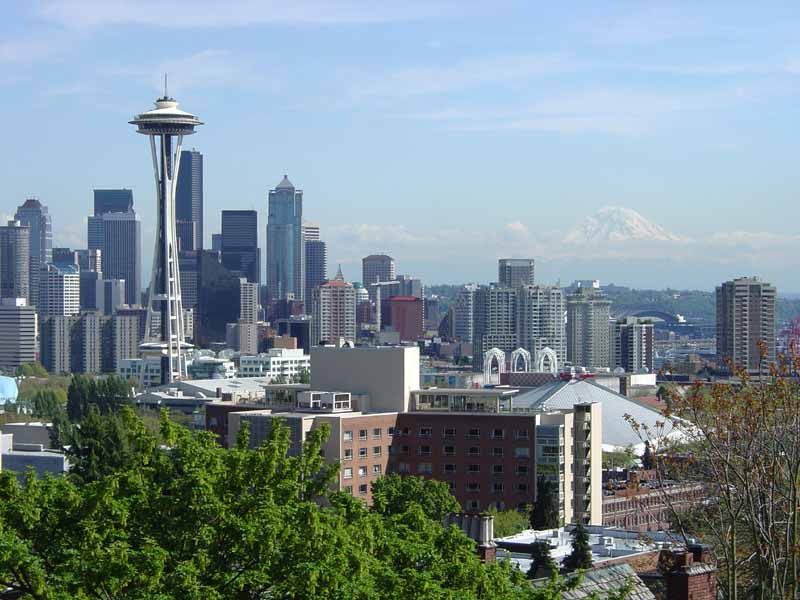
View of downtown Seattle from Kerry Park. Mt. Rainier appears barely visible through the haze to the right of the city. [public domain]
When I landed, it was like entering a different world. Strangers don’t stare at me here for being trans or dressing alternatively, and instead I regularly have entire conversations with them (Seattle Freeze be damned.) There’s always something to do, some meetup for some niche interest. Naturally, I thought, this must apply to Paganism too. I immediately set to searching for groups. What I found was a small smattering of groups, most of which were either chock full of AI, Wiccan (or pretending not to be Wiccan but functionally following the Rede and the Wheel), or both. No shame to Wiccans, but I knew there had to be more.
A good chunk of the links on the Puget Sound Pagan Pride are defunct, as is the event itself as of last year, despite plans for 2027 being listed on the site. The listed Heathen group, Riðar Ók Wyrd, has a defunct phone number and a Facebook profile that hasn’t had a post in four years. There are two or three major groups outside of these bounds that show up in searched, but few of them have much readily available information on their sites.
Certainly, I thought, groups must exist – but why would they hide in such a generally welcoming place? Even Robert Anderson, proprietor of Edge of the Circle Books in U District, who generally has a finger on the pulse about these things, knows very few local groups.
“I remember way back when,” he says, “with Wicca and all that, there used to be newsletters, but as far as groups were concerned there would be a coven structure. But even if modern groups aren’t initiatory, they’ve been equally secretive. There are the larger groups, and then there are the individual groups where I don’t really know how to contact them. I do know about a couple of Druid groups, but only because they’ve used my basement. Not everybody tells me their group exists. How the Asatru people find each other, I’m not sure. My guess is they do it through some of the larger Pagan networking, including Facebook groups.”
It wasn’t always like this here. Our Lady of the Earth and Sea (OLOTEAS) is one of the oldest groups in the area, founded in 1995. One of its co-founders, Stephanie WaveSinging, described to me what the local scene was like back then.
“I had read Drawing Down the Moon in my senior year of high school, and based on that, thought for sure I would find a Pagan group I could connect with when I got to college,” she says. “That didn’t happen, but by the time I was in college I had made a connection with a local coven through the Aquarian Tabernacle Church, and with their support I started an on-campus group. AT that time, there were at least five different organization regularly hosting events at least on a monthly basis, and that’s not counting the ceremonialists.”
But most of those older groups have dissolved, and the variety of reasons I heard from WaveSinging surprised me. Some had personal falling outs, embezzlement scandals, excessive hedonism, or plain old burnout. The latter seems to be one of the biggest drivers. Even some of the largest events in the area, such as Puget Sound Pagan Pride, have fallen to it, as WaveSinging described to me that the main organizer burned out from doing the heavy lifting by himself. (Said organizer did not respond to a request for comment.)
Those gaps were eventually filled by more groups, but then the next great extinction event arrived – COVID-19. All three sources I spoke to mentioned the pandemic as a source of division and cultural shifts. Although OLOTEAS survived the pandmic, it wasn’t easy.
“We did hybrid events for a while,” says WaveSinging. “We’d have social time and a workshop online, then some of us would meet outdoors in a park for ritual, and others would stay for an online ritual. That was a lot of effort; at the time we only had six staff members spread over all of King and south Snohomish counties. Once we were doing full events in person again, we tried to maintain some online events, but it was too much. We just didn’t have the capacity.”
The pandemic led to a major shift toward online communities. The Church of the Moon is a Seattle area Discord server with around 600 members. Its founder, Sunshine (Sunny), started the server in 2025 after posting her frustrations at the lack of local groups to TikTok. After that, membership spiked to around 1500, but then dwindled down to 200. Sunny noted that this might reflect a tendency for local groups to fizzle out as quickly as they start up.
“They just don’t have the energy or the know-how,” Sunny says. “I’m not sure on specifics, but I did watch things pop up and die out pretty quickly. It is definitely a lot of work to advertise and organize. It’s no small task. It’s like herding cats.”
Many of the older groups in the area have indeed survived, and some of their secrecy might be an issue of PR. Sunny noted that a lot of the organizations that have survived are run by older folks, who simply have a different approach to running things.
“They’ve been around since the 90s,” she says, “and they don’t have anyone younger or tech-savvy running their social media, so they have a very, very old style website. And they have older folks running the social media who don’t think to post things ahead of time. I’ve noticed sometimes they don’t post until 24 to 48 hours before an event, which can be pretty frustrating for people like me who really would love to attend and can’t do so on such short notice because my life gets so crazy packed.”
WaveSinging echoed this, though she thinks a lot of it is more about generational differences in approach than a lack of know-how.
“I have heard from my oldest, in their 20s, that other groups they have checked out have been mostly run by older folks who don’t seem to have a lot of interest in, shall we say, intergenerational reciprocity,” says WaveSinging. “I feel like most of the folks of my generation are reasonably tech savvy and can figure out how to promote themselves via social media, but social media itself seems to be more and more segregated by generation, and I do think a lot of us on the older side are just not as excited by learning a whole new platform when we’ve already lived through a bunch being really popular and then fading out.”
Older Pagans might also find themselves more nervous about the public eye as things change and evolve in our political landscape.
“I don’t think my children, in their teens and twenties now, feel any hesitation about being out as Pagans,” says WaveSinging, “but my partner and I and some of our friends look around at things happening in the country and even in the state and wonder just how safe we’re going to be. Federal lawmakers specifically calling out Pagans as a threat that needs to be addressed makes some of us pretty nervous, because we remember how it was before, or how it was told to us.”
So how do we move forward? There’s clearly interest from all ages in coming together as Pagans and as magical practitioners. Both WaveSinging and Sunny reported a wide range of ages and practices represented at their meetups and good attendance numbers. While publicity can be a hurdle, it clearly hasn’t stopped OLOTEAS from thriving, and Church of the Moon does not survive on online interactions alone.

Aerial photograph of Seattle and Puget Sound, with the Olympic Mountains in the background [Murray Foubister, Wikimedia Commons, CC 2.0]
Consistency seems to be key between both groups. They have stable groups of volunteers or staff that keep events moving, regular events, and no expectation of growth. Church of the Moon may have peaked at high membership, but they didn’t lose steam when it dipped low. And while OLOTEAS may not be the easiest to find, WaveSinging thinks this may contribute to the group’s stability.
“We could do more publicity,” she says. “We could make an effort to have more people and make more money. But I think that would ultimately have a negative impact. We typically have three or four newcomers every month, and our average attendance is probably around 45. If we were to encourage a lot more newcomers each month, I think it would really change the dynamic and make it harder to maintain the sanctuary space we strive to create.”
Both groups also cited affordability and accessibility as hurdles to other groups and keys to their success. Venues can be expensive, and transportation costs are always rising. While OLOTEAS’s site can be a bit hard to access without a car, carpools are arranged and no one is turned away if they can’t make the suggested donation. Sunny kept this issue in mind when founding the Church of the Moon, as well.
“I try to make my events open to the public and free because I want to encourage people to come no matter how much money they have in their bank account,” she says. “I don’t care. I want people to have fun and be able to do a craft and meet people in their community and I really want to bridge that gap between soul practitioners and lonely practitioners who want a sense of community with like-minded folks, but have difficulty finding that.”
WaveSinging’s advice to those who may seek to found their own groups? Gather good people, and stick with it.
“Be clear about what you want to do and be firm in your boundaries around that,” she says. “Make sure your motivation is sound – don’t do it for ego. Leave room for spirit to show up in ways you didn’t expect, but can be so wonderful. And be sure you have a trusted co-pilot (not the AI!) who can help you think things through, listen to you vent, and celebrate with you when things go well!”
The Wild Hunt is not responsible for links to external content.
To join a conversation on this post:
Visit our The Wild Hunt subreddit! Point your favorite browser to https://www.reddit.com/r/The_Wild_Hunt_News/, then click “JOIN”. Make sure to click the bell, too, to be notified of new articles posted to our subreddit.