

Uncovering the Past
LONDON – An archaeological discovery in Pembrokeshire has raised the possibility that one of the most evocative tales of medieval Wales, part of the body of Welsh legend known as the Mabinogion, preserves a memory of real events. This is the section of the Mabinogion known as the Dream of Macsen Wledig.
Magnus Maximus himself was not an imaginary figure. Historically, he was one of the Roman generals commanding forces in Britain, and was proclaimed Emperor by his troops in AD 383. Crossing to Gaul, he defeated the western emperor Gratian and established control over substantial territories of the western Roman Empire.
For several years Maximus ruled from Trier, before attempting to extend his authority into Italy. His ambitions ended in AD 388, when he was defeated by the eastern emperor Theodosius I and executed.
But the Welsh continued to remember him, not principally as a defeated Roman usurper, but as Macsen Wledig (‘Wledig’ means “ruler” or “leader”), an ancestor whose story helped explain the origins of Welsh kingship and the country’s relationship with its Roman past.
Why did a Roman emperor become such a significant figure in Welsh mythology?
The answer lies partly in the complex inheritance of Roman Britain. After the collapse of Roman administration, the peoples of western Britain preserved aspects of Roman culture, Christianity and political identity while developing their own kingdoms and traditions.
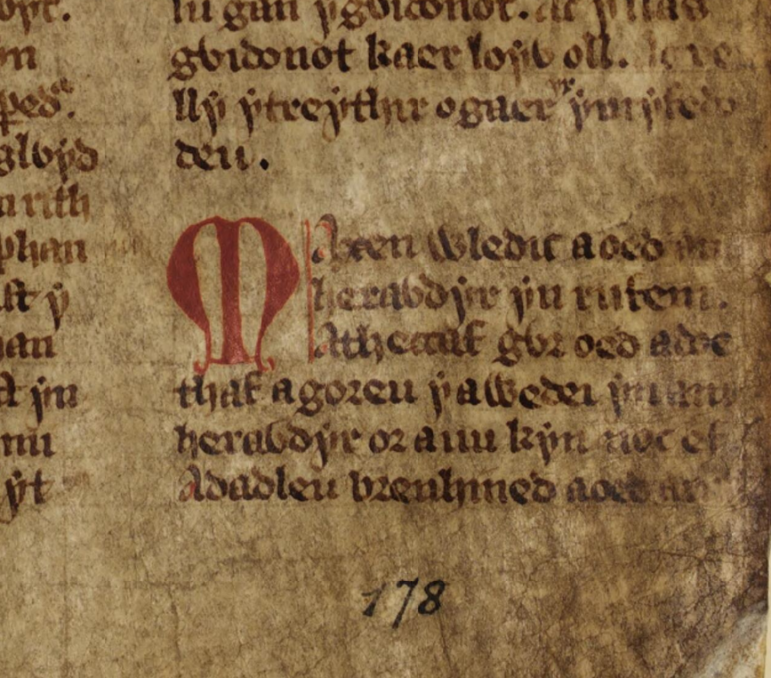
F.45.r of the White Book of Rhydderch showing the beginning of The dream of Macsen Wledig. Image Credit: CC0 – Public Domain
Macsen offered a powerful ancestral connection between the authority of Rome and the legitimacy of native British rulers.
By the ninth century, his importance was already established. The Pillar of Eliseg, an early medieval monument near Llangollen, invokes Magnus Maximus in a royal genealogy, demonstrating that his association with Welsh dynastic identity significantly predates the surviving manuscripts of the Dream.
In the Breuddwyd Macsen Wledig, or The Dream of Macsen Wledig, one of the medieval Welsh prose narratives later collected under the title The Mabinogion, Macsen’s story is told as a romance. But although it is grouped with the Mabinogion, the story is not one of its Four Branches. It belongs to the wider body of medieval Welsh storytelling, combining historical figures, legendary geography, and dynastic traditions.
Its earliest surviving manuscript dates from the 13th century, and versions also appear in the White Book of Rhydderch and the Red Book of Hergest, compiled during the fourteenth century. The traditions themselves are considerably older.
The story begins with Macsen as Emperor of Rome. One day, while hunting, he falls asleep and experiences an extraordinary dream. He finds himself travelling across mountains, rivers and seas until he reaches a distant island. There he discovers a magnificent castle, containing a beautiful young woman seated upon a golden throne. Macsen falls instantly in love.
When he awakens, the dream obsesses him. He neglects the affairs of his empire, consumed by longing for the mysterious woman. Eventually, messengers are dispatched to discover whether she exists. After an extensive search, they find the castle in Britain, at Caer Aber Seint, identified with the Roman fort of Segontium near modern Caernarfon. The woman is Elen, daughter of the British ruler Eudaf Hen.
Macsen travels to Britain, finds Elen and marries her. But Elen is no passive romantic prize. She negotiates substantial privileges for herself and her family, including authority over territories in Britain and the construction of three great strongholds. Later Welsh tradition associates her with the building of roads, earning her the name Elen of the Hosts or Elen of the Ways, and she is venerated as a deity by many pagans today.
The marriage between Macsen and Elen also has a symbolic dimension. It unites imperial authority with the sovereignty of Britain, but significantly, the emperor must travel to the woman’s homeland and accept her conditions. Elen becomes not merely the object of an emperor’s desire, but a figure through whom political authority, territory and lineage are negotiated.
When Macsen’s prolonged absence causes him to lose his imperial throne, Elen’s brothers help him recover his power. The tale concludes with British warriors establishing themselves in Armorica, providing a legendary explanation for the settlement of Brittany.
The connection with Pembrokeshire occurs during Macsen’s travels through Britain. The narrative describes him journeying from Carmarthen towards the hill called Frenni Fawr in the eastern Preselis, where he pitches his tent. The place subsequently becomes associated with the name Cadair Facsen, or Macsen’s Chair.
Until recently, there was no identified Roman military installation sufficiently close to the location to provide an obvious archaeological counterpart to this episode. Now, however, archaeologists investigating a previously unknown Roman fort near Frenni Fawr have uncovered evidence suggesting that this medieval Welsh legend may contain a kernel of historical truth.
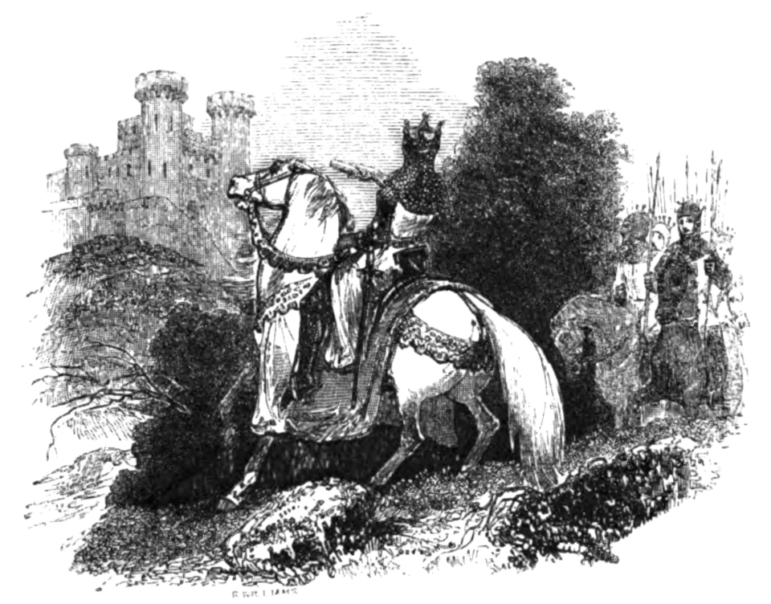
illustration from the The Mabinogion in 1877 [Public Domain
The fort was identified in 2024 by Dr Mark Merrony, an archaeologist affiliated with the University of Oxford, who noticed its distinctive outline in satellite imagery. Subsequent excavations have revealed Roman building tiles, pottery, an iron writing stylus, compacted floors, wagon tracks and, most intriguingly, two coins dating from the late fourth century. The late-fourth-century coins are especially interesting because their date falls within the broad historical period of Magnus Maximus.
Lying approximately two miles southwest of Frenni Fawr and measuring approximately 180 by 150 metres, the fort has the characteristic rounded corners of a Roman military installation. Geophysical surveys suggest the presence of a commander’s residence, while its size indicates that it may have accommodated around 500 soldiers.
Merrony’s discovery therefore offers an intriguing possibility: that the medieval storytellers were drawing upon a much older local memory of Roman military activity. Merrony himself is hopeful, telling the Guardian that
“It’s such a remote area, but the tale mentions the easternmost peak of the Preseli Hills, which is where this site is. The presence of a heavily fortified Roman auxiliary fort may help unlock the mystery of a Mabinogion legend that has endured for nearly 1,700 years.”
Nevertheless, caution is essential. The discovery of Roman coins does not demonstrate that Maximus personally visited the site, nor does it establish that the fort was occupied during his brief reign. Coins could remain in circulation for decades, and the chronology of the fort requires further investigation.
The fort’s location also differs from the precise hilltop setting described in the tale and Medieval manuscript readings of the place-name vary, leaving some uncertainty about the identification of Frenni Fawr itself.
Thus the archaeological discovery is important in its own right, but a direct connection with Macsen remains a hypothesis rather than an established fact. The discovery near Frenni Fawr obviously does not prove that the events of the Dream happened as described. Medieval legends are not straightforward historical records, and their geographical details may preserve layers of interpretation accumulated over centuries.
Further excavation and publication will be needed before stronger conclusions can be drawn, yet we may note that stories can retain memories of real landscapes, buildings and events – long after their original circumstances have been forgotten.
The Wild Hunt is not responsible for links to external content.
To join a conversation on this post:
Visit our The Wild Hunt subreddit! Point your favorite browser to https://www.reddit.com/r/The_Wild_Hunt_News/, then click “JOIN”. Make sure to click the bell, too, to be notified of new articles posted to our subreddit.