

Today’s offering comes to us from Cosette Paneque. Cosette is a long-time Pagan, a Georgian Wiccan Priestess, and a daughter of Ogun. She works in spiritual care and end-of-life education, and supports heart-centred organisations through web and community management. Her work centres on community, meaning-seeking, and social justice. Born in Havana, raised in Miami, she lives in Melbourne, Australia. Visit her at cosettepaneque.com.
Rome has never been my Roman Empire. I’ve always been more drawn to ancient Greece: its myths, philosophy and religion. Rome, by comparison, has always been something I admired more than loved. Even so, I rarely pass up an exhibition on the ancient pagan world, and I was keen to see ROME: Empire, Power, People. I expected emperors, gladiators and displays of imperial wealth. What I hoped to find as well was the quieter Rome of ordinary lives, lived religion and the ways people remembered their dead.
The Melbourne, Australia-exclusive exhibition draws on the collections of the Museo Nazionale Romano and the Museo Archeologico Nazionale di Firenze, bringing together more than 180 objects dating from the first to third centuries CE. Organized into five themes — Ambition, Life, Luxury, The Divine, and Eternity — it is staged with the theatrical confidence that has become a hallmark of Melbourne Museum’s major exhibitions.
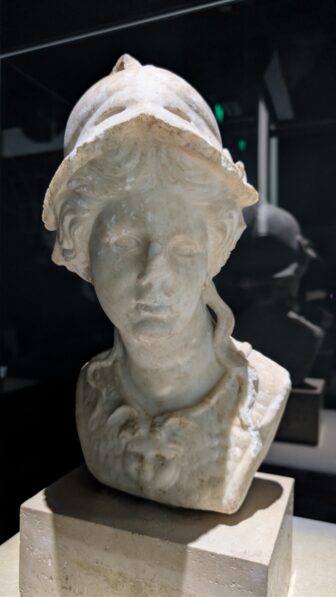
Bust of Minerva, 2nd – 3rd century CE, fine-grained white marble [C. Paneque]
The exhibition opens, appropriately enough, with Ambition: the assassination of Julius Caesar and marble portraits of emperors alongside some of Rome’s most influential women. It establishes the familiar image of Rome as a civilisation of power and spectacle. But I found myself more interested in what came next.
The Life gallery offers glimpses of ordinary Roman citizens. A modest bronze plaque, once fixed to a cart, records that the Vestal Virgin Calpurnia Praetextata was exempt from paying tolls, a small bureaucratic mercy granted to a woman whose life was defined by ritual obligation. Nearby, funerary plaques commemorate the dead not only by name but by occupation: a weaver, a sausage maker, people who wanted their work remembered alongside their lives.
The gallery even recreates part of a Roman bathhouse. Dappled blue lighting, calming music and the scent of oregano, lavender and rosemary evoke the steam and herbs of the real thing.
Spectacle returns in the gladiator gallery, where a stone relief of fighters in combat stands before a projection of a packed amphitheater. It’s an effective piece of staging, bringing the ancient carving briefly to life, while reconstructed armor completes the scene.
From there, the exhibition moves into Luxury, a room designed to evoke life inside the patrician home. It holds jewelry, mosaics, frescoes, cups, plates, lamps, and small, vivid pieces of everyday Roman wealth, along with a statue of a beautiful, life-sized Venus and a bust of Dionysus. Its centerpiece recreates a banquet: couches arranged around a low table, a garden mural wrapping the walls behind, plaster food standing in for the meal. It’s a room built for lingering, and I happily did.
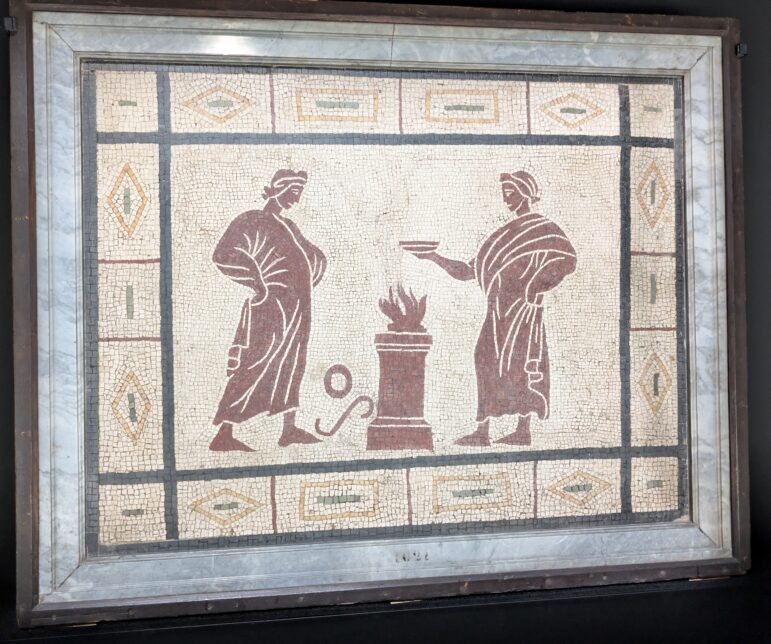
Mosaic with a scene of a sacrifice, 3rd century CE, black and red limestone tesserae [C. Paneque]
After the warmth of Luxury, the Divine shifts the mood completely. The walls turn black, lit only by geometric white fixtures, creating a space that feels stark and almost clinical. At its center stand a statue of Dionysus and a statue of an unnamed priestess, elevated above a glowing platform with a painted sacrificial scene behind them, while suspended wireframe forms suggest the ghost of an architecture that isn’t quite there. This is where the exhibition allows Roman religion to become strange, serious and faintly unsettling, rather than simply a footnote to politics.
Around the edges of the room are the objects that mattered most to me. A bronze hand amulet ends in a ram’s head, linking it to the mystery cults of Jupiter Dolichenus and Sabazius, while still forming the benedictio latina, the gesture of blessing later adopted in Christian ritual. Nearby, household bronzes of Eros, Diana, Mercury and a veiled sacrificant show how Romans kept their gods close at hand in domestic shrines rather than confining them to temples. A marble bust of Minerva, the head of Mars, a statuette of Aesculapius, a mask of Jupiter, and a small bronze oracle from a temple of Fortuna complete a quietly fascinating portrait of lived religion.
Not everything here is gentle. A lead curse tablet, inscribed against a man and a woman named Malchio and Rufas, probably over a romantic rivalry, works methodically through the body—eyes, hands, teeth, bones—cursing each in turn before compounding the malice through repetition and grammatical slips, as though the writer’s anger outran their Latin. Once inscribed, it would have been rolled, pierced three times with a nail and deposited in a tomb, temple or well. Two thousand years later, whatever happened between Malchio, Rufas and the person who cursed them, that tablet still carries the exhibition’s most recognizably human emotion.
The exhibition concludes with Eternity. Romans held no single idea of the afterlife. Instead, continuity mattered more than doctrine: family rituals kept the dead present, while epitaphs invited passers-by to pause and remember. A fresco from an underground family tomb built by Octavius Felix forms the emotional center of the room. The burial niche of his daughter, Octavia Paulina, who died aged six, is painted with children playing and gathering roses, watched over by Hermes as guide of souls. It is a small, devastating image: grief transformed into a garden that a father could bear to imagine his daughter wandering forever.
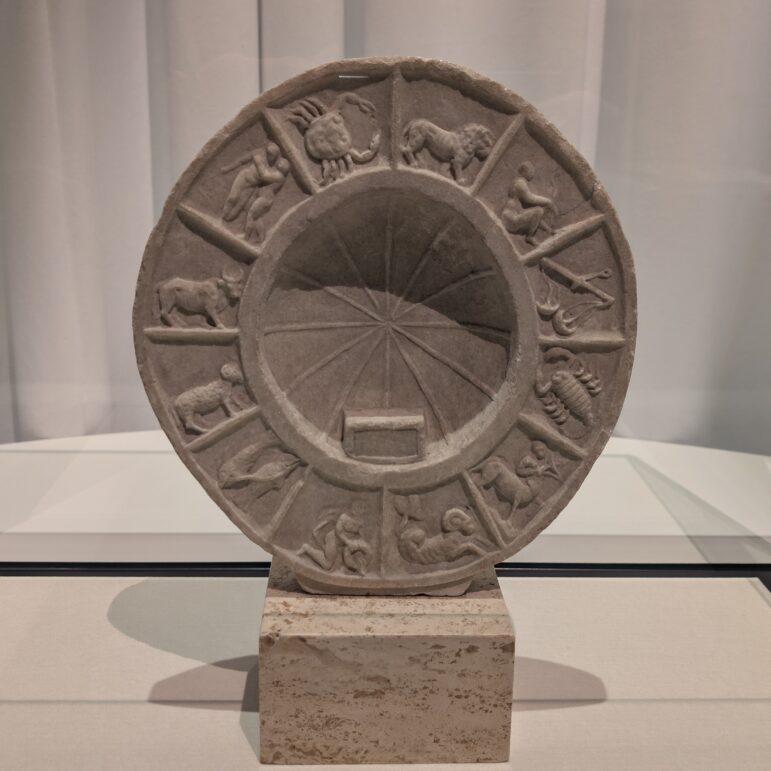
Sundial with zodiac symbols, 1st – 3rd century CE, marble [C. Paneque]
If the exhibition has a weakness, it is that it hesitates to dwell on the harsher realities that made Rome’s splendor possible. In the Life gallery, a marble sarcophagus depicting soldiers leading bound prisoners before a victorious commander carries the exhibition’s only substantial reference to slavery. A single label explains that captives taken in war might be executed or enslaved, and that some were eventually freed. It is easy to miss. Yet slavery underpinned much of what the exhibition celebrates, from bathhouses and banquets to the households that produced those funerary monuments. One brief label cannot quite bear that weight.
Still, this is a rare opportunity to stand before objects that have never before left Italy, presented in galleries designed with genuine care for atmosphere as well as scholarship. If your Rome is one of emperors and gladiators, you’ll find plenty to admire. If, like me, your Rome is the gods, the dead and the quiet traces of ordinary devotion, you’ll find that here too.
ROME: Empire, Power, People is on at Melbourne Museum, 11 Nicholson Street, Carlton, until Sunday 25 October 2026. Open 9 am to 5 pm daily. Tickets, which include general museum entry, range from $15 for children to $38.50 for flexible adult entry, with member and concession pricing available. Details and bookings at museumsvictoria.com.au.
The Wild Hunt is not responsible for links to external content.
To join a conversation on this post:
Visit our The Wild Hunt subreddit! Point your favorite browser to https://www.reddit.com/r/The_Wild_Hunt_News/, then click “JOIN”. Make sure to click the bell, too, to be notified of new articles posted to our subreddit.