

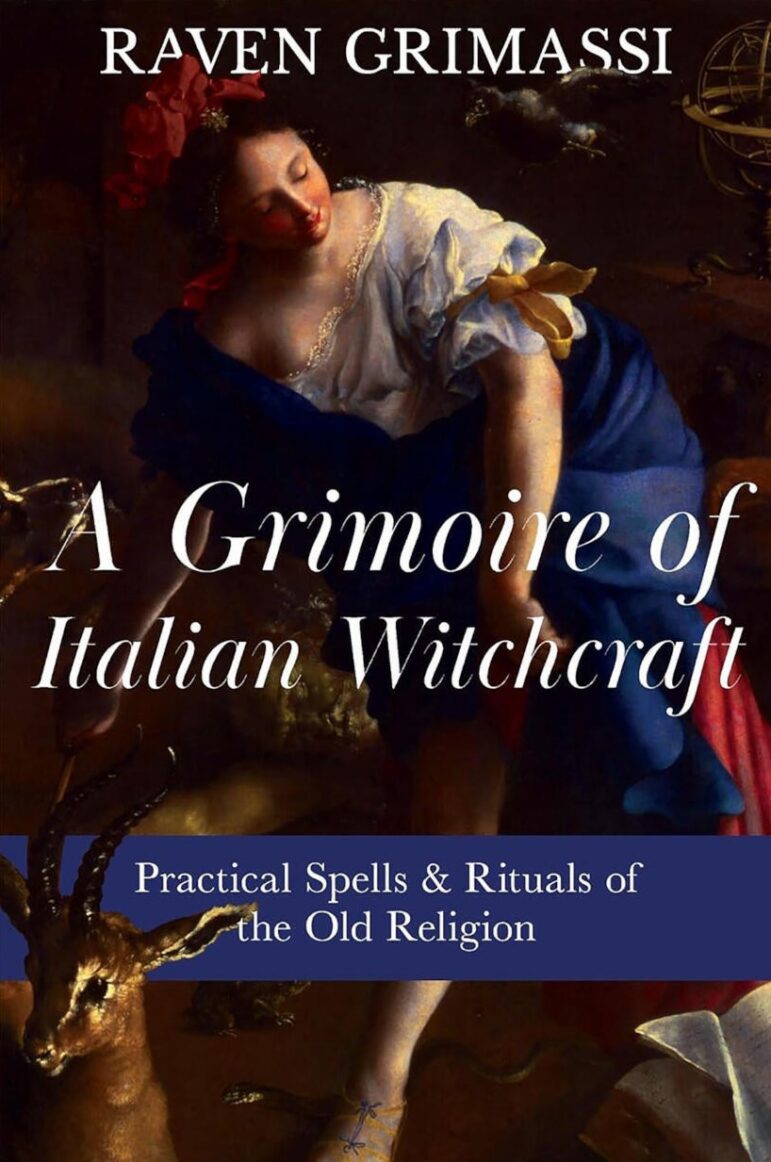
When Raven Grimassi passed away in 2019, I thought that his wisdom and knowledge passed away with him. Luckily, his wife, Stephanie Taylor, has been working with Crossed Crow Books to ensure that is not the case, publishing several previously unseen volumes. Among Grimassi’s posthumous releases is an entirely new work entitled A Grimoire of Italian Witchcraft: Practical Spells & Rituals of the Old Religion.
- Print Length: 252 pages
- Publisher: Crossed Crow Books
- Publication Date: February 10, 2026
- Genres: Non-Fiction, Witchcraft, Stregheria, Stregoneria, Folklore, Spellcasting, History
- Rating: 4/5 stars
Study the customs and traditions of Italian Witchcraft with a full Book of Shadows.
A Grimoire of Italian Witchcraft: Practical Spells & Rituals of the Old Religion is a vital tome for anyone seeking the ancient path of the Strega. Raven Grimassi created a complete Book of Shadows for witches dedicated to the Italian path, including incantations, practical spells, and more. Explore everything from witchcraft for the monthly full moon to magic dedicated to festivals, utilizing secret secret symbols and everyday ingredients.
Grimassi’s classic insights on Italian Witchcraft center practical applications for the reader, derived from traditions and history sure to inspire practitioners at any stage. This book also functions as a course, full of spells, rites, and reflective questions to bolster your learning. A Grimoire of Italian Witchcraft is a brilliant exploration of both practice and the religion, history, and tradition that underlies Italian Witchcraft both in the past and today.
For readers new to Grimassi’s writings, there’s a lot here to chew on, but there’s still good stuff for experienced practitioners, too. While this not 100% new material, this work provides a deeper “why” of much of what he’s published before.
For example, one whole chapter discusses the signs and symbols used in his tradition of Italian Witchcraft, describing why the symbols are crafted the way they are. This deeper description of these symbols will help a Witch better utilize these symbols in their own workings.
Another example is the “Making Contact” chapter, where Grimassi delves into the Grigori, the Watcher spirits of Italian Witchcraft, who guard the Watchtowers of a circle. In this chapter, he provides meditations to meet with the Grigori and to gain a deeper relationship with them than has previously been provided in other books.
The whys of the tradition accumulate through the book, and I definitely appreciated this deeper dive into aspects of his flavor of Stregheria than I’d previously been exposed to. The whys serve to connect the dots, so to speak, and those chapters feel like you’re sitting down with him, finally able to ask all the questions you’ve had about his tradition.
I know that I keep using the word “deeper,” but that’s what this book feels like – a deeper dive into the pool that is Grimassi’s works on his style of Italian Witchcraft. This isn’t a “get your toes wet” sort of book. It’s more about holding your nose and plunge into the cool, dark waters of the lake of knowledge.
The sections on folk magic, and the overlaying of Christianity to The Old Ways, were interesting. Some of the folk techniques I had heard of – for example, the various ways that a lemon is used in Italian folk magic. But other workings were ones that were new to me, and I appreciated that they were included in his book.
There’s even a chapter dedicated to rituals, from Full Moons to one for each treguenda (the word Grimassi uses for Italian Sabbats). This allows the reader to start to put more of the work into practice by accumulating the necessary tools and starting their devotional works right away.
Along the way, each chapter is peppered with numerous resources and quotes supporting his hypothesis and theories about the longevity of the tradition of Witchcraft in Italy, at one point tracing it’s history back to 30 B.C.E. Readers who have previously read any work by Grimassi know he draws on various sources to back up any claims he makes, and the variety of sources is wide and mostly accessible to an English-speaking audience.
This is less of a cohesive book than some of his others; it feels like this was put together from various workshops and teachings that Grimassi had previously written or given. The overarching theme is, obviously, the legitimacy of his style of Italian Witchcraft, but the chapters don’t always feel like one flows into the next. There were several points where concepts were introduced, but then not explained until much further into the texts. I felt like another pass by the editor could have closed some of those loops and produced an easier to read tome.
That said, this book is a wonderful resource to anyone who is already practicing using texts that have previously been published, such as Hereditary Witchcraft, which is enjoying its 25th anniversary of publication.
The Wild Hunt is not responsible for links to external content.
To join a conversation on this post:
Visit our The Wild Hunt subreddit! Point your favorite browser to https://www.reddit.com/r/The_Wild_Hunt_News/, then click “JOIN”. Make sure to click the bell, too, to be notified of new articles posted to our subreddit.