
When I die, I don’t want to rest in peace
I want to dance in joy
I want to dance in the graveyards
–Delta Rae, “Dance in the Graveyards”
MIAMI – Cemeteries are having a moment. Of course, none of this is particularly surprising to those of us who have been happily wandering among the dead for years.
Two recent articles suggest that the living are rediscovering the pleasures of visiting the resting places of their ancestors, famous strangers, and occasionally people whose epitaphs raise more questions than they answer.
In The Art of Manliness, an article titled “Why You Should Spend More Time in Graveyards” encourages readers to reconsider cemeteries as places of historical discovery, artistic appreciation, and reflection on mortality rather than locations associated primarily with fear or mourning.
Gravestones, the authors observe, reveal intimate details of earlier generations: family tragedies, changing life expectancies, religious beliefs, and the ways communities have remembered their dead. Cemeteries offer opportunities to encounter history directly, without the glass cases and carefully arranged exhibits of conventional museums.
Meanwhile, Euronews reports that European cemeteries are becoming increasingly popular tourist destinations. Its article, “Graveyard tourism: Why Europe’s cemeteries are on the must-visit list for Halloween,” explores burial grounds celebrated for their architecture, cultural significance, and famous residents.
From Paris’s Père Lachaise to London’s Highgate Cemetery, these historic landscapes attract visitors interested in far more than ghost stories. They are outdoor museums, architectural treasures, and repositories of collective memory.
Both articles make an important point: cemeteries deserve appreciation throughout the year, not merely during Halloween.
For many Pagans, that observation carries additional significance. As Samhain approaches, thoughts turn toward ancestors, remembrance, mortality, and the continuing presence of the dead in our lives. Cemeteries can offer places for contemplation, connection, and gratitude, whether or not the people buried there are our own ancestors.
They also invite us to consider memento mori, the reminder that death is inevitable and that contemplating mortality can encourage a fuller appreciation of life.
Of course, some of us need little encouragement to visit a cemetery, and naturally, we have our own list, not all closer to home, but emphasizing memento mori, the reminder that death is inevitable and that contemplating mortality can encourage a fuller appreciation of life.
So, fellow taphophiles, pack your walking shoes, bring a camera, and perhaps leave a little room in the itinerary for the unexpected that might include a flotation device.
Honorable Mentions
No cemetery tour is complete without a few detours. Two additional burial grounds deserve special recognition, one for its literary residents and feline escorts, and the other for reminding visitors that even in death, a sense of humor can survive.
Cimitero Acattolico, the Protestant Cemetery of Rome.

The Weeping Angel at the Protestant Cemetery in Rome. [Photo Credit: M. Tejeda-Moreno]
Rome has no scarcity of active necropoles. The Eternal City has been collecting its residents for almost three millennia and the area far longer as one of the oldest continuously occupied sites in Europe.
As a garden, the cemetery is a respite from the bustle of Rome. Tucked away behind the Pyramid of Cestius and incorporated into the Aurelian Walls of the Testaccio district, it is covered in stunningly adorned burial sites and surrounded by Mediterranean cypresses and pomegranates. It is the final resting place of English poets John Keats and Percy Bysshe Shelley, two of its famous literary residents, but others include American abolitionist, women’s suffrage advocate, and agent of the American Anti-Slavery Society, Dr. Sarah Parker Remond.
Your escorts in this cemetery are cats that have made the cemetery home. They have become so accustomed to visitors that they accompany you on your tour of the grounds.
The Key West Cemetery, Key West, Florida
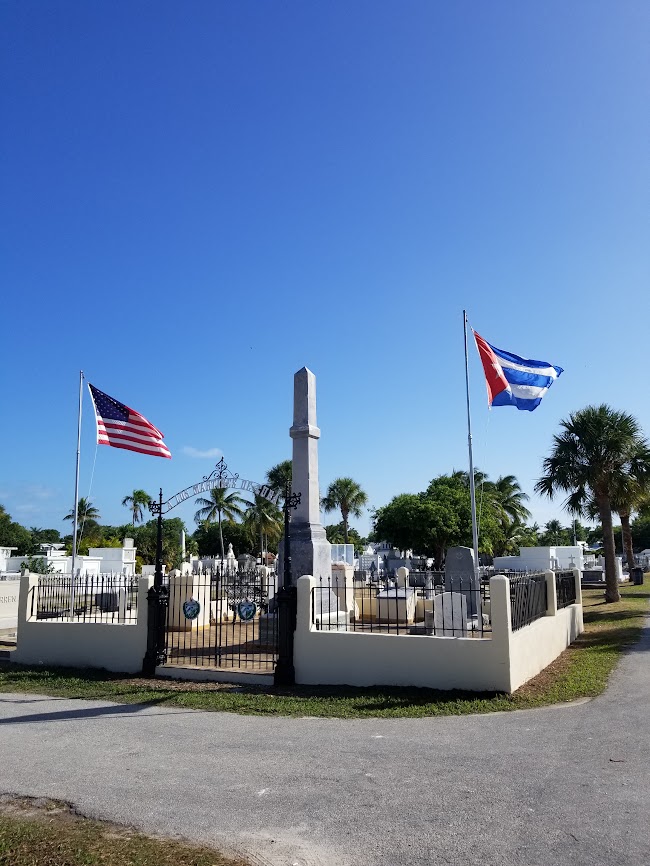
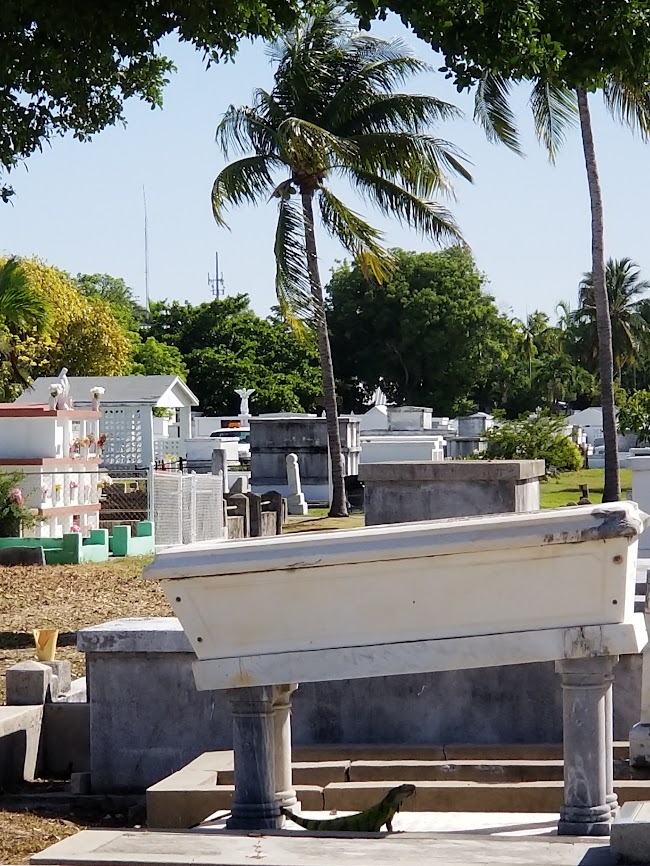
Spanning 19 acres at the foot of Solares Hill in Old Town, the Key West Cemetery is the final resting place for an estimated 70,000 to 100,000 souls, far exceeding the island’s living population. Founded in 1847 after the Great Havana Hurricane of 1846 washed away the original seaside graveyard, it features whitewashed, above-ground vaults built to overcome the island’s shallow coral water table.
The grounds reflect Key West’s layered history, preserving dedicated monuments to the sailors lost in the 1898 USS Maine explosion, soldiers of the Civil War, and martyrs of the 1868 Cuban Revolution.
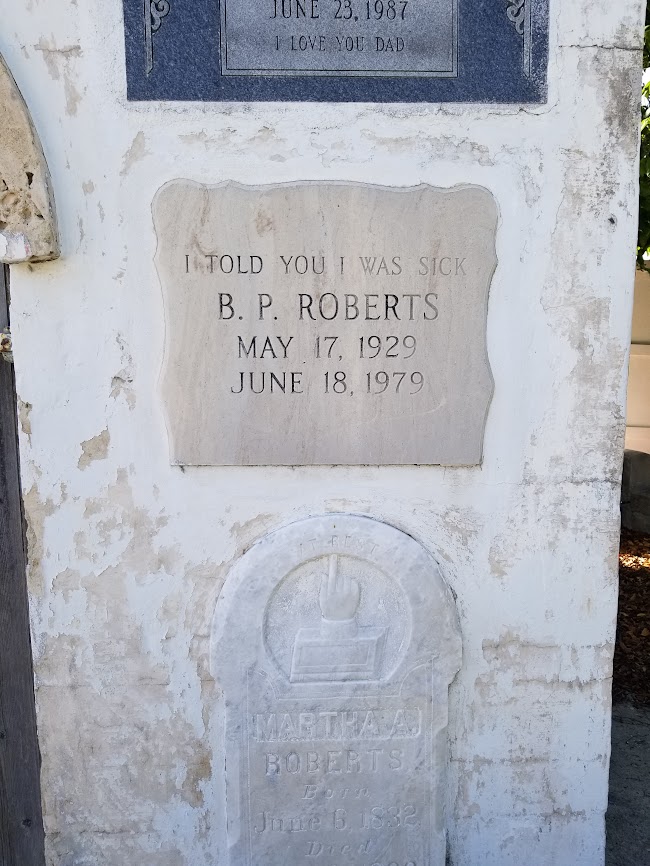
Beyond military history, the cemetery is renowned for local folklore and cheeky Conch wit, immortalized by epitaphs like B.P. “Pearl” Roberts’ iconic “I Told You I Was Sick” and Gloria Russell’s “I’m just resting my eyes”. Darker legends linger here as well, notably the macabre saga of Carl Tanzler, who stole the body of Elena Milagro de Hoyos from her family mausoleum in 1933.
Notable burials include William Curry, Florida’s first self-made millionaire; “Sloppy” Joe Russell, Ernest Hemingway’s fishing guide and bar owner; and 40-inch circus performer “General” Abe Sawyer, who requested a full-size tomb.
5. Green-Wood, Brooklyn, New York

Gothic Revival Entrance to Green-Wood Cemetery [Photo Credit: S. Ciotti]
A nearly 500-acre memorial park in the heart of Brooklyn, Green-Wood Cemetery is both a National Historic Landmark and one of New York City’s most remarkable landscapes. Established in 1838, the cemetery combines elaborate 19th- and 20th-century funerary sculpture, imposing mausoleums, rolling hills, glacial ponds, and winding, secluded pathways. It is a paradise where the interests of taphophiles, gardeners, birdwatchers, historians, and architecture enthusiasts happily intersect. During the 19th century, Green-Wood became such a celebrated destination that it reportedly ranked second only to Niagara Falls among New York State’s tourist attractions.
Visitors enter through magnificent Gothic Revival gates designed by Richard M. Upjohn, a prominent architect and founding member of the American Institute of Architects. Beyond the entrance lies an extraordinary landscape containing approximately 600,000 burials and a living collection of some 7,000 trees, making Green-Wood as much an urban arboretum and wildlife refuge as a cemetery.
Among its notable residents are Henry Bergh, founder of the American Society for the Prevention of Cruelty to Animals (ASPCA), and Henry Jarvis Raymond, co-founder of The New York Times. Their memorials are among countless monuments commemorating individuals whose lives helped shape New York and the nation.
Green-Wood also remains an active cemetery, offering cremation services and housing an impressive columbarium. With its combination of architectural grandeur, natural beauty, and historical significance, it offers visitors an extraordinary opportunity to wander among the dead while appreciating the remarkable abundance of life surrounding them.
4. St. Louis Cemetery, New Orleans

St. Louis Cemetery No. 1 [Photo Credit: Vrlobo888/ Public Domain]
Any list of American cemeteries worthy of a road trip that omits the St. Louis Cemeteries of New Orleans invites serious questions about its credibility. Located in one of America’s most enchanting—and undeniably magical—cities, these historic burial grounds are among the nation’s most distinctive funerary landscapes.
The St. Louis Cemeteries comprise three separate Roman Catholic burial grounds. Cemeteries No. 1 and No. 2 are listed on the National Register of Historic Places and are recognized along the Louisiana African American Heritage Trail. Cemetery No. 3, the largest of the three, lies farther inland near City Park. The oldest, St. Louis Cemetery No. 1, was established in 1789, with the others following as the city expanded.
Unlike the sprawling lawns and conventional headstones characteristic of many North American cemeteries, the St. Louis Cemeteries feature elaborate above-ground tombs and family vaults, reflecting funerary traditions found throughout Europe and the Caribbean. Particularly in Cemeteries No. 1 and No. 2, narrow passageways wind between weathered monuments, creating an extraordinary labyrinth of stone, sculpture, and memory. These are not simply historical attractions, however, but sacred spaces where families continue to honor and inter their dead.
St. Louis Cemetery No. 1 is perhaps best known as the reputed resting place of Marie Laveau, the legendary 19th-century Voodoo priestess whose spiritual influence remains deeply embedded in New Orleans culture. Cemetery No. 2 holds the remains of notable musicians, civic leaders, and other figures whose lives shaped Louisiana’s complex history.
2. Neptune Memorial Reef, Miami

Neptune Memorial Reef [Photo Credit: Todd Murray CC BY-SA 2.0]
Some cemeteries invite visitors to wander beneath ancient trees. Others offer elaborate mausoleums, Gothic monuments, or quiet gardens. Miami’s Neptune Memorial Reef, however, requires a boat, a mask, and preferably scuba equipment; not to mention swimming skills.
Located approximately four miles off the coast of Key Biscayne, at a depth of about 40 feet, Neptune Memorial Reef is an extraordinary underwater memorial garden and artificial reef. Conceived as a submerged city inspired by the legendary Atlantis, the site combines funerary architecture, marine conservation, and an unconventional approach to honoring the dead.
The reef encompasses a planned 16-acre site, with underwater pathways, columns, arches, statuary, and memorial structures designed to accommodate cremated remains. These remains are incorporated into specially formulated concrete memorials, creating permanent resting places that also provide habitat for marine life. The project ultimately envisions space for approximately 125,000 individuals.
Unlike conventional columbaria, Neptune’s memorials become part of a living marine ecosystem. Fish and other sea creatures inhabit its structures, while corals and additional marine organisms gradually colonize the artificial surfaces. The result is a remarkable intersection of remembrance and ecological restoration, where memorials to the dead help sustain life beneath the waves.
The reef is accessible to recreational divers and boaters, although scuba equipment offers the best opportunity to explore its submerged architecture. Fishing and the collection of marine life are prohibited within the protected site.
Among the most frequently mentioned names associated with the reef is legendary chef Julia Child, although her ashes were reportedly scattered at sea rather than incorporated into one of its memorial structures. However, the reef’s operator has explicitly disputed claims that her remains are there.
2. Santa María Magdalena de Pazzis Cemetery, Old San Juan, Puerto Rico.
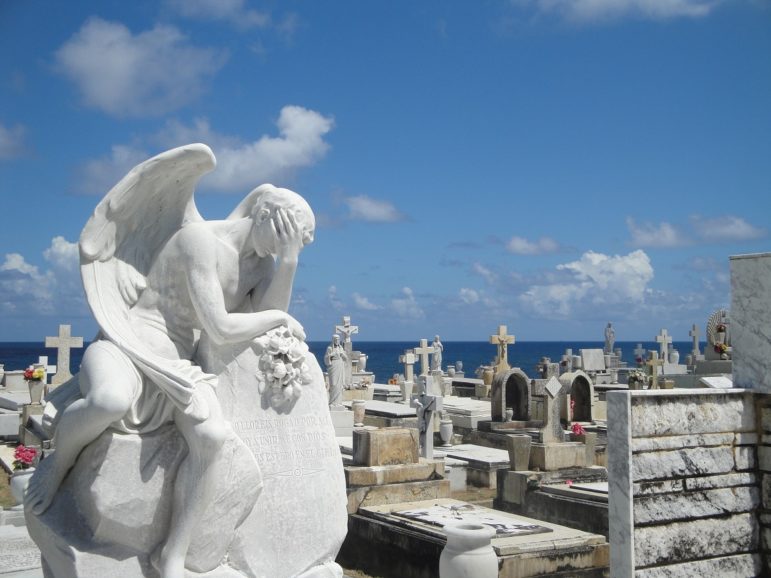
Santa María Magdalena de Pazzis Cemetery [Photo Credit: S. Ciotti
Admittedly, you cannot drive to this cemetery from the North American mainland. But it is only a short flight away, requires no passport for U.S. citizens traveling from the mainland, and certainly qualifies as a road trip once you arrive on the island.
Santa María Magdalena de Pazzis offers an unforgettable encounter with the intersection of colonial history, Catholic funerary traditions, ancestral remembrance, and the natural beauty of the Caribbean. Few cemeteries offer such a spectacular reminder that the resting places of the dead can also be among the most beautiful landscapes enjoyed by the living.
Perched dramatically above the Atlantic Ocean, the Santa María Magdalena de Pazzis Cemetery is among the most breathtaking burial grounds in the Caribbean. Located just outside the historic walls of Old San Juan, beneath the imposing Castillo San Felipe del Morro, the cemetery occupies a narrow stretch of land between the centuries-old fortifications and the sea. Its location is traditionally associated with the symbolism of the ocean as a passage between the world of the living and the realm of the dead.
Visitors exploring El Morro and the surrounding historic district can easily overlook the cemetery, which lies below the broad, grassy slopes leading to the fortress. Access is through a small side street and tunnel that opens onto a remarkable landscape of white marble monuments, elaborate statuary, family mausoleums, and memorials overlooking the Atlantic.
Established in 1863 and named for the Carmelite saint Mary Magdalene de’ Pazzi, the cemetery is both inspiring and profoundly peaceful. Trade winds carry the salt air and ocean mist across the graves, while waves break against the rocks below the cemetery walls. The brilliant Caribbean sunlight illuminates the monuments, creating an extraordinary contrast between the white stone, green lawns, and seemingly endless blue ocean.
The cemetery remains an active burial ground, with carefully maintained graves adorned with flowers and offerings left in remembrance of loved ones. Its monuments commemorate generations of Puerto Ricans, including prominent figures in the island’s political, artistic, literary, and cultural history.
1. Bonaventure, Savannah, GA

Bonaventure Cemetery [Photo Credit: Slowking4/ CC BY-SA 3.0]
Bonaventure is an essential pilgrimage: a place where art, history, nature, and the memory of the dead converge beneath a cathedral of living oaks.
Overlooking the Wilmington River just east of Savannah’s historic center, Bonaventure Cemetery is among the most atmospheric burial grounds in the American South. Already celebrated for its natural beauty and elaborate funerary monuments, the cemetery gained international attention following the publication of John Berendt’s 1994 novel Midnight in the Garden of Good and Evil and its subsequent film adaptation.
Originally part of an 18th-century plantation, the property became a public cemetery in 1868 and was acquired by the City of Savannah in 1907. Its landscape is an extraordinary combination of Victorian funerary art, winding pathways, and magnificent live oaks draped in Spanish moss. Few places capture the aesthetic of Southern Gothic quite so completely.
Among Bonaventure’s most notable visitors was naturalist John Muir, often called the “Father of the National Parks,” who camped in the cemetery during his 1867 journey south. His experiences inspired passages in A Thousand-Mile Walk to the Gulf, including a chapter titled “Camping Among the Tombs.” Muir was particularly captivated by the cemetery’s towering oaks and the luxuriant vegetation growing among their branches.
He described the trees as magnificent natural gardens, their spreading limbs forming a leafy canopy over the pathways. Of the Spanish moss, he wrote that its long, silvery-gray strands, moving gently in the wind, produced “a solemn funereal effect singularly impressive.”
More than a century and a half later, Bonaventure retains much of the beauty that captivated Muir. Ancient oaks still shelter weathered monuments, marble angels, and elaborate family memorials, while curtains of Spanish moss sway above the graves. The interplay of sunlight, shadow, sculpture, and vegetation creates an atmosphere that seems almost deliberately designed for contemplation—and perhaps the occasional ghost story.
One famous resident of the cemetery is no longer there. Bird Girl, the bronze sculpture by Sylvia Shaw Judson that appeared on the cover of Midnight in the Garden of Good and Evil, was relocated to Savannah’s Telfair Museums, where it is preserved and displayed.
Cemeteries are not merely repositories of the dead. They are gardens, historical archives, wildlife sanctuaries, architectural treasures, and places where memory remains part of the living world. Some invite quiet contemplation; others offer breathtaking landscapes, unexpected humor, or encounters with the extraordinary.
As Samhain approaches, perhaps the growing interest in cemetery tourism offers an opportunity to reconsider our relationship with these spaces. Whether we visit to honor ancestors, explore history, admire funerary art, or simply enjoy a peaceful afternoon, we enter places shaped by generations of lives and the people who remember them.
And perhaps that is the real pleasure of taphophilia. We visit the dead, but invariably discover something about the living.
After all, as Delta Rae reminds us, there is joy to be found in the graveyards.
The Wild Hunt is not responsible for links to external content.
To join a conversation on this post:
Visit our The Wild Hunt subreddit! Point your favorite browser to https://www.reddit.com/r/The_Wild_Hunt_News/, then click “JOIN”. Make sure to click the bell, too, to be notified of new articles posted to our subreddit.