

Uncovering the Past
ALEXANDRIA, Egypt — Nearly two millennia after the Lighthouse of Alexandria guided ships across the Mediterranean, archaeologists have discovered a bronze seal ring bearing an image of the legendary structure beneath the waters of the city’s Eastern Harbor. The unusual artifact, recovered from the submerged remains of Alexandria’s ancient royal quarter, may offer new clues about the administration of one of the Seven Wonders of the Ancient World.
The discovery was announced by Egypt’s Ministry of Tourism and Antiquities following underwater excavations conducted by a joint archaeological mission involving the European Institute of Underwater Archaeology (IEASM) and Egypt’s Supreme Council of Antiquities.
The bronze ring was recovered from Antirhodos, an island that once formed part of Alexandria’s royal district within the ancient harbor known as Portus Magnus. Its engraved image depicts the Pharos lighthouse in a form resembling representations found on Roman coins dating to the second century CE.
According to Hisham El Leithy, secretary-general of the Supreme Council of Antiquities, this is the first known discovery of a seal ring bearing an image of the celebrated lighthouse.
The artifact may also provide evidence of the continued use of the royal palace on Antirhodos long after the end of the Ptolemaic dynasty.
The Greek geographer and historian Strabo described the palace during his visit to Egypt between 29 and 25 BCE, shortly after Egypt became a Roman province. The newly discovered ring raises the possibility that the palace continued to serve administrative functions into the second century CE, potentially including responsibilities associated with the lighthouse.
Egyptian authorities emphasized that this interpretation remains a possibility rather than an established conclusion.
The Lighthouse of Alexandria, also known as the Pharos, was among the most celebrated engineering achievements of antiquity. Commissioned during the reign of Ptolemy I Soter and completed under his successor, Ptolemy II Philadelphus, around 280 BCE, the lighthouse stood on the island of Pharos at the entrance to Alexandria’s harbor. Its construction is traditionally associated with the Greek architect Sostratus of Knidos.
Estimated to have stood between 330–430 feet (100 and 130 meters) tall, the structure was one of the tallest buildings of the ancient world.
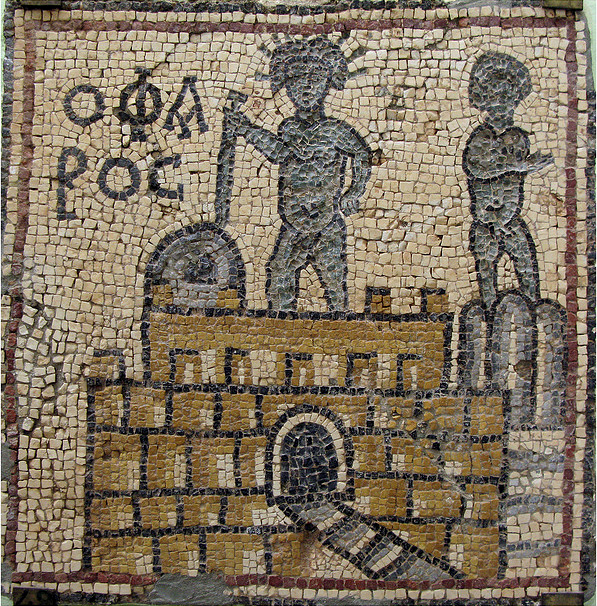
A mosaic depicting the Pharos of Alexandria (labelled “Ο ΦΑΡΟϹ”), from Olbia, Libya, c. 4th century AD – Qasr Libya Museum Public Domain
Ancient descriptions and surviving representations suggest a three-part design consisting of a square lower section, an octagonal middle tower, and a cylindrical upper structure. A monumental statue, possibly representing Zeus, Poseidon, or another protective deity, may have crowned the building.
The lighthouse served both practical and symbolic purposes. Its beacon helped mariners navigate the busy harbor of Alexandria, one of the Mediterranean’s most important commercial and intellectual centers. At the same time, its extraordinary height and architectural sophistication proclaimed the wealth and power of the Ptolemaic kingdom.
Accounts describe a fire burning at its summit, while later traditions attribute the use of a reflective mirror to amplify its visibility. Some details of its operation remain uncertain.
The monument’s influence extended well beyond Egypt. Its name survives in words for lighthouse across several European languages, including faro in Spanish and Italian and phare in French.
A succession of earthquakes damaged the structure over several centuries, eventually leaving it in ruins. During the fifteenth century, Sultan Qaitbay constructed a fortress on the site, incorporating stone from the ancient monument.

The ring with an engraved image of the Alexandria Lighthouse. Image via Facebook – Credit: C. Gerigk / F. Goddio / Hilti Foundation
The ring is only one of several discoveries made during the current underwater excavation season.
According to Franck Goddio, director of IEASM and head of the archaeological mission, researchers are investigating four locations within Alexandria’s Eastern Harbor: the Temple of Isis, the palace and western hill of Antirhodos, an area containing monumental architectural remains, and the Timonium, traditionally associated with Mark Antony.
The inclusion of the Temple of Isis is particularly significant. Alexandria was an important center for the worship of the Egyptian goddess, whose cult expanded throughout the Mediterranean during the Hellenistic and Roman periods.
Isis is associated with protection, healing, kingship, and, increasingly in ancient times, the safeguarding of sailors and maritime travel. Her worship became closely tied to Alexandria’s religious identity, reflecting the city’s blend of Egyptian and Greek religious traditions.
The submerged remains offer researchers an opportunity to investigate how religious, political, and commercial activities intersected within the ancient harbor.
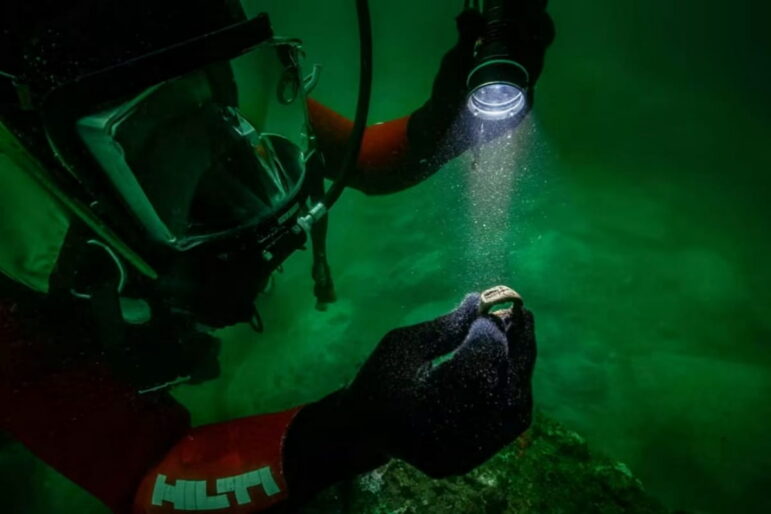
The underwater discovery of the ring. via Facebook – Image Credit: C. Gerigk / F. Goddio / Hilti Foundation
Other discoveries include pottery spanning approximately eight centuries, from the fourth century BCE through the fourth century CE.
The recovered objects include everyday utensils, tableware, amphorae used to transport and store goods, bottles, vessels, and oil lamps. Archaeologists also identified fragments of ancient glassware.
Together, these materials provide evidence of daily life, trade, and changing patterns of occupation in Alexandria across the Ptolemaic and Roman periods.
Egyptian Minister of Tourism and Antiquities Sherif Fathy recently visited the excavation sites to review the mission’s progress. He praised the specialized expertise required to locate, recover, record, and preserve archaeological remains beneath the Mediterranean.
Fathy emphasized that the discoveries contribute to a more complete understanding of Alexandria’s history and the civilizations that shaped it.
Following the completion of the current season in the Eastern Harbor, the archaeological mission plans to continue its underwater investigations in Abu Qir Bay, another area rich in submerged remains.
For archaeologists, the bronze ring offers a particularly intriguing connection between the legendary lighthouse and the people who lived and worked within sight of it.
Although the Pharos itself was destroyed by centuries of earthquakes, with portions of its remains submerged and others incorporated into later fortifications, its image survived on a small object that may once have carried an official seal.
The discovery raises the possibility that the lighthouse was not merely an architectural wonder but also part of an administrative system whose workings are only beginning to emerge from Alexandria’s submerged past.
The Wild Hunt is not responsible for links to external content.
To join a conversation on this post:
Visit our The Wild Hunt subreddit! Point your favorite browser to https://www.reddit.com/r/The_Wild_Hunt_News/, then click “JOIN”. Make sure to click the bell, too, to be notified of new articles posted to our subreddit.