
TWH — The Wild Hunt has previously explored what psychologists have been learning about ritual and sacred experience. Earlier research has suggested that rituals can reduce anxiety, provide structure during times of uncertainty, and that profound experiences of awe or the sacred can have lasting psychological benefits. A study published late last year in Frontiers in Psychology adds another dimension, suggesting that communal rituals may also strengthen social bonds, evoke awe, and even expand people’s sense of connection to humanity itself.
Ritual is not unique to religion. From athletes who repeat the same pregame routines before every competition to families who gather around holiday traditions year after year, ritual provides structure, continuity, and meaning. While there is little evidence that a particular ritual improves athletic performance, psychologists have long recognized that ritual behavior can reduce anxiety, focus attention, reinforce identity, and create a sense of belonging. On a cultural level, rituals help communities mark transitions, remember the past, transmit values across generations, and reaffirm who they are.
As Circle Sanctuary’s Rev. Selena Fox has written, “Through rituals, Pagans deepen their relationship with the Divine in one or more sacred forms. Through rituals, Pagan culture flourishes and evolves.” Like prayer or meditation, ritual creates space for reflection while connecting participants to something larger than themselves.
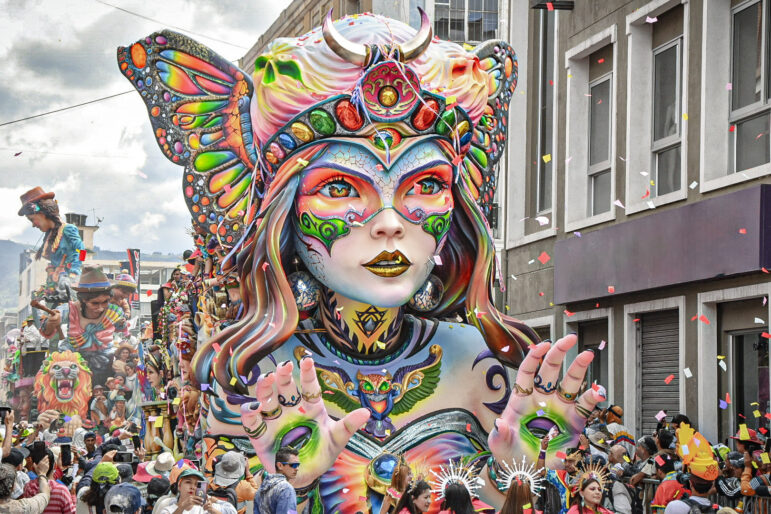
Carroza participante del Carnaval de Negros y Blancos 2024 (Pasto, Nariño, Colombia) – Float participating in the 2024 Blacks and Whites’ Carnival . Photo Credit: Jhonsca CCA-SA 4.0
The new study explores that idea through the Carnaval de Negros y Blancos in Pasto, Colombia, a centuries-old celebration recognized by UNESCO as an Intangible Cultural Heritage of Humanity. Blending Indigenous, African, and European traditions, the annual carnival fills the city with parades, music, dancing, elaborate costumes, and communal celebration. Rather than simply asking whether people enjoyed the festival, researchers wanted to understand what happens psychologically when thousands of people participate in a shared ritual experience.
Their work draws on the ideas of French sociologist Émile Durkheim, who argued more than a century ago that communal rituals generate what he called “collective effervescence,” a heightened emotional state in which people feel carried beyond themselves and into a shared emotional experience. Although Durkheim developed his theory while studying religion broadly, the concept of collective effervescence has since become one of the foundational ideas in the sociology and anthropology of ritual. According to Durkheim, this shared emotional energy is one of the forces that creates and sustains communities.

The Greek capital letter psi is often used to represent the word, or study of, Psychology.
More than a century later, the researchers found evidence supporting that theory.
Participants who reported stronger experiences of collective effervescence also reported stronger identification with their local community and with Colombia as a nation. Perhaps more surprisingly, they also expressed a greater sense of connection to humanity as a whole.
Among the study’s findings, one emotion stood out: awe.
Participants who felt the strongest shared emotional energy during the carnival were also more likely to experience awe, the feeling that arises when encountering something so vast or meaningful that it changes one’s perspective. Those moments of awe were associated with stronger community identity and a greater willingness to help others.
In other words, it was not simply attending the festival that mattered. The greatest psychological benefits came from feeling emotionally synchronized with other participants—singing together, dancing together, celebrating together, and sharing a common emotional experience.
The findings also challenge the assumption that communal rituals necessarily encourage an “us versus them” mentality. Although participants felt more connected to their local community, they also reported a stronger identification with humanity as a whole. Rather than narrowing their sense of belonging, the shared ritual experience appeared to broaden it.
The researchers caution that the study cannot establish cause and effect. It remains possible that people who already feel more socially connected are also more likely to experience collective effervescence during festivals. Even so, the findings provide empirical support for a theory that has shaped the sociology of religion for more than a century.
The findings build on earlier psychological research covered by The Wild Hunt, which has reported that rituals can help people manage anxiety and that experiences of awe and the sacred can produce lasting psychological benefits. Taken together, these studies suggest that ritual’s influence extends beyond the individual. Whether performed in a solitary circle, a coven, a festival field, or a city-wide celebration, ritual appears capable of shaping not only how people understand themselves, but also how they relate to one another.
For many Pagans, the conclusions may feel less like a revelation than a confirmation. Seasonal festivals, Pagan Pride celebrations, public rituals, and gatherings around the Wheel of the Year have long been understood as opportunities not only to honor the sacred but also to strengthen community. While this study examined a Colombian cultural festival rather than a Pagan gathering, it lends empirical support to something many practitioners have long described from experience: ritual’s transformative power lies not only in its symbols and ceremonies, but also in the profound human experience of sharing them together.
The Wild Hunt is not responsible for links to external content.
To join a conversation on this post:
Visit our The Wild Hunt subreddit! Point your favorite browser to https://www.reddit.com/r/The_Wild_Hunt_News/, then click “JOIN”. Make sure to click the bell, too, to be notified of new articles posted to our subreddit.