

News from the U.S. Supreme Court is full of horrors, but expected ones.
In recent weeks, the august institution has decided that sports are a suitable excuse to begin depriving not only transgender people, but ultimately all women and girls, of their right to bodily autonomy; that one of the last remaining barriers to unlimited money entering politics will come down; and that a president may fire the head of any independent agency at will, unless that agency happens to be the Federal Reserve, because that would be bad for the justices’ money.
Even the bright spots are checkered: yes, the court thankfully upheld the plain text of the 14th amendment and declared that the president cannot unilaterally overturn birthright citizenship. But that decision, despite a century of precedent, the clear intentions of the congressional record, and, I repeat, the plain text of the amendment, was decided five to four. (Kavanaugh concurred on the finding, but not the constitutional question; as far as he’s concerned, Congress could overturn birthright citizenship tomorrow.) It’s about as bad as it could have been short of actually revoking the citizenship rights of millions of Americans.
But, as I said, these horrors are only to be expected under the Roberts Court. It’s news about the next term that has me surprised.
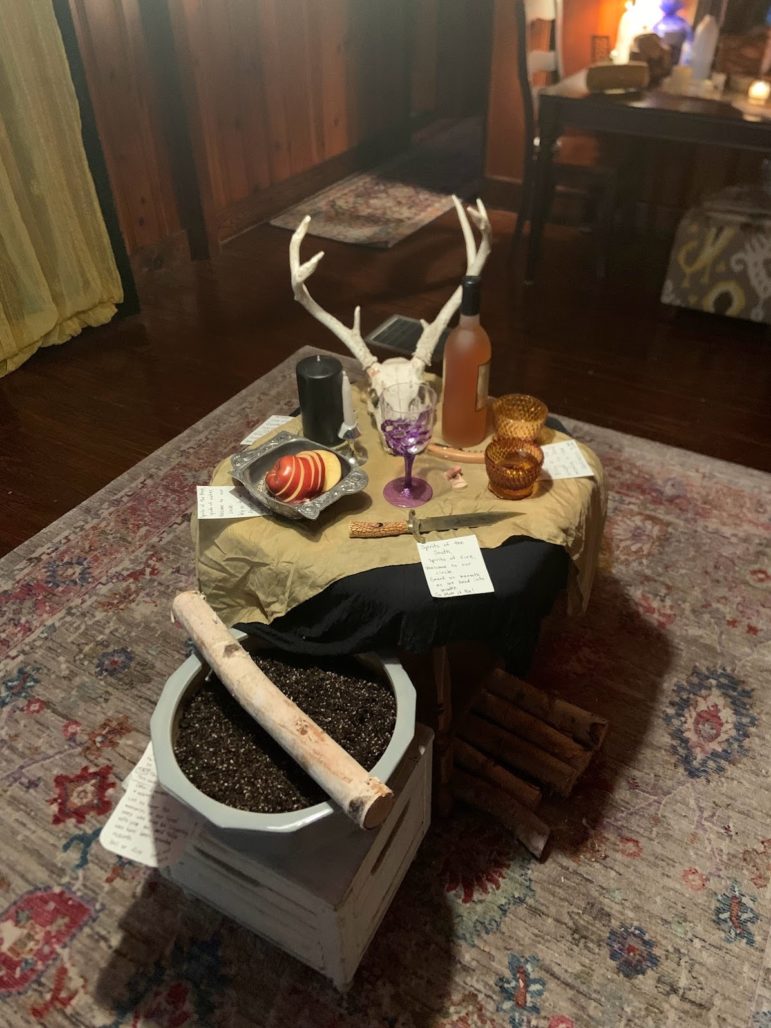
Sabbatsmeet Samhain altar, 2022 [E. Scott]
As we reported on Monday, the Supreme Court has decided to hear Grand v. City of University Heights, Ohio, a case involving an Orthodox Jewish plaintiff who sought to hold a regular minyan, a group of at least 10 Jewish men required for certain prayer services in their religion. The city sent him a cease and desist, arguing that the group meeting in his house would constitute a “shul or synagogue” and would violate the city’s zoning ordinances. The plaintiff alleges that the city not only denied his ability to hold the minyan in his home, but went on to harass him and even suggested his neighbors spy on him.
The plaintiff applied for a special use permit to hold his minyan, but withdrew the case before a final decision and instead filed suit in federal court under the First and 14th Amendments, Ohio state law, and the Religious Land Use and Institutionalized Persons Act (RLUIPA). Up to this point, courts have denied the claims by stating that the case was “unripe” due to the plaintiff never receiving a final decision on his special use permit – the idea being that the government has never decided one way or another whether he is allowed a permit to hold the minyan and therefore there’s nothing to challenge yet in court.
Now the case will be heard at the Supreme Court.
As we said on Monday: “The legal question before the Court is narrower than whether municipalities may regulate religious land use. Local governments retain authority to enforce neutral health and safety regulations involving occupancy limits, parking, traffic, fire codes, noise, and nuisance… In practical terms, the case asks where the line exists between ordinary religious gatherings in a home and a “house of worship” subject to zoning approval.”
This case is naturally of interest to me because my family’s Wiccan coven has been meeting in our various living rooms for almost half a century now. Much of my childhood memories are structured around observances of the Full Moon esbat in my parents’ home, standing in a candlelit circle with our coven mates, holding hands with the other Witch-children and wondering when we would be free to run off and play. And even today, the wheel of my years turns on celebrations at my home and the homes of my fellow Witches. My view of religion has always been cramped and intimate as a result – part of why I am so fascinated by cathedrals and shrines is that there’s something unfamiliar to me about a religion that doesn’t have to be put away before bed.
Writing things out like this, it can’t help but sound like the minyan – a different set of rituals and prayers, but fundamentally the same sort of religious gathering. In my 40 years as a Witch it’s never occurred to me that zoning laws or the RLUIPA could have anything to do with what we were doing.
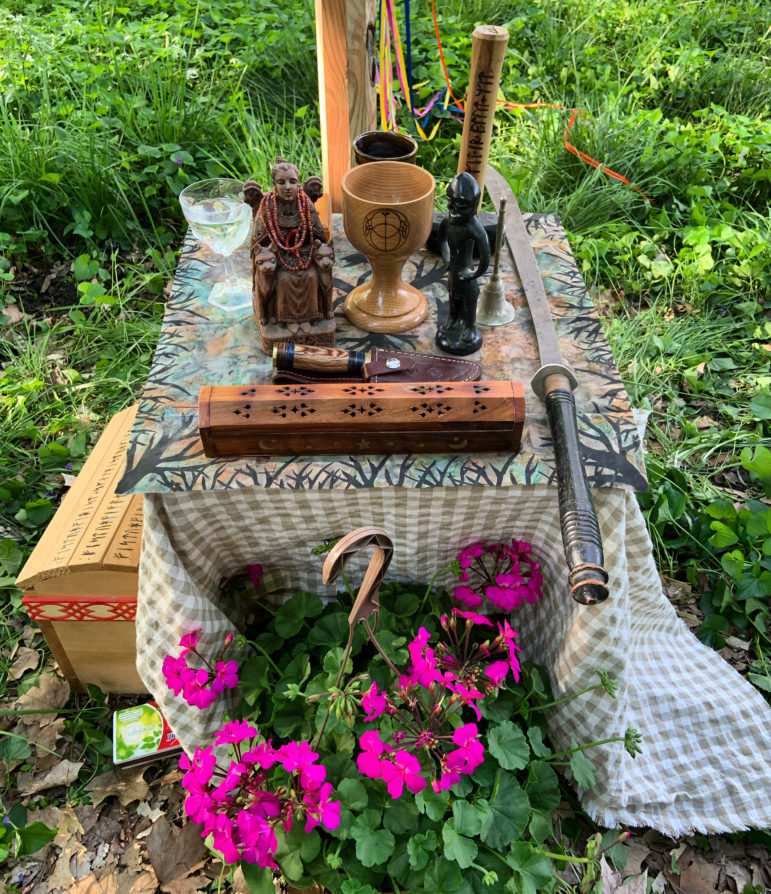
Sabbatsmeet Beltane altar in the author’s backyard [E. Scott]
Naturally, my first impression is sympathy for the plaintiff. It does strike me as unreasonable to expect someone to get a permit to invite a small set of people into their homes for religious purposes, especially since, as the briefs note, such permission isn’t required for secular purposes. The plaintiff could have invited a dozen friends over every week for a book club without getting pestered by a zoning commission, but not for his minyan. That certainly strikes me as off, and something worth rectifying.
On the other hand, I can’t help but feel pause when I see some of the names lined up to support him. His representation comes from the Alliance Defending Freedom, a right-wing advocacy group that has produced politicians no Pagan would consider friends, like Speaker Mike Johnson and former Vice President Mike Pence. The Southern Poverty Law Center considers the ADF an anti-LGBTQ hate group, and the Alliance wrote the Mississippi legislation that directly led to the overturning of Roe vs. Wade.
In the friend of court briefs, we see further strange bedfellows. Alongside the expected Jewish advocacy groups like Agudath Israel and the National Jewish Advocacy Center are briefs from a variety of other conservative-aligned groups, like the American Center for Law and Justice, famous for attempting to block the construction of a mosque near the site of the World Trade Center. Some of the groups supporting the plaintiff are not even obliquely related to religious freedom: the Manhattan Institute, a business-friendly conservative think-tank, doesn’t have any direct ties to religious institutions but still filed a brief because it has “a strong interest in ensuring that courts safeguard the freedoms that enable individuals and organizations to live out their convictions without undue government interference.”
Again, it is hard to say what the outcome of this case would look like, and especially what it could mean for Pagan groups like mine who meet in their homes. But much of the game of court filings is to find sympathetic plaintiffs whose individual circumstances can be grist for the mill of overturning generally positive precedents. (I think here of Loper Bright from 2024, in which the court used a relatable grievance of fish catchers not wanting to pay for a regulator to overturn the fundamental workings of federal agencies, a result drastically out of step with the stakes of the individual case.) I don’t think the Manhattan Institute is getting involved in this because the ability of Orthodox Jewish people to practice their faith matters all that much to them.
I absolutely want the plaintiff here to be able to hold his minyan on his sabbath, just as I absolutely want the freedom to invite my coven into my home on my sabbats. But I worry about the road this case may lead us down when I see the groups who are ahead of us paving it.
The Wild Hunt is not responsible for links to external content.
To join a conversation on this post:
Visit our The Wild Hunt subreddit! Point your favorite browser to https://www.reddit.com/r/The_Wild_Hunt_News/, then click “JOIN”. Make sure to click the bell, too, to be notified of new articles posted to our subreddit.