

LYNSTED, KENT, England – A copper alloy die stamp dated to circa 550 to 650 C.E. has been found in a field near Kent and could shed new light on one of England’s most famous archeological finds.
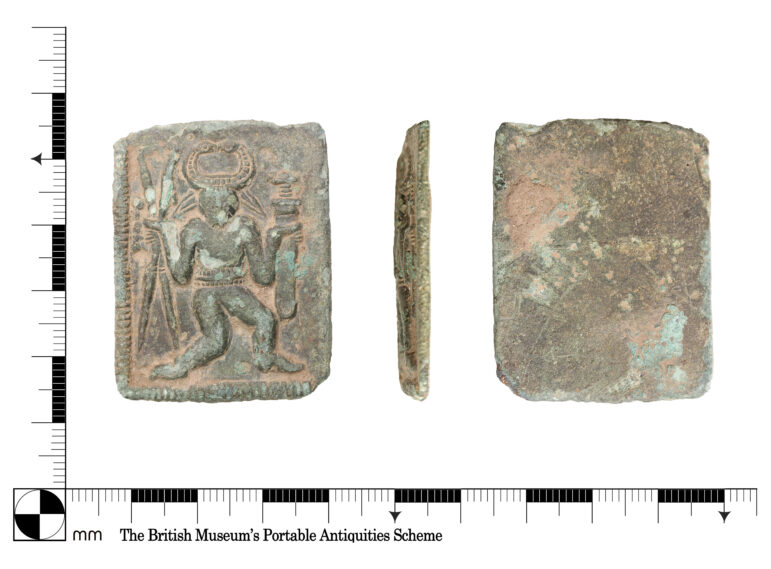
Rectangular die-stamp of a horned figure, c. 550 to 650 CE, found in Lynsted, Kent, April 2024 [Portable Antiquities Scheme of the British Museum, CC 4.0]
The stamp, as described by the U.K.’s Portable Antiquities Scheme (PAS) website, is about 42 mm by 33 mm and weighs about 28 grams, and depicts a horned figure wielding a sword and spears:
The central panel depicts a relief human figure wearing a headdress with horn-shaped extensions terminating in birds’ heads, and two sloping ear-like features beneath where the extensions meet the head. The figure is wearing a belt but otherwise appears to be naked. The figure’s legs are dynamically posed to suggest movement, perhaps running or dancing, towards the left. In the right hand the figure holds two spears, both apparently with point upwards. In the left hand, the figure holds a sheathed sword, blade downwards. The pommel of the sword appears to depict an attached sword-ring.
The stamp would have been used to create Pressblech decorative panels for the armor of elite warriors. The most famous example of these Pressblech designs is the famous helmet from Sutton Hoo, one of the icons of Anglo-Saxon archeology. Although the die does not directly match any of the designs on the Sutton Hoo helmet, there are panels showing pairs of similar horned figures.
This is the only example of this kind of stamp to have been found in England. Other examples have been found in Scandinavia.
“Although the Lynsted die could be an import,” notes that PAS report, “it is notable that the spears depicted appear to be point upwards, as is the case with other English depictions of the horned figure, in contrast to Scandinavian depictions that usually show spears point downwards. Thus, it is certainly possible that the Lynsted die was made in Britain.”
If so, that could also suggest that Pressblech armor designs were created in England, and that multiple designs were in circulation. The prevailing interpretation has been that the known Pressblech armor finds were imported from Scandinavia.
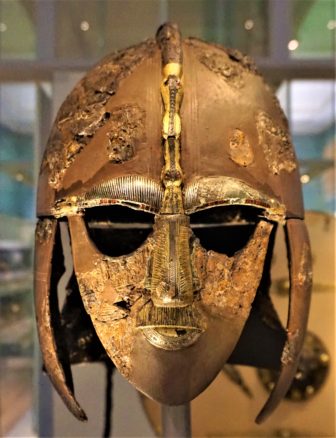
Sutton Hoo helmet – Image credit: Joyofmuseums – CC BY-SA 4.0, https://commons.wikimedia.org/w/index.php?curid=71020963
The object was found by a metal detectorist, Stephen Newbury, in April 2024. It has since been declared Treasure under the U.K.’s 1996 Treasure Act.
“This small but remarkable find,” said Andrew Richardson, finds liaison officer for KCC and Kent officer for the PAS, to the BBC, “provides important evidence that helmets like the Sutton Hoo example could have been made in Kent, highlighting the skill and connections of early medieval craftworkers in the county.”
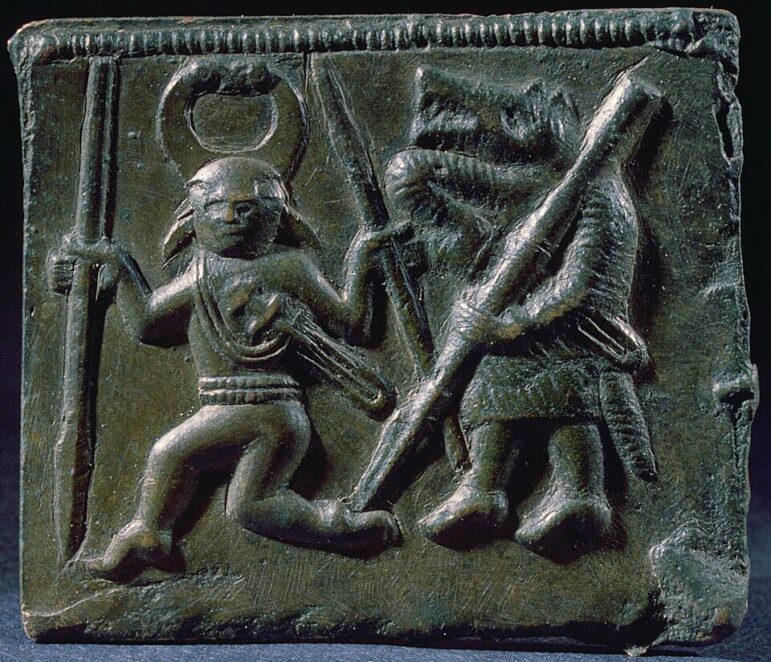
Plate from Torslunda showing a figure with one eye and a horned headdress next to a warrior in wolf-skin, c. 6th to 8th century CE [CC 4.0, Wikimedia Commons, National Historical Museums of Sweden]
The horned figure designs, which have been found in art across England, have frequently been interpreted as connected to the cult of Woden/Odin. The bird-headed horns are sometimes identified with Odin’s ravens, and one example of the motif, found in the 1870s in Torslunda, Öland, Sweden, shows a figure wearing a horned helmet and missing his right eye. This interpretation has been challenged in recent years by scholars offering analysis that situates the horned figure imagery in the late Roman army, perhaps even as figures inspired by Christian saints, though the PAS report still confidently claims that “there can be little doubt that these ‘horned figures’ represent pre-Christian iconography”:
The Lynsted die stamp also marks a significant addition to the known corpus of northern European ‘horned figures’, making it a rare witness to the propagation of Anglo-Saxon pre-Christian beliefs and rituals. The Staffordshire Hoard helmet and its imagery have been linked to the construction and embodiment of royal and dynastic origin myths at a time when political, hierarchical and royal structures were developing […]. In the absence of contemporary written records, objects such as the Lynsted piece become critical evidence to understanding this formative moment in Anglo-Saxon England’s development.
The Beaney House of Art and Knowledge in Canterbury looks to acquire the object and display it as a symbol of Kent’s contributions to England’s heritage.
“This is an exciting discovery for Kent, strengthening our reputation as a county with a rich and internationally significant heritage,” Jamie Henderson, cabinet member for environment, coastal regeneration and public health, told the BBC. “Our county has played a vital role throughout history, and this is another piece of evidence showing Kent’s importance in the story of early England, as a place of craftsmanship, culture and international connections.”
The Wild Hunt is not responsible for links to external content.
To join a conversation on this post:
Visit our The Wild Hunt subreddit! Point your favorite browser to https://www.reddit.com/r/The_Wild_Hunt_News/, then click “JOIN”. Make sure to click the bell, too, to be notified of new articles posted to our subreddit.