

Due to its nebulous nature, “Faery” is a term that is most often misunderstood. Related to the Latin fata, meaning fate, the word referred simply to things of magic and enchantment before it became attached to a race of beings (and the realm in which they exist). If something was “fae” it was considered to be enchanted, magical, or otherworldly.
The folklore from several different cultures on Earth describes a wide variety of magical beings said to engage our world, at times in strikingly similar terms. Germanic Elves, Irish Faeries, and Hawaiian Menehune, are each unique beings, and yet they can all be seen as existing under the same umbrella, that of preternatural life forms who inhabit the natural world and yet most often prefer to remain hidden, revealing themselves to humanity only in certain places, or under certain conditions.
While popular culture most often speaks of faeries in terms of creatures of delight and whimsy, folklore reveals an altogether different story. Far from being the harmless pixies much loved of the Victorian era, the folk-beliefs of many areas described them as magically powerful, morally confusing, potentially helpful, but also exceedingly dangerous. In fact, most folkloric examples of magic concerning the Fae focus on magic to protect against them.
Witchcraft and Faery
Witchcraft cannot be divorced from Faery. In Leland’s Aradia, or the Gospel of the Witches, the titular figure, Aradia, is sent to earth to teach the art of witchcraft to an oppressed populace. She is the avatar of the supreme deity: the goddess Diana, who is described in the text as the Queen of the Witches and Faeries.
Pre-modern tales of European witchcraft provide us a recurring theme, that of a familiar spirit and the relationship between this being and the magical practitioner. A commonly held belief dictated that each witch or warlock was in communion with an otherworldly spirit that either granted them their powers, or provided magical instruction and assistance. Often described in terms of an animal, folklore was clear that these spirits could take many forms, including that of humans, demons, or imps. Their nature as shape-shifters is one clue to their true nature: by whatever name, they are Faery.
The Faery Doctor
In Ireland, those magical practitioners and traditional healers who elsewhere might be said to be practicing cunning craft, were (and still are) called “Faery Doctors” (much as the term “Conjure Doctor” has traditionally been used in Hoodoo, or how “Witch Doctor” has been used by anthropologists in a trans-cultural sense). These people were thought to either be in league with the Faeries (from whom they drew their otherworldly power) or were perhaps Faeries themselves. It is because of this association for more than any other reason that caused this previously unnamed strain of traditional Witchcraft which bloomed in the United States, to be called “Faery.”
The Anderson Feri Tradition
While the initiatory lineage of our tradition is said to have originated with the Faery race (described as the extra-temporal descendants of humans and fallen angels) it was popularized and given form by the late Victor Anderson (1917-2001), Grandmaster and “Fairy Chief.” His unique initiation as a child in the woods by a stranger, and his subsequent adoption into a Witch coven as a teen in 1932, along with his physical blindness, all aided in the development of his etheric sight, and formed the basis of his spiritual outlook.
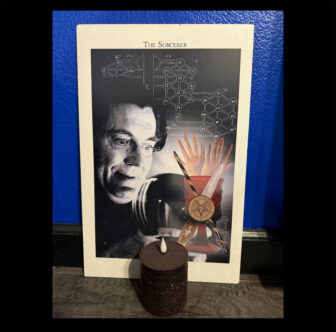
Victor Anderson as the Sorcerer (Magician) card in the Feri Tarot by Michele Jackson. Privately printed. Here shown as part of my ancestral altar.
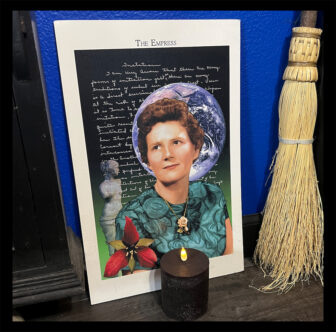
Cora Anderson as the Empress in the Feri Tarot by Michele Jackson. Privately printed. Here as part of my ancestral altar.
The Faery tradition stresses intimate communion with the various spirits of nature, within the guidelines of some simple personal practices and observances, and the engagement of art, poetry, and revelry.
Labeled “Feri” by some contemporary practitioners, this unique tradition shares many similarities with other traditional forms of magic and spirit-work like Hoodoo, Conjure, Braucherei, and Trolldom, as well as with more ceremonial religions like Vodou and Wicca.
Unlike a majority of Wicca (arguably the most popular form of modern Witchcraft) practitioners of Faery focus not on fertility and agriculture, but on ecstasy: the experience of transcending normal consciousness. It is this state of controlled enchantment in which the practitioner is able to more deeply commune with the spirits that inhabit the universe, and at times enlist their aid toward the betterment of their magical goals.
While being named after these beings of power (and even our deep lore speaking of them as the mythological progenitors of our magical path), not all Feri practitioners work with the Faery realm directly. Our path is sufficiently diverse to cause even the most seasoned initiates many headaches when trying to decide exactly what material is central to our religion or indeed how private or secret that material should be treated. Just as in the folkloric descriptions of our traditions’ namesake, Faery is a thing of liminality, or being “in between the worlds.” The boundaries are blurred and uncertain.
Faery as always is a mystery.
“All gods are Feri gods”
Another detail that sets Faery apart from most of its neo-Pagan cousins is the fact that it has no set pantheon. While it is most traditional in Faery to speak of Deity in female terms (the Star Goddess or “God Herself”) and her “son, lover, and other half,” the dualistic God, the tradition is one of personal connections and so any and all deities and spirits may be equally honored in our path, the only determining factor would be the practitioner’s own experiences. Because of this, different lineages have developed their own customs as to with which particular spirits they may predominately work.
Working with the Fae
A Faery ally can be an invaluable asset for the Witch, as well as a relationship that is deeply personal, intimate, and even possibly romantic or erotic, just as with any human in with whom we may engage.
To begin a relationship with the Fae we must first quiet our minds and attune our attention to the natural world. They comprise the spiritual consciousness of the land, and as such they must be approached with thoughtfulness and respect. One time-honored method of engaging them is to appease them with offerings of milk and honey, with dancing and song, and to provide spaces for them with bells and shiny objects.
When engaging them we are given certain folkloric keys as well as prohibitions by which we can more safely navigate the Faery encounter. In trance, we seek them in the Underworld, generally by envisioning the visual key of an opening in the earth and journeying below into the Shining Realm. We are admonished not to bring iron into their realm (as it dispels their magic), and not to eat or drink anything during our stay (lest we become contractually connected to the Faery ream forever). Perhaps the strangest is an admonishment never to say ‘thank you’ to the Fae, an act that speaks of how little our word as humans is valued. In the land of the Fae, our actions speak much louder.
The Blue God
In the Faery tradition it is taught that another name for one’s personal God (or “God Soul”) is Dian y Glas, who is depicted as a youthful effeminate male with blue skin, peacock feathers in his hair, and a green serpent coiled around his neck. He is our natural divine state of beauty, pride, and sexual exuberance. He is the child of the Mother, as we are all Her children.
Collectively, the individual God souls of humanity are reflected in another aspect of the Blue God, the Peacock Angel of Yazidi myth, Melek Ta’us. In this form, he is the god of free-will and redemption, as well as the potential (both light and dark) of all humankind. We offer him acts of devotion to cleanse, empower, and elevate him in order to inspire and guide the evolution of the world.
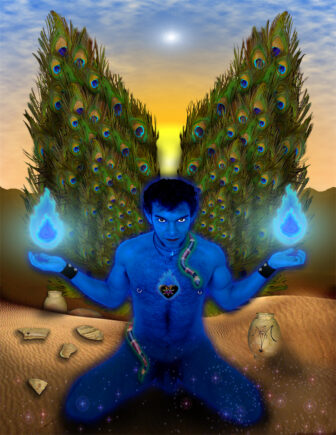
“Melek Ta’us, the Peacock Angel.” Digital Mixed Media. ©2006, Storm Faerywolf.
Invoking the Blue God
Call to the Blue God with acts of sensuality and joy. Adorn yourself with beautiful clothing or jewelry. Dance, sing, and shake your tail feathers! Light a blue candle in his honor and anoint yourself with scented oils. Use peacock feathers as his holy symbol. Admire your beauty in a mirror.
It is said that he is the unification of the higher and lower selves, symbolized by the dove and the serpent. These are the Divine Twins, a reminder that we do not honor only the “enlightened” parts of ourselves; that the primal is equally holy.
“Arise! Descend! Thy Twins of flame,
Who flow as one into my heart
We call the Winged Serpent’s name:
Dian y Glas, son of the Arte!”
Behold how beautiful you are!

For more information about the Anderson Faery tradition, please see Storm’s books, Betwixt & Between: Exploring the Faery Tradition of Witchcraft (2017)and Forbidden Mysteries of Faery Witchcraft (2018), both from Llewellyn Worldwide.
The Wild Hunt is not responsible for links to external content.
To join a conversation on this post:
Visit our The Wild Hunt subreddit! Point your favorite browser to https://www.reddit.com/r/The_Wild_Hunt_News/, then click “JOIN”. Make sure to click the bell, too, to be notified of new articles posted to our subreddit.