
WASHINGTON — The Trump Administration has finalized its rescission of the Bureau of Land Management’s 2024 “Public Lands Rule,” formally eliminating a policy that elevated conservation and ecosystem restoration as central considerations in the management of federal public lands. The repeal marks a significant shift in federal land policy toward resource extraction and “multiple use” priorities such as grazing, mining, logging, and energy development.
The decision arrives amid a long evolution in how Americans understand conservation, stewardship, and the purpose of public lands; not only in environmental policy, but also in spiritual traditions that view the natural world as sacred.
Modern Pagan spirituality has long been intertwined with environmental stewardship, ranging from personal ecological practice to political activism. Themes of reciprocity, ritual relationship with the land, and direct environmental action have been spearheaded by figures such as Starhawk and organizations including the Covenant of the Goddess. Environmental protection, sacred land preservation, and ecological responsibility have remained central concerns across many Pagan communities, particularly since the rise of modern environmental movements such as Earth Day.

Seal of the United States Department of the Interior
Indeed, that broader cultural and spiritual conversation about preservation has deep roots in the history of the American conservation movement itself.
Early national parks such as Yellowstone and the Grand Canyon were largely preserved for their monumental scenery and national symbolism. Everglades National Park, however, represented a major turning point in the history of the National Park Service because it was the first park created specifically for biological conservation rather than scenic “monumentalism.”
Unlike Yellowstone or Yosemite, protected for their awe-inspiring geological landscapes, the Everglades was established to preserve a fragile and rapidly vanishing ecosystem. By the 1920s and 1930s, conservationists recognized that the “River of Grass” was being devastated by drainage projects, plume hunting tied to the fashion industry, and agricultural expansion. Advocates, including Ernest F. Coe and Marjory Stoneman Douglas, argued that the Everglades’ value lay not in dramatic scenery, but in its biodiversity — mangrove forests, sawgrass marshes, wading birds, manatees, and the endangered Florida panther. When Congress authorized the park in 1934, it directed that the area be “preserved as a wilderness” where development would not interfere with protecting its “unique flora and fauna.”
Biscayne National Park later extended that conservation philosophy into marine environments. It was created in response to mounting industrial and development pressures threatening South Florida’s coastal ecosystems. The park protects coral reefs, mangrove shorelines, seagrass beds, and endangered marine species while also preserving submerged cultural resources through its Maritime Heritage Trail, which includes shipwrecks spanning centuries of Florida history. Unlike earlier parks centered on dramatic vistas, Biscayne demonstrated that underwater ecosystems and marine heritage were equally deserving of federal protection.
On the other side of the North American continent, Denali National Park and Preserve holds a unique place in the history of conservation because its creation was driven by a very specific goal: the protection of large mammals, particularly the Dall sheep. Denali is often cited as the gold standard for wilderness management. Management at Denali emphasizes minimal human impact, allowing ecological processes to function with limited interference while preserving what many conservationists describe as a complete ecosystem.
The Bureau of Land Management’s now-rescinded Public Lands Rule halts the arc of conservation. Previously, BLMS’s 2024 Conservation and Landscape Health Rule, commonly called the “Public Lands Rule,” sought to establish conservation as a formal land-management use alongside traditional commercial and extractive activities. The rule created restoration and mitigation leasing mechanisms and directed the agency to place greater emphasis on ecosystem resilience, restoration, and landscape health.
The newly finalized rescission, published as Federal Register document 2026-09386, eliminates the rule in its entirety.
In the rule’s executive summary, the administration argued that the 2024 policy “inappropriately elevated conservation as a discrete ‘use’ of the public lands” and imposed “unnecessary complexity” and “operational constraints” on land management and permitting. The document repeatedly emphasizes that public lands should be managed under principles of “multiple use and sustained yield,” language long associated with balancing recreation, grazing, timber, mining, and energy development.
The administration further contended that restoration and mitigation leases exceeded the BLM’s statutory authority because federal law authorizes land to be used, occupied, and developed, but does not explicitly authorize conservation as a leasing category.
The final rule also restores older regulations governing Areas of Critical Environmental Concern (ACECs), removes restoration and mitigation leasing provisions, and rescinds land health standards and monitoring requirements adopted under the Biden administration.
In press releases and statements, environmental organizations quickly condemned the move as part of a broader effort to prioritize extractive industries over conservation.
“Repealing the Public Lands Rule is the clearest example yet that the Trump administration will stop at nothing to sell out our country’s precious landscapes to private industry,” said Athan Manuel, director of the Sierra Club’s Lands Protection Program. “The rule simply acknowledged the fact that conservation on public lands has value, but even that was too much for Trump and his billionaire backers to tolerate.”
Manuel continued: “By now, the administration’s playbook is clear – disregard the will of the American people, refuse to protect our public lands, hand control over to corporate polluters, then dispose of these landscapes entirely. If they’re allowed to succeed, the natural heritage we pass onto the next generation will be defined by locked gates, ‘no trespassing’ signs, and irreversible pollution.”
Alison Flint, senior legal director for The Wilderness Society, argued that the rescission conflicts with the BLM’s long-standing legal responsibilities.
“Public lands provide us the freedom to explore the great outdoors,” Flint said. “Congress directed the BLM to manage public lands in a way that balances uses like outdoor recreation with needs as varied as grazing, energy development and conservation of wildlife habitat. The administration’s rescission of the BLM Public Lands Rule flouts both the agency’s legal mandate and the overwhelming wishes of the American people for public lands to be managed in a balanced and sustainable way that conserves special places for future generations.”
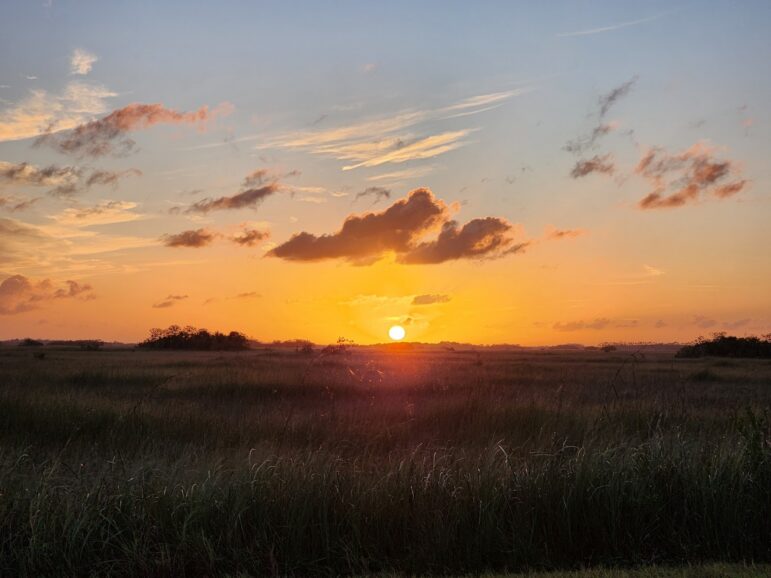
Sunset over Everglades National Park [Photo Credit: MJTM
Critics also pointed to regional ecological consequences.
“Oregon’s high desert, its cherished fish and wildlife, expansive wilderness, irreplaceable cultural resources, boundless recreational opportunities, and the communities and economies that depend on these healthy, intact public lands were all beneficiaries of the Public Lands Rule,” said Mark Salvo, senior advisor for the Oregon Natural Desert Association. “Who now, besides unfettered extractive industry, benefits from the Trump administration’s elimination of the rule?”
Defenders of Wildlife similarly warned that the repeal arrives during worsening climate and ecological pressures.
“Today’s repeal of the Public Lands Rule abandons progress at the same moment climate change, chronic drought and accelerating habitat loss demand better stewardship from BLM,” said Maddy Munson, senior planning and policy specialist for federal lands at Defenders of Wildlife.
“When this rule was finalized almost two years ago, the agency acknowledged then what remains true today: decades of prioritizing resource extraction has resulted in large-scale degradation of habitats which urgently needs to be corrected through improved oversight and restoration. Irrespective of today’s repeal, the realities facing our public lands remain, as does BLM’s responsibility to sustainably manage them for the benefit of wildlife, communities and future generations.”
The Bureau of Land Management stated that the rescission aligns with Executive Orders focused on “Unleashing American Energy” and deregulation. The agency also emphasized that the repeal itself does not directly authorize new drilling, mining, or grazing projects, but instead removes regulatory structures the administration viewed as burdensome to permitting and land management. Time will tell.
The Wild Hunt is not responsible for links to external content.
To join a conversation on this post:
Visit our The Wild Hunt subreddit! Point your favorite browser to https://www.reddit.com/r/The_Wild_Hunt_News/, then click “JOIN”. Make sure to click the bell, too, to be notified of new articles posted to our subreddit.