

Uncovering the PastCOLOGNE, Germany — Practically all urban construction projects in Europe typically begin with archaeologists working alongside excavators, carefully documenting what lies beneath modern streets. In Cologne, that routine collaboration has produced a discovery considered unique in Northern Europe: a remarkably preserved 2nd-century Roman lararium, or household shrine, uncovered during construction of the MiQua – Jewish Museum in the Archaeological Quarter.
The shrine was found during deep excavation work for an underground visitor route and is part of a broader set of newly documented structures belonging to the ancient praetorium, a palace that housed Rome’s provincial governor in the area. Alongside the lararium, archaeologists from the Römisch-Germanisches Museum identified a late 1st-century staircase descending toward the Rhine and substantial remains of a 4th-century basilical foundation. Together, these finds create a layered portrait of Cologne’s Roman past spanning the 1st through 4th centuries CE.
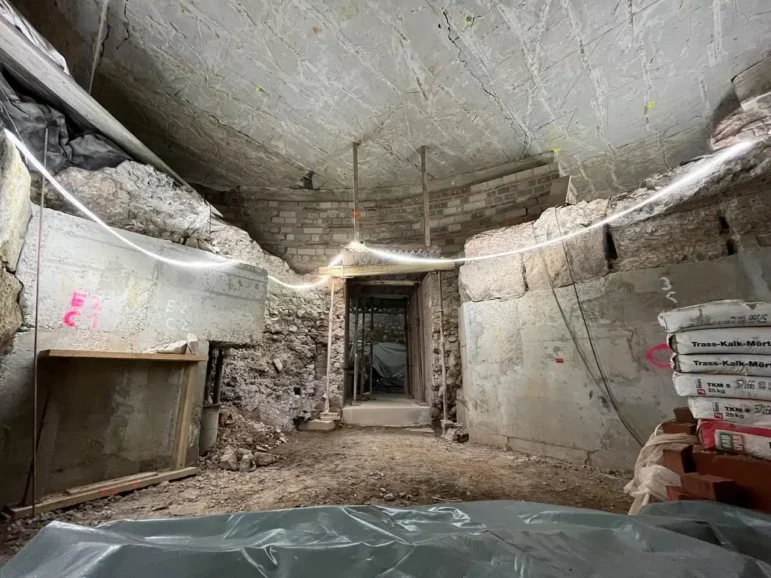
Archaeological excavation of the Praetorium’s basilica. Credit via: City of Cologne/Roman-Germanic Museum, Michael Wiehen.
The lararium, however, is especially significant. Fully preserved household shrines are rarely found north of the Alps, and almost never within their original architectural setting.
The lararium’s survival offers rare, direct evidence of domestic religious life in a provincial capital and provides a tangible link between imperial administration and private devotion. While sites such as Pompeii and Herculaneum have long shaped scholarly understanding of Roman household religion, this discovery demonstrates that comparable sacred spaces once existed along the Rhine frontier, even if they seldom endured.
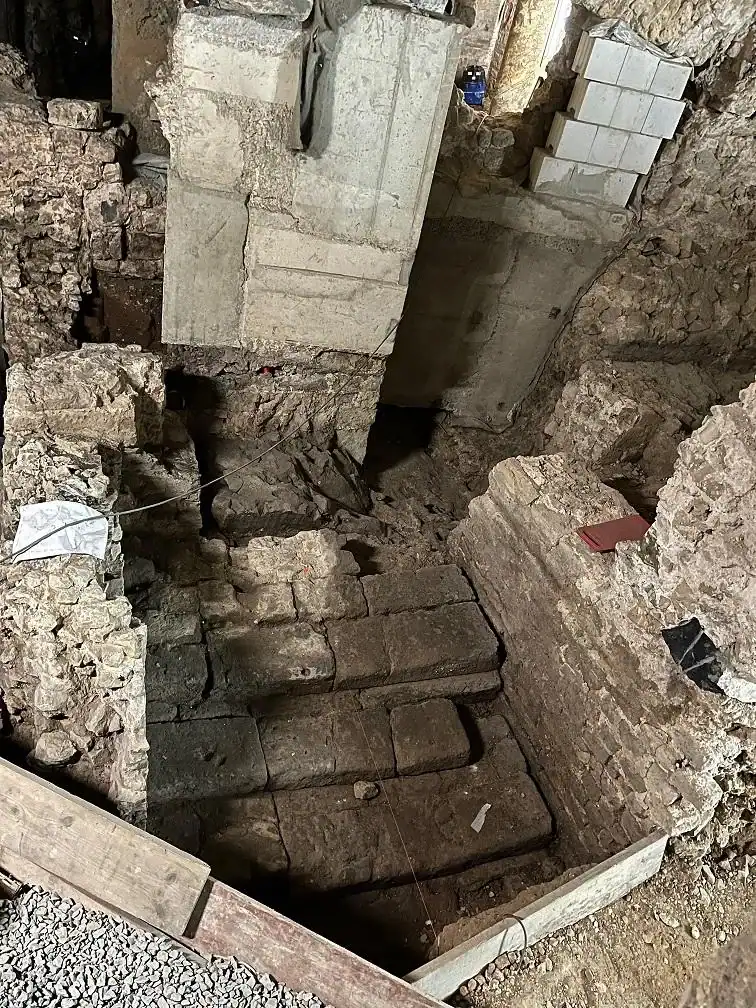
The Roman staircase dates to the first century. Credit via: City of Cologne/Roman-Germanic Museum, Franziska Bartz.
Most Roman houses and villas contained a larariae. They were usually a small shrine where members of the household (all members regardless of status) performed daily acts of devotion and worship. These spaces were typically dedicated to the Lares, protective spirits guarding the well-being of the family. Offerings of food, wine, or incense were placed on a small altar shelf, and lamps were lit as part of regular observances. Families might also honor the genius of the paterfamilias, the protective spirit of the male head of household.
In contrast, greater Roman gods such as Jupiter or Venus were worshipped at temples and public festivals.
The Cologne example consists of a niche cut into a wall of a 2nd-century phase of the praetorium. Though modest in size, it preserves striking detail: traces of painted stucco remain inside the recess, and small holes around the opening once held iron nails used to suspend garlands or votive ribbons. Beneath the niche, a fracture line marks the position of the original altar slab, which was found displaced but intact and is expected to be restored to its original setting. Architectural features along the sides suggest that the shrine may once have been framed by a small decorative pediment or molding.
Interestingly, its preservation is due less to extraordinary building materials than to circumstance. In Late Roman times, the area appears to have been artificially raised with soil to stabilize the steep Rhine riverbank. Those fill deposits sealed lower levels of the praetorium complex, protecting them from medieval demolition and stone reuse. In effect, the shrine and staircase survived because they were buried early and then forgotten.
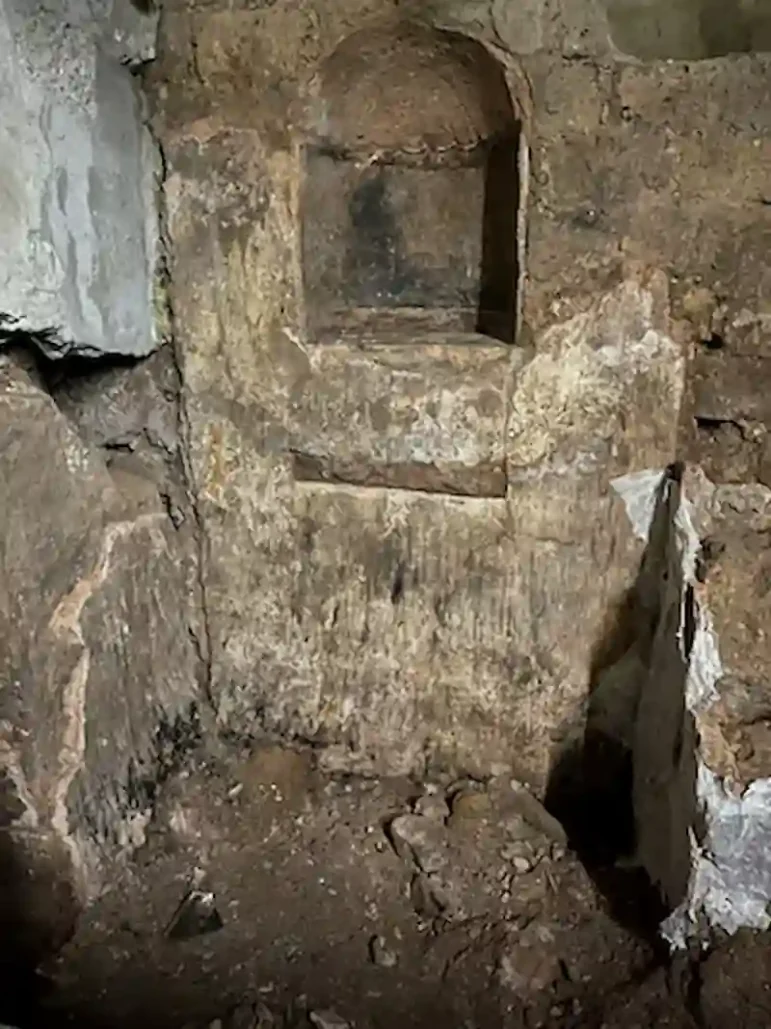
The Roman Lararium: Close-up view of the 2nd-century household shrine niche, showing surviving traces of painted plaster and architectural detailing revealed during excavations in Cologne’s Praetorium complex. Credit via: Stadt Köln/Römisch-Germanisches Museum, Michael Wiehen
The newly uncovered staircase further illustrates how Roman builders adapted elite architecture to Cologne’s terrain. Because the praetorium stood on sloping ground, engineers constructed a substantial stone stairway to navigate a sharp change in elevation toward the river. Staircases are rarely preserved in Roman sites in Germany, where only foundations typically survive. Here, however, early burial shielded the structure from later dismantling, leaving an unusual glimpse of circulation within the governor’s residence.
Excavations also reexamined the apse of a large 4th-century basilical structure once located beneath today’s Rathausplatz. What had appeared to be a shallow depression in the pavement concealed a massive foundation nearly four meters thick, built with carefully layered stone and a durable mortar mixture rich in crushed ceramics. These remains underscore the architectural ambition of late Roman Cologne and the scale of imperial investment in the provincial capital.
The depth of the current excavation, reaching below medieval occupation layers and even beneath the historical water table, has required continuous pumping and careful stabilization of trench walls. Yet it is precisely this unusual depth that has made the discoveries possible. Unlike many urban excavations that stop at later strata, this project penetrated the earliest Roman settlement levels, revealing contexts preserved by centuries of accumulated fill.
Museum officials have announced that the lararium and staircase will be incorporated into the exhibition narrative of MiQua, allowing visitors to view the structures in situ. Climate-controlled protection will safeguard the painted surfaces while maintaining direct visual access to the shrine’s original setting.
The find also serves as a reminder that Roman religion was not confined to grand temples or state ceremonies. It also lived in small wall niches, where lamps flickered, and offerings were laid before protective spirits, quietly and privately.
The Wild Hunt is not responsible for links to external content.
To join a conversation on this post:
Visit our The Wild Hunt subreddit! Point your favorite browser to https://www.reddit.com/r/The_Wild_Hunt_News/, then click “JOIN”. Make sure to click the bell, too, to be notified of new articles posted to our subreddit.