The Goddess and the Green Man

Glastonbury – The Goddess and The Green Man by Colin Smith [Geograph Britain Project CC A-SA 2.0
GLASTONBURY, England — The Wild Hunt was saddened to learn that one of Glastonbury’s most enduring Pagan landmarks is preparing to close. The Goddess and the Green Man, widely regarded as the oldest Pagan shop on Glastonbury High Street, will permanently close its doors at Imbolc 2026 after 34 years of service to the Pagan community.
Founded and owned by Tyna Redpath, now 76, the small but influential shop has been a spiritual fixture at 17 High Street since 1991. In a public announcement, Redpath shared that the decision reflects a natural turning of the Wheel. “After 34 years of trading, it is time to end this chapter of my life and close our business,” she wrote. The shop will remain open through January 31, closing on February 1, 2026, fittingly marking Imbolc. Its mail-order service has already ended.
Redpath described the shop’s origins as almost magical, noting that both the name and the concept were “conjured spontaneously” during an especially fertile creative period in Glastonbury’s history. The business began as a partnership with sculptor Phillipa Bowers, whose iconic Goddess figures are well known throughout the town. After two years, Redpath continued on her own, securing the High Street location and grounding the shop firmly in the Wheel of the Year.
Over the decades, The Goddess and the Green Man has been deeply woven into Glastonbury’s evolving spiritual landscape, participating in a town-wide rhythm of seasonal celebrations shared across faith communities. Redpath expressed pride in that legacy and gratitude for the customers, suppliers, and staff, especially longtime team lead Debs Summers-Cooper, who has been integral in sustaining the store.
“Thank you so much for your support, which we have always treasured,” Redpath wrote. “Blessed Be—and some tears.”
Miccosukee Tribe Responds to Presidential Veto

Flag of the Miccosukee Tribe of Indians of Florida
MIAMI – The Miccosukee Tribe of Indians of Florida has forcefully rejected President Donald Trump’s claim that the Tribe sought to obstruct his administration’s immigration agenda, a charge Trump cited when vetoing bipartisan legislation aimed at flood protection and land management in the Everglades.
The vetoed bill, HR 504, would have directed the Secretary of the Interior and the Tribe to take steps to protect structures at Osceola Camp, a historic Miccosukee village within Everglades National Park, from increasing flood risks linked to restoration projects and altered water flows. Sponsored by U.S. Rep. Carlos Gimenez, the measure had broad bipartisan support and was widely viewed as noncontroversial until the White House announced the veto.
In his veto letter, Trump accused the Tribe of seeking “special treatment” and of opposing immigration enforcement, referencing its participation in a federal lawsuit challenging the construction of a 3,000-bed immigration detention facility in the Everglades, commonly known as “Alligator Alcatraz.” The Tribe joined that lawsuit alongside environmental groups, arguing that required federal environmental reviews were not completed.
Tribal Chairman Talbert Cypress said the Tribe has long supported Everglades restoration and denied any opposition to immigration policy. Instead, he emphasized the Tribe’s constitutional duty to protect its traditional homelands and ensure environmental due diligence for federally funded restoration projects. Cypress also noted the Tribe’s historic support for Trump, including the late Chairman Billy Cypress’s early endorsement in 2016.
According to Politico, the U.S. House is expected to vote on overriding the veto, though prospects in the Senate remain uncertain. The Tribe says it will continue working with Congress and federal partners to safeguard the Everglades for future generations.
Winter Storm Sparked Norwegian Witchcraft Trials
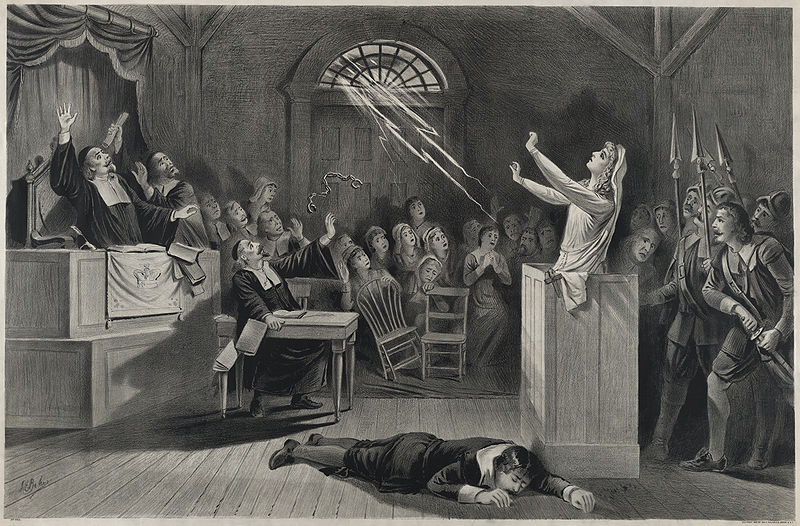
1892 Lithograph depicting a somewhat exaggerated presentation of the Salem Witch Trials.
A feature article titled “How a Sudden Winter Storm in 1617 Sparked the Deadliest Witchcraft Trials in Norwegian History,” published by Smithsonian Magazine, examines how a sudden and devastating winter storm in 1617 helped trigger the deadliest witchcraft prosecutions in Norwegian history, particularly in the Arctic region of Finnmark. The article explains how a sudden and catastrophic winter storm that struck northern Norway on Christmas Eve became a turning point. It capsized fishing boats off the coast near Vardø, killing dozens of men and leaving local communities shattered.
In the aftermath, grief, fear, and social instability took hold. With many households suddenly headed by widows and with livelihoods destroyed, authorities and clergy sought explanations rooted in supernatural causation. Over the following decades, this environment of anxiety fed into a series of witchcraft trials in which natural disasters were framed as acts of maleficium—deliberate magical harm.
The article explains that Norway’s witch trials, especially in Finnmark, were shaped by a convergence of harsh climate, rigid Lutheran theology, and the influence of continental European demonological ideas. Prosecutors increasingly embraced the belief that witches could control the weather, an accusation that resonated powerfully in a region where survival depended on the sea. In those trials, the majority of the men targeted were Sámi, while the majority of the women were Norwegian. All were accused of consorting with the Devil to summon storms.
Between 1621 and 1663, more than 90 people were executed for witchcraft in Finnmark alone, a staggering number relative to the region’s small population. The Smithsonian article emphasizes that the 1617 storm did not cause the trials by itself, but served as a catalytic trauma that made communities receptive to scapegoating and state violence.
By situating the trials within environmental history, the piece highlights how climate events can intensify fear, reinforce existing prejudices, and shape deadly outcomes when filtered through systems of power and belief.
Thank you! Thank you! Thank you!
If you’ve been thinking about supporting The Wild Hunt, now is the time.

Events and Announcements
More Events at our new Events Calendar
Tarot of the Week by Star Bustamonte
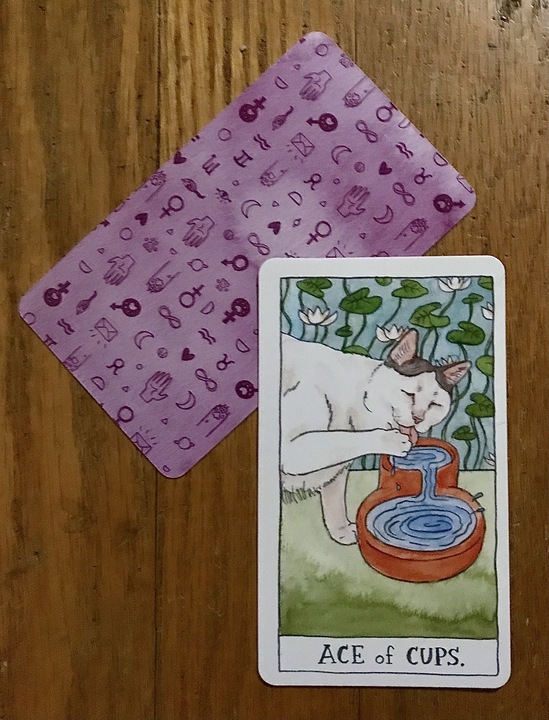 Deck: Cat Tarot by Julia Smillie, illustrated by Megan Lynn Kott, published by Chronicle Books, LLC.
Card: Ace of Cups
This week, there is likely to be an emphasis on love, healing, and spiritual growth, as well as new beginnings. Strong emotions are also likely to be prevalent and potentially overwhelming. Invitations to be open-hearted and express compassion and kindness may be in the mix, but ultimately, it is up to the individual whether to choose that path forward.
In contrast, there may be situations that are underlined by disappointment and sadness that result in the need for introspection. Practicing some radical self-care and self-love is likely to be called for in order to regain balance. The emotional demands and expectations of others should be staved off until some sense of equilibrium has been restored within the self.

possibly hijacked EMLC logo
Within Everglades Moon Local Council of the Covenant of the Goddess, few issues have inspired as much passion, pearl-clutching, and side-eye as The Flamingo Question. It all began nearly 20 years ago, at the dawn of the Local Council itself, with what seemed like an innocent query: Are flamingos actually native to Florida?
Enter our Palantír. True, we don’t know who is on the other end of that glowing stone (and yes, we acknowledge the risk), but we trust it implicitly on this one.
(What’s the worst that could happen?)
According to our mystical intelligence network, fierce debates have once again erupted over flamingo legitimacy. Reports include Palantír-generated visions of witches glaring sternly at one another, some with a single eyebrow—or eye—half raised in profound disbelief.
At some point, someone allegedly hijacked the Everglades Moon logo and inserted a flamingo. Witnesses describe the reaction as… intense. Think ritual gasps. Think dramatic sighs. Think pearls in genuine peril.
Then, following what experts insist was ecological intervention (though we cannot entirely rule out EMLC Witchcraft), flamingos began reappearing in Florida after nearly a century’s absence. It is a major achievement in ecological restoration, protecting not only flamingos but also other birds in the South Florida wild.
Contrary to popular belief, American flamingos are native to Florida, where they once thrived in the Everglades and Florida Bay before being hunted nearly to extinction. Conservation efforts, habitat restoration, and shifting climate patterns now appear to be welcoming them home—pink, leggy, and unapologetic.
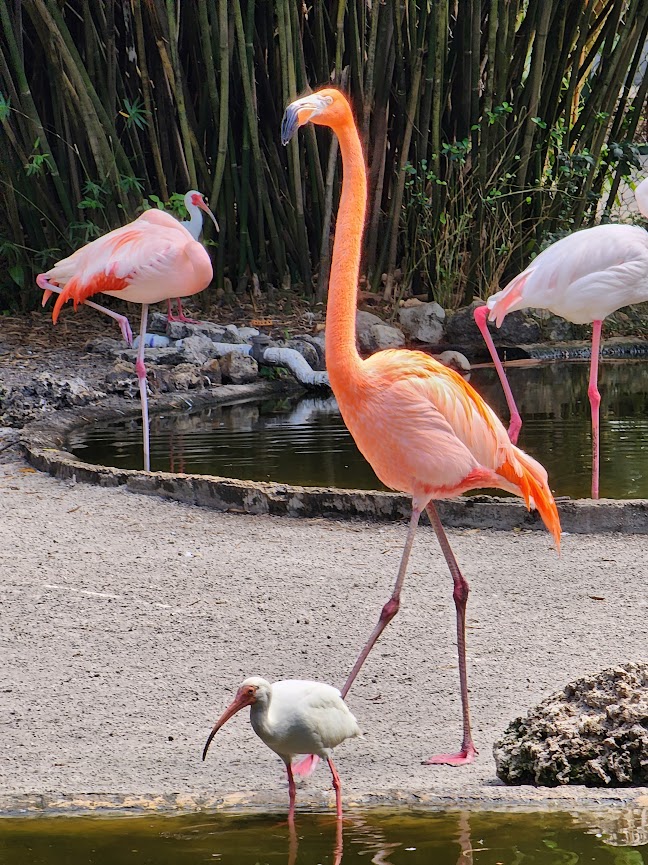
Flamingos [MJTM
The Florida House and Senate are now debating whether the American flamingo should replace the northern mockingbird as the state bird. The proposal, led by Jim Mooney of Islamorada, would also designate the Florida scrub jay as Florida’s official state songbird.
Everglades Moon Local Council, as part of its ongoing philanthropy in support of native wildlife, sponsors scrub jay habitat protection and restoration—long before it was a legislative talking point.
The legislation is advancing, and the controversy is very real.
Our Palantír is now set to “auto-detect,” and it has reportedly picked up the unmistakable sound of Everglades Moon elders muttering, “We told you so.”
👉 Don’t forget: supporting The Wild Hunt helps sustain independent Pagan journalism.
Tax-Deductible Donation
PayPal
Patreon
As always, our deepest gratitude to everyone who has brought us this far.
