

“I want to stand here all afternoon,” I said to my partner, “just to see how this one changes as the sun sets.”
It’s just before the new year, and we are standing in the Sculpture Hall of the Saint Louis Art Museum, looking up at one of the monumental paintings installed there by the German painter Anselm Kiefer as part of his current exhibition, Becoming the Sea. The exhibition comes in two parts. Deeper into the galleries, the museum hosts a retrospective of Kiefer’s career tracing back decades, but here, in the massive hall that is the entrance foyer and grand ballroom of the institution, Kiefer has produced a set of five new paintings. One of them was so freshly delivered that a docent waved us from getting too close because not all of the materials had dried.
I say “materials,” because while Kiefer is primarily known as a “painter,” his work involves multiple media that stretch the definitions of paint. Looking over the plaques hanging nearby, one sees a list that goes far beyond the expected pigment and substrate: “emulsion, oil, acrylic, shellac, gold leaf, and sediment of electrolysis on canvas,” reads the one for “Anselm fuit hic (Anselm Was Here),” the painting which we are looking upon and which, from my perspective, is the masterpiece of the collection.
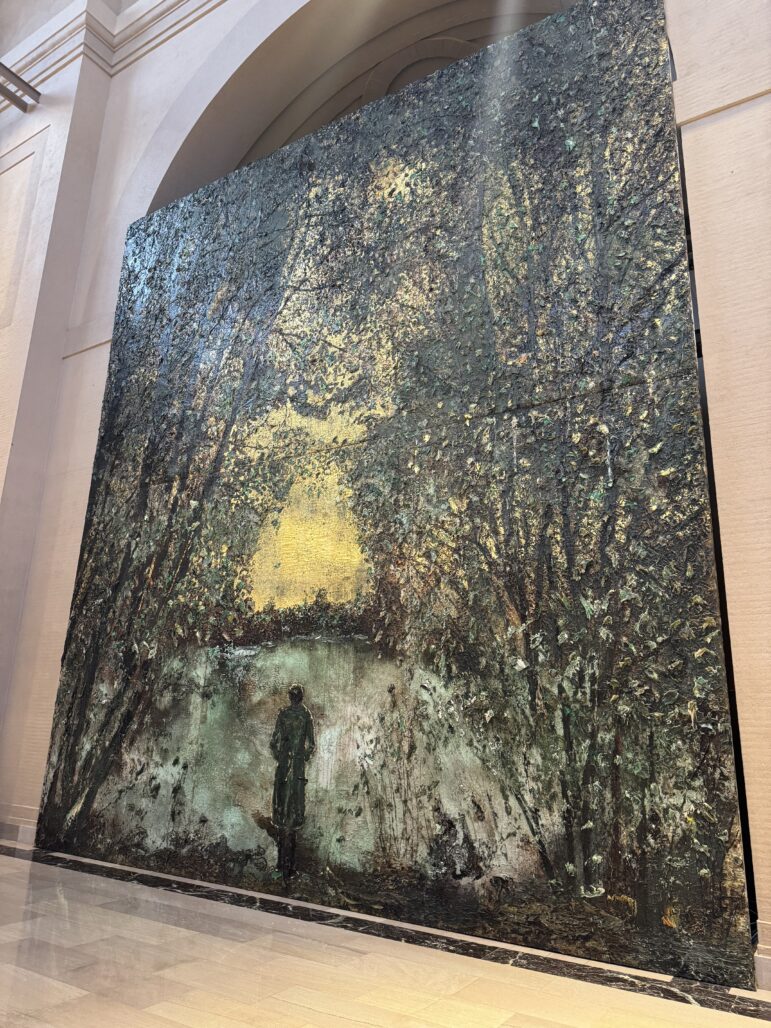
Anselm Kiefer, German, born 1945; “Anselm fuit hic” (Anselm Was Here) (detail), 2024; emulsion, oil, acrylic, shellac, gold leaf and sediment of electrolysis on canvas; 30 feet 10 1/16 inches x 27 feet 6 11/16 inches x 3 15/16 inches; Collection of the artist and courtesy Gagosian 2025.309; © Anselm Kiefer, Photo: E. Scott
No photograph could hope to demonstrate what’s so mesmerizing about this painting, unfortunately. “Anselm fuit hic” was the main image used to advertise Becoming the Sea, and to be honest, I was not impressed by what I saw in the advertisements, so I did not make a priority of visiting the exhibit. I regret that now – the painting was, as the cliché goes, a religious experience for me. I can only trust that, as a reader of The Wild Hunt, you know that I use that phrase with sincerity.
“Anselm fuit hic” amazes on several levels. The first is simply the scale: this painting is 30 feet tall and nearly as wide, and dominates the eye. The second is the technique which builds upon that scale: dense layers of paint that build up to create an abundance of texture, surrounding the negative space at the center of the image.
Finally there is the material, in particular those last two items, gold leaf and “sediment of electrolysis,” which creates an ghostly blue-green hue. “You can’t find that color in paint,” said the artist in an interview with BOMB Magazine in 2023, “so there is no other way to create it besides collecting the sediments from electrolysis. It’s the positive and negative ions reacting with copper and salt or one metal on the other. The sediments gather at the bottom of a bath, and it’s a kind of spiritualization.”
Those two colors – the gold and the turquoise – play together against the dark-hued strokes of tree and leaf to represent a calm river at sunset. A single figure in the center – Anselm himself – contemplates nature in all her sublime mystery, like the protagonist of Caspar David Friedrich’s “Wanderer above the Sea of Fog.”
While some of Kiefer’s other paintings in the Sculpture Hall have more overtly mythological themes – “Missouri, Mississippi” depicts a river nymph as the headwaters of the great rivers; “Lumpeguin, Cigwe, Animiki” shows three spirits from American Indigenous tribes looking down from a golden sky over bridges – for me, “Anselm fuit hic” expressed a joy that resonated the most deeply with my Pagan heart. Perhaps it should not take a canvas three storeys tall covered in gold leaf to remind us that every sunset on every river is an epiphany, but it does.
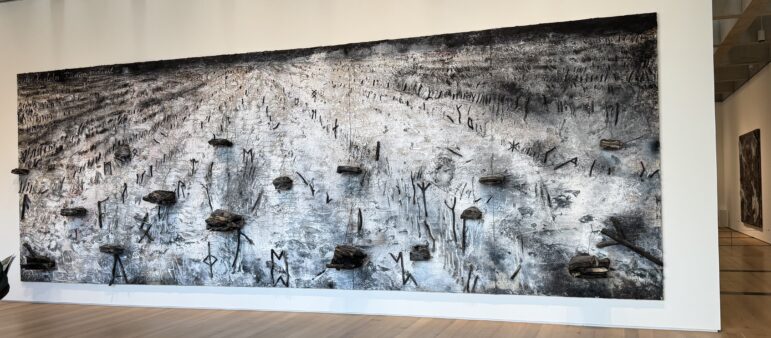
Anselm Kiefer, Des Herbstes Runengespinst (Autumn’s Runic Weave), 2005–06 emulsion, acrylic, oil, shellac, burnt wood, burnt books, charcoal, metal, and wire on canvas, collection of the artist 2025.313; © Anselm Kiefer, Photo: E. Scott
In the retrospective section, there are several works that evoke imagery of interest to Pagans: paintings named “Sol Invictus Elagabal” and “The Rhinemaidens,” along with “Brennestäbe (Fuel Rods)”, the latter a mainstay of the museum’s collection that combines ideas of nuclear power and the myth of Isis and Osiris. But there is one painting that struck me as a counterpart to the warm joy of “Anselm fuit hic.”
Kiefer’s work is famous for confronting the legacy of the Third Reich and its victims, interrogating the ways in which the Nazis used history, language, and mythology to bolster their claims to the German identity. So it is with “Des Herbstes Runengespinst (Autumn’s Runic Weave)” – another monumental painting, as long as an entire wall of the exhibition call, that seems to depict a barren, wintry field lined with fence posts receding into a bleak horizon. It’s only after a moment’s observation that the truth of the fence posts becomes apparent: many of them are in the shape of runes.
“Des Herbstes Runengespinst” is one of many paintings Kiefer has created inspired by the poet Paul Celan, a German-speaking Romanian Jewish poet whom the Nazis sent to a labor camp during World War II. Celan spent much of the rest of his career grappling with his experiences during the Holocaust, and especially the question of how to be a poet in the language used by those who killed both of his parents. The phrase “autumn’s runic weave” is a line from one of Celan’s poems. Kiefer described how the phrase came to mind while looking at photographs he had taken of a landscape in Salzburg: “And suddenly, these stumps made me think of runes. It was then that I remembered that Paul Celan had written a poem containing the words autumn’s runic weave.”
The painting is abstract, and at once seems to represent a fallow field and the carnage of no-man’s-land. But the connection to Celan makes it feel impossible to disentangle from the poet’s concerns about heritage, language, and history. The runes stick up from the frozen earth, weaving between wires dangling from hooks that carry burnt manuscripts – symbols of the mythologized past the Nazis drew upon and the real books – and lives – that they destroyed.
I stood looking at the painting for a long while – not to drink in its beauty, as with “Anselm fuit hic,” but to let it trouble me. As a Heathen, I struggle with how these symbols appeal to me and to the far right alike, and with how difficult it is to honestly reckon with the racist and antisemitic threads woven into the reconstruction of my religion. Is it possible to create something worthwhile from such materials? I hope so, but it requires constant effort, and the bravery to face the past as it truly was.

Anselm Kiefer, detail of Des Herbstes Runengespinst (Autumn’s Runic Weave), 2005–06 emulsion, acrylic, oil, shellac, burnt wood, burnt books, charcoal, metal, and wire on canvas, collection of the artist 2025.313; © Anselm Kiefer, Photo: E. Scott
On our way out of the museum, my partner and I wandered back through the Sculpture Hall and looked up again at Kiefer’s installations. It was getting near sunset, and the light through the galley’s windows had grown fainter, paler. It reflected in the gold leaf of “Anselm fuit hic,” which took on a cooler tone, and in its leaves, which grew darker, and in the sedimentary pigment which formed the river at the figure’s boots. We lingered there again, just as we had a few hours before, not wanting to leave.
“If we just stayed here long enough,” I told her, “I think the gold would fade to night.”
Anselm Kiefer: Becoming the Sea will be on display at the St. Louis Art Museum until January 25.
The Wild Hunt is not responsible for links to external content.
To join a conversation on this post:
Visit our The Wild Hunt subreddit! Point your favorite browser to https://www.reddit.com/r/The_Wild_Hunt_News/, then click “JOIN”. Make sure to click the bell, too, to be notified of new articles posted to our subreddit.