
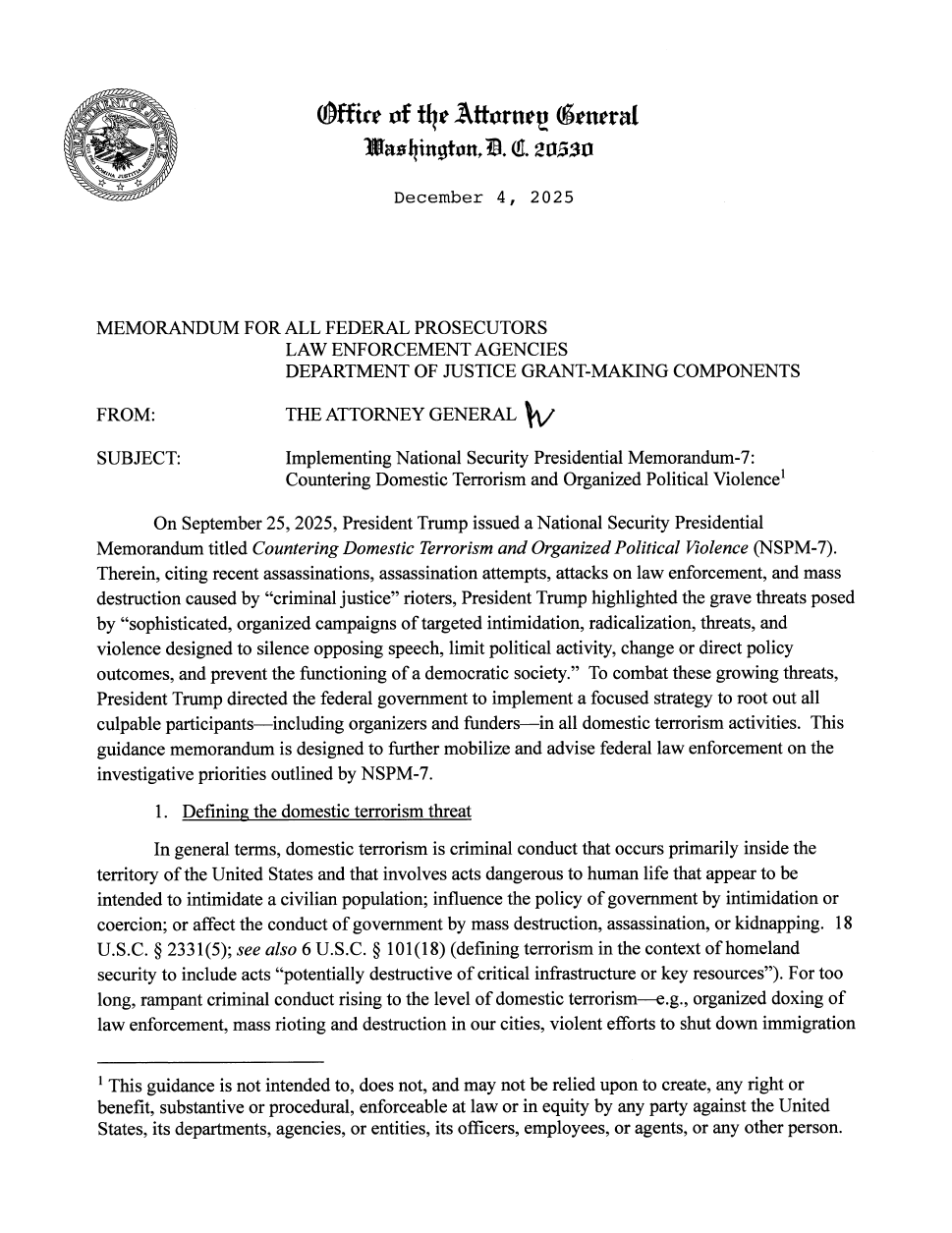
WASHINGTON, D.C. — A December 4, 2025, memorandum from Attorney General Pam Bondi confirms that the FBI has been directed to compile a list of U.S.-based groups and entities the Department of Justice says may be engaged in “domestic terrorism,” implementing a sweeping national security directive signed by President Donald Trump earlier this fall.
The memo, sent to all federal prosecutors, law-enforcement agencies, and DOJ grant-making offices, carries out National Security Presidential Memorandum-7 (NSPM-7), which Trump signed on September 25, 2025. Its stated purpose is to reorganize federal law-enforcement priorities around what the administration defines as domestic terrorism and organized political violence.
Reports about the memo began circulating on social media in early December, including posts claiming that Bondi had directed the FBI to assemble a list of Americans considered “extremists.”
BREAKING: Attorney General Pam Bondi has directed the FBI to assemble a list of Americans who may be considered “extremists.” pic.twitter.com/yhX8o1cCqX
— The General (@GeneralMCNews) December 7, 2025
At the time, the authenticity of the document remained unclear. Last week, Reuters described the memo’s contents without publishing it. Two days later, independent journalist Ken Klippenstein published what he described as a leaked copy on his Substack newsletter. A Department of Justice spokesperson subsequently confirmed the memo’s authenticity and shared the original document, which matches the version Klippenstein published.

How the Memo Defines “Domestic Terrorism”
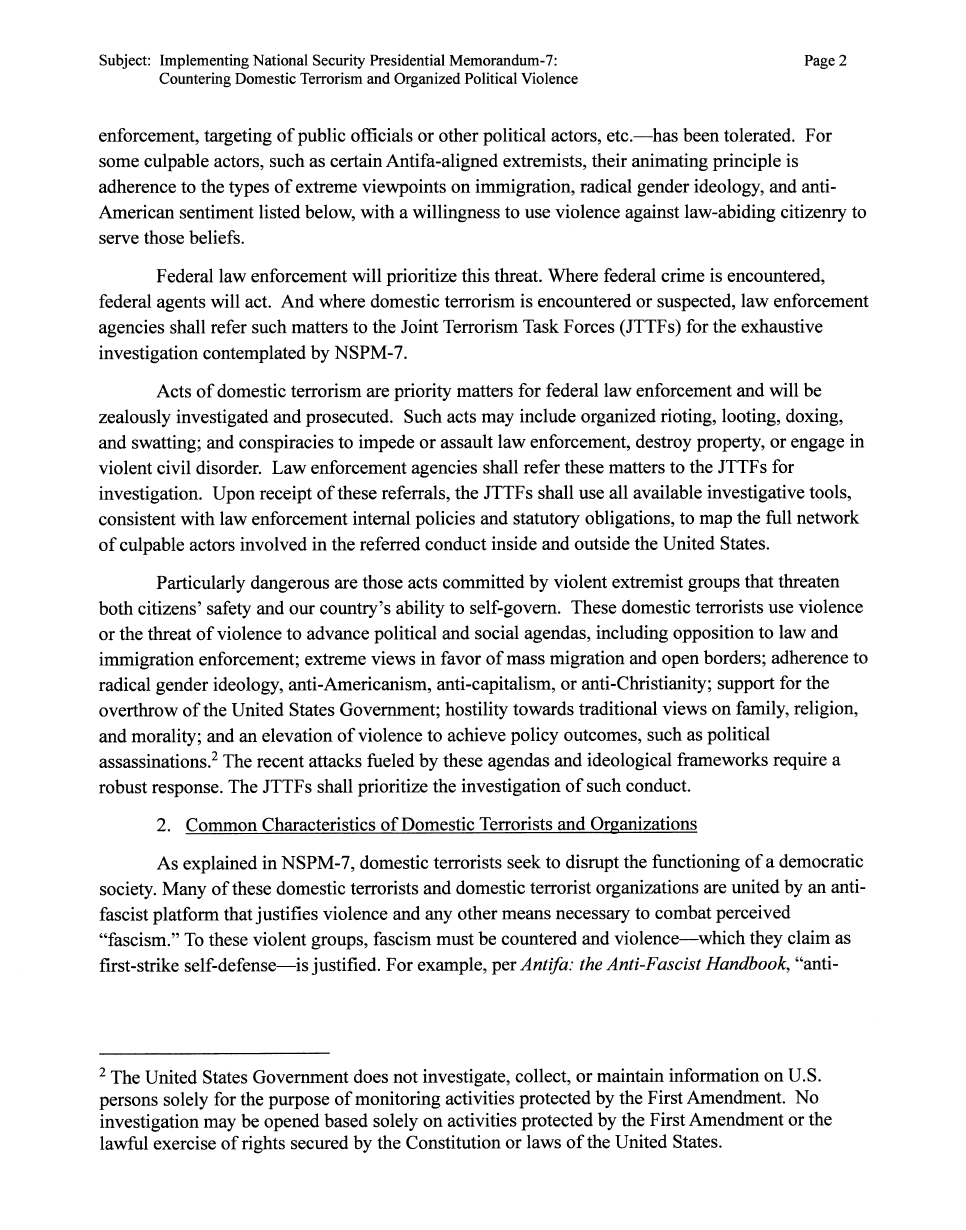
The Bondi memo explicitly frames left-wing, anti-fascist, anarchist, and immigration-justice movements as a central domestic terrorism threat. It repeatedly references what it calls:
- “Antifa-aligned extremists”
- “Anti-fascist ideology”
- “Radical gender ideology”
- “Anti-American sentiment”
- Opposition to immigration enforcement
- Hostility toward “traditional views on family, religion, and morality”
- Anti-Christianity
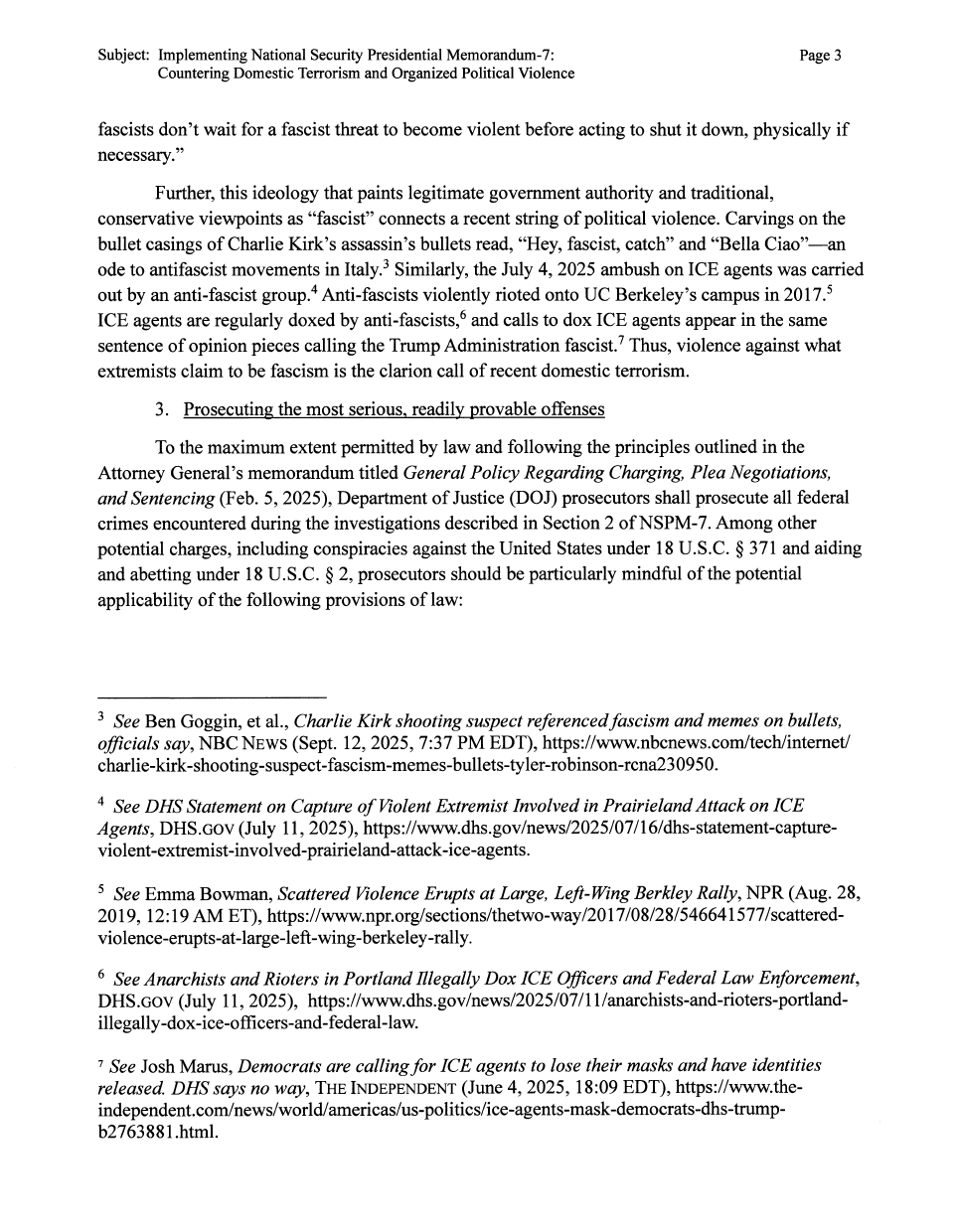
According to the memo, these ideological positions are said to justify violence, and violence carried out in opposition to what participants label “fascism” is treated as evidence of domestic terrorism.
The document acknowledges, in a footnote, that First Amendment-protected activity alone is not intended to trigger investigation. However, throughout the memo, ideological positions, protest activity, and civil disorder are repeatedly linked to terrorism frameworks and national-security enforcement mechanisms.

Official portrait of Pam Bondi, the United States Attorney General (2025) [Public Domain
FBI Directives: Lists, Tip Lines, and Network Mapping
Under the memo, the FBI is ordered to:
-
Compile a list of groups or entities engaged in acts that may constitute domestic terrorism
-
Refer suspected cases to Joint Terrorism Task Forces (JTTFs)
-
Use “all available investigative tools” to map entire networks of participants, organizers, and funders, including those outside the United States
The memo further directs the FBI to review intelligence and investigative files from the past five years, reopening closed cases where appropriate, particularly those involving protests, doxing of law enforcement, attacks on nonprofit organizations, and demonstrations at officials’ homes, including Supreme Court justices.
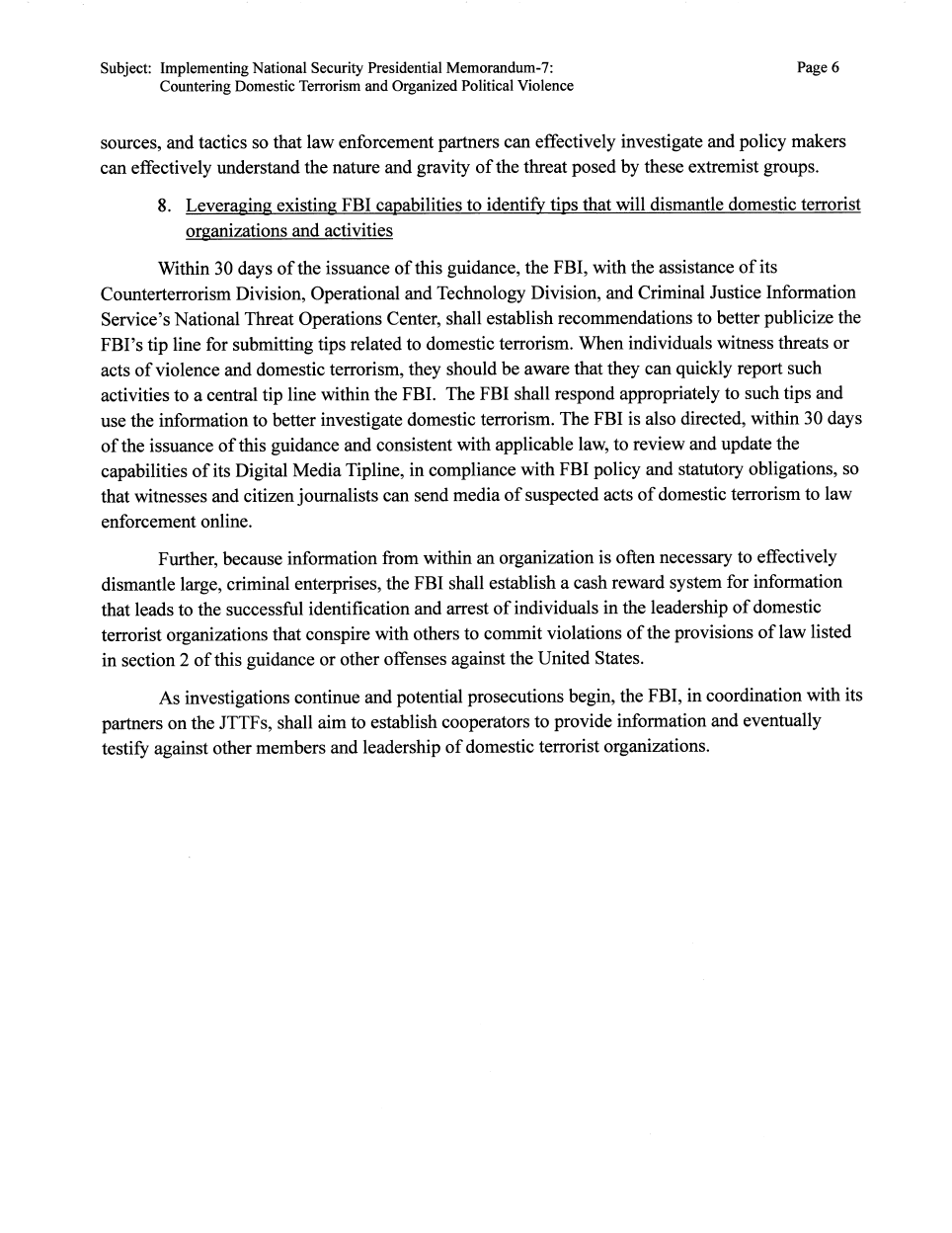
Bondi also instructs the FBI to expand and publicize its tip line, update digital submission tools so members of the public and citizen journalists can upload material, and establish a cash-reward system for information leading to the identification and arrest of leadership figures within targeted organizations.
Aggressive Prosecution and Funding Incentives
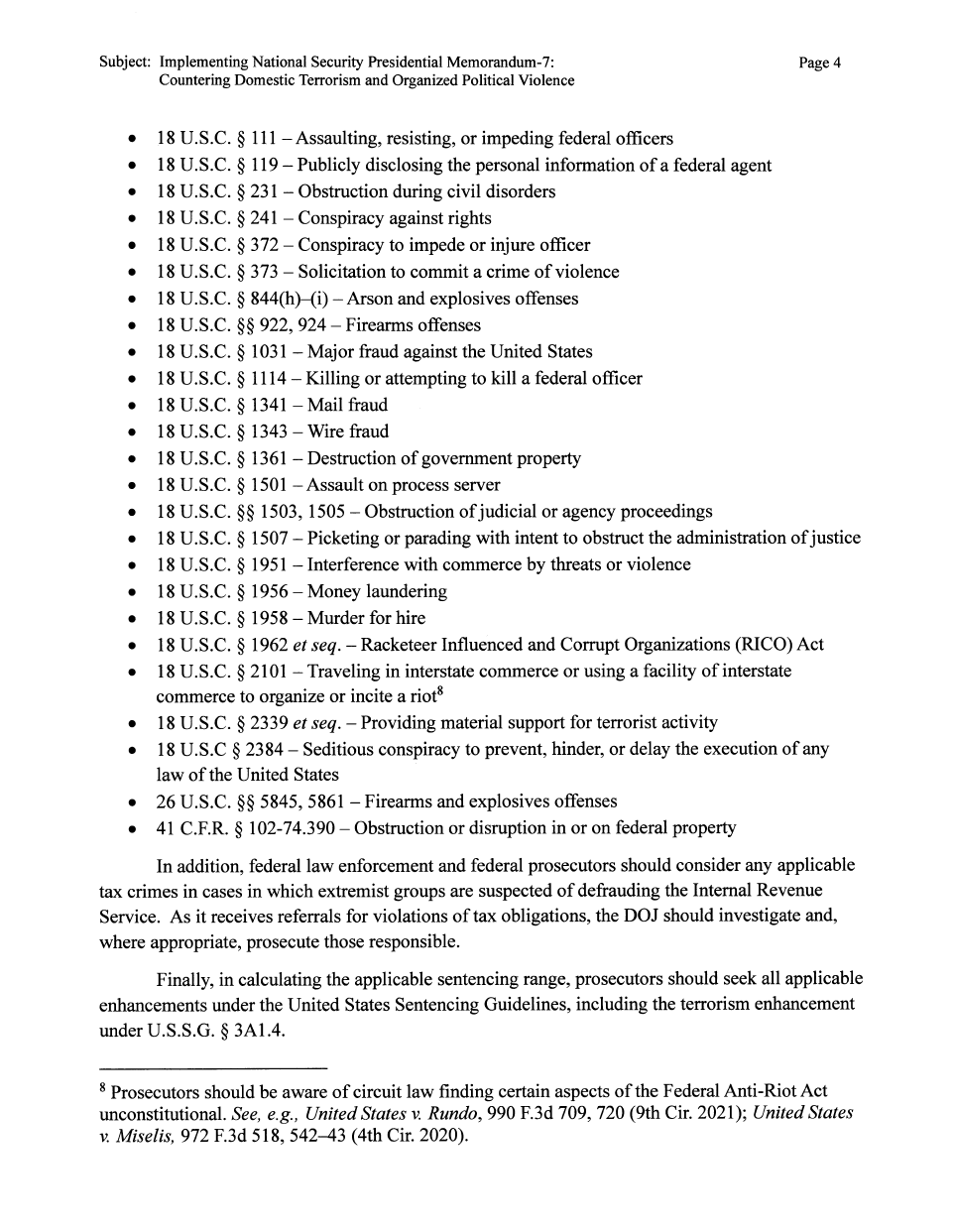
The memo orders federal prosecutors to pursue the “most serious, readily provable offenses,” encouraging the use of conspiracy charges, terrorism sentencing enhancements, RICO statutes, and related federal crimes. It lists more than two dozen statutes prosecutors should consider, including obstruction, firearms offenses, arson, sedition, and material support for terrorism.
In addition, DOJ grant-making offices are directed to prioritize funding for state and local law-enforcement programs that align with NSPM-7’s domestic terrorism framework, effectively tying federal funding to participation in these enforcement priorities.
Official Response and Civil Liberties Concerns
In confirming the memo’s authenticity, a DOJ spokesperson said, “Political violence has no place in this country, and this Department of Justice will investigate, identify, and root out any individual or violent extremist group attempting to commit or promote this heinous activity.”
Civil liberties advocates have raised concerns that the memo blurs the line between violent criminal conduct and political or religious viewpoints, particularly given its repeated references to “anti-Christianity,” “radical gender ideology,” and opposition to immigration enforcement as indicators of extremist threat.
The FBI has previously stated that it does not open investigations based solely on religious belief or lawful political activity. Critics note, however, that the memo’s language closely tracks ideological descriptors rather than specific criminal acts, raising questions about how broadly its provisions may be applied.

Possible Implications for Pagan Organizations
Formally, the memo includes a standard disclaimer that First Amendment-protected activity, including religious practice, is not itself grounds for investigation. The DOJ states that it does not investigate individuals or organizations solely for belief, speech, or lawful religious practice.
Being Pagan—or operating a Pagan news outlet—is not listed as a trigger. However, Pagan organizations have reason to pay close attention. Minority religions are often affected indirectly, not because they are explicitly named, but because they fall outside dominant religious norms, engage in political or social activism, operate through organized yet frequently misunderstood structures, and lack the institutional protections afforded to larger faith traditions. The directive expands law-enforcement discretion, encourages ideological profiling, incentivizes surveillance through funding mechanisms, and reframes domestic dissent as a national-security concern.
The memo does not target Pagan religions by name, but it creates an ideological and behavioral framework that could be applied to Pagan groups, organizations, or covens if their activities are interpreted through its lens.
The following activities, none of which are illegal, could nevertheless increase the risk of scrutiny or misinterpretation under the memo’s framework:
- Public criticism of Christianity or Christian nationalism
- Participation in protests related to immigration, gender rights, anti-fascism, policing, or government policy
- Coalition work with activist groups already under law-enforcement scrutiny
- Organized religious networks with identifiable leadership, membership lists, or funding streams
- Mutual-aid or fundraising efforts that could be mischaracterized
- Ritual symbolism or language unfamiliar to outsiders
- Online political speech using charged rhetoric
- Hosting events that draw counter-protesters or heightened police presence
The risk arises not from any single factor, but from how ideology, association, and activism may be combined under the memo’s expansive definition of domestic extremism.
The memo also explicitly encourages public reporting and “citizen journalist” participation by directing the FBI to expand tip lines, accept digital submissions, and offer cash rewards for information leading to the identification of “culpable actors.” This creates a risk environment in which articles, photos, videos, quoted sources, public statements, or online content produced by Pagan organizations or Pagan-facing media could be submitted to federal tip lines by third parties, potentially out of political hostility or misinterpretation rather than evidence of wrongdoing.
In addition, the memo instructs Joint Terrorism Task Forces to map full networks of “culpable actors” and review up to five years of past activity. For Pagan organizations that publish content, host events, interview activists or clergy, participate in coalitions, or document firsthand accounts, this raises the possibility of being swept into network analysis as an informational or organizational node, even absent any allegation of misconduct. A Pagan news outlet such as The Wild Hunt illustrates how lawful religious journalism—covering activism, minority faith issues, non-Christian perspectives, and the impact of Christian nationalism—could theoretically appear in such mapping due to association and visibility rather than criminal conduct.
To be clear, the memo does not authorize targeting Pagan organizations, criminalize journalism, or restrict religious practice. The risk it creates is ambient and structural, not explicit. The memo addresses “anti-Christian” sentiment not as an automatic trigger, but as an ideological indicator that may contribute to federal scrutiny when combined with other activities. This framing raises civil-liberties concerns for Pagan churches, covens, nonprofits, and media organizations that engage in lawful critique of Christianity or Christian nationalism as part of religious expression, education, or advocacy.
The Wild Hunt is not responsible for links to external content.
To join a conversation on this post:
Visit our The Wild Hunt subreddit! Point your favorite browser to https://www.reddit.com/r/The_Wild_Hunt_News/, then click “JOIN”. Make sure to click the bell, too, to be notified of new articles posted to our subreddit.