
WASHINGTON – The U.S. Supreme Court heard oral arguments on Monday, Nov. 10, 2025, in a case that could reshape how far religious freedom protections extend behind bars, and whether state officials can be held personally liable when they violate them.
The case, Landor v. Louisiana Department of Corrections and Public Safety, involves Damon Landor, a devout Rastafarian whose long dreadlocks were forcibly shorn by prison guards in 2020, by order of the prison warden just three weeks before his scheduled release.
Landor claims that the warden’s order violated both a standing judicial ruling and the federal Religious Land Use and Institutionalized Persons Act (RLUIPA), which forbids the government from imposing “substantial burdens” on the religious practices of incarcerated people.
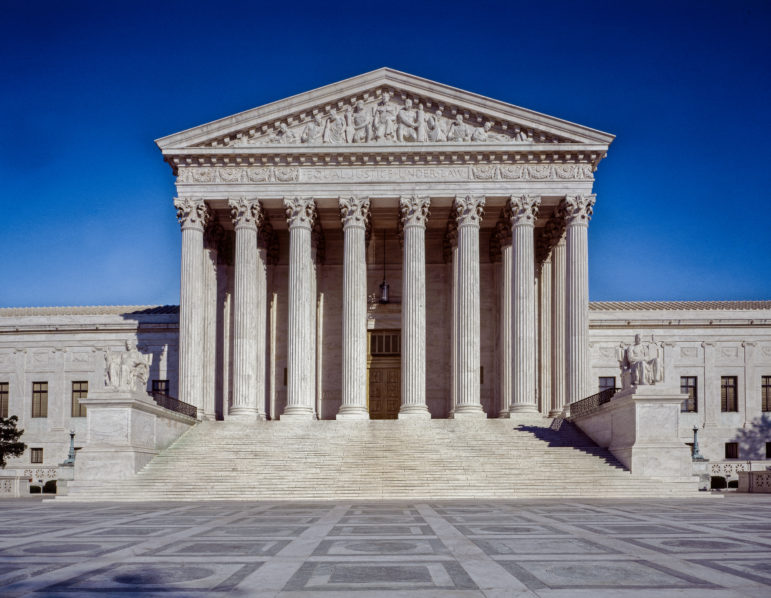
United States Supreme Court Building By Carol M. Highsmith – Library of CongressCatalog: Public Domain.
Landor is a Rastafarian, a syncretic faith that originated in Jamaica in the 1930s and blends biblical teachings with Afro-Caribbean spirituality. The religion is perhaps best known for its ritual use of cannabis (ganja) as a sacrament to aid meditation and connection with the divine; the distinctive plant-based Ital diet, emphasizing natural, unprocessed foods; and the Nazarite vow, a sacred commitment not to cut one’s hair, symbolizing spiritual strength and divine covenant.
For nearly twenty years, Landor had honored his Nazarite vow. He had served most of his sentence in two Louisiana prisons that respected this observance, even allowing him to wear his hair under a “rastacap.” But when transferred to Raymond Laborde Correctional Center, Landor’s dreadlocks were cut off after he presented officers with a copy of the federal appeals court ruling affirming his right to keep them. According to court filings, guards handcuffed Landor to a chair, ignored the order, and shaved his head bald.
After completing his sentence, Landor sued for monetary damages, arguing that his constitutional and statutory rights had been flagrantly violated. Louisiana later revised its grooming policy following the incident, but that change does not affect the question of whether damages are available. Indeed, lower courts condemned Landor’s treatment but held that RLUIPA does not authorize individual-capacity damages against state officials. That is now the question before the Supreme Court: whether individual officers can be sued under RLUIPA for violating an inmate’s religious freedom.
Faith Behind Bars
Landor’s case highlights how U.S. religious freedom laws, more often tested by Christians, are increasingly applied to diverse minority traditions. Christians now represent roughly 62 percent of the U.S. population, while 7 percent belong to other faiths and 29 percent identify with none.
The forced cutting of dreadlocks, Landor’s attorney Zachary Tripp told the justices, was a “brazenly illegal assault” and “the poster child for a RLUIPA violation.” The law, passed in 2000, was designed to protect inmates’ ability to practice religion freely even under the constraints of incarceration. Yet for Landor, the promise of protection appears hollow without the possibility of redress.
A Question of Remedy
At the center of the dispute is the meaning of a few words: RLUIPA’s provision that individuals may seek “appropriate relief” for violations of their rights. In a 2020 decision, Tanzin v. Tanvir, the Court held that under the similar Religious Freedom Restoration Act (RFRA), this language allows lawsuits for money damages against federal officials. Landor’s attorney argued that RLUIPA and RFRA are “twins separated at birth” and should be interpreted alike. Without the threat of personal liability, he warned, officials could “treat the law like garbage.”
But several justices appeared unconvinced. Justice Brett Kavanaugh noted that RLUIPA’s phrase “appropriate relief” was “not as clear as it could be,” emphasizing that government officials must have explicit notice before being exposed to personal financial risk. Justice Neil Gorsuch observed that every federal appellate court to address the issue has rejected claims like Landor’s, adding that officials never “agreed to be bound” by RLUIPA’s spending-clause conditions.
Justice Samuel Alito echoed that concern, questioning why “appropriate relief” was not clear enough to overcome sovereign immunity when suing the state but would be clear enough to hold individual officers personally liable.
Image credit: Blogtrepreneur – CC BY 2.0, https://commons.wikimedia.org/w/index.php?curid=50979400
Support from Unlikely Allies
The case has drawn an unusually broad coalition of supporters. Americans United for Separation of Church and State and the Becket Fund for Religious Liberty, organizations that often stand on opposite sides of church-state issues, both filed briefs urging the Court to hear Landor’s appeal. Their rare alliance underscores the wider significance of the issue: whether government actors who knowingly violate a person’s religious rights can escape accountability simply because the victim was incarcerated.
Even the Trump administration joined in, filing a brief supporting Landor and arguing that RLUIPA “puts states on clear notice” that individual officials may be sued for damages. Assistant Solicitor General Libby Baird told the Court that when states accept federal funds under RLUIPA, their employees are bound to comply with the terms of the Act.
Divided Bench, Uncertain Future
Justices Ketanji Brown Jackson and Elena Kagan signaled sympathy for Landor’s claim. Jackson argued that prison officials are clearly subject to RLUIPA as part of their employment, while Kagan compared the situation to lawsuits under Section 1983, which routinely allow damages against state officials who violate constitutional rights.
Others were less persuaded. Chief Justice John Roberts called the argument that officials consented through employment a “legal fiction.” Meanwhile, Justice Amy Coney Barrett pressed for examples of other spending-clause statutes that impose personal liability on non-recipients of federal funds.
Justice Sonia Sotomayor, one of the Court’s most consistent voices on religious liberty and prisoner rights, appeared to seek a compromise. Even if officials could not be held liable retroactively, she suggested, the Court might craft a rule providing clearer notice for future cases.
The Stakes for Religious Freedom
Beyond the technical questions of statutory interpretation, Landor v. Louisiana raises a broader moral issue: whether the nation’s promises of religious liberty have real force for the least powerful among us. If the Court rules against Landor, prisoners may be left with little recourse when officials deliberately trample their faith.
For minority religions like Rastafarianism, the decision could set a lasting precedent. It will determine whether the law protects their sacred practices or whether, in the words of Landor’s counsel, those protections “exist only on paper.”
A ruling is expected by late June or early July 2026.
The Wild Hunt is not responsible for links to external content.
To join a conversation on this post:
Visit our The Wild Hunt subreddit! Point your favorite browser to https://www.reddit.com/r/The_Wild_Hunt_News/, then click “JOIN”. Make sure to click the bell, too, to be notified of new articles posted to our subreddit.