

Uncovering the Past
WARSAW – Archaeologists working at the Łysa Góra site in Poland’s Mazovia region have uncovered one of the rarest Celtic artifacts ever found in Central Europe: an iron scalpel apparently designed for trepanation, the ancient procedure of cutting or scraping into the skull for medical or ritual purposes. The discovery, announced by Dr. Bartłomiej Kaczyński of the State Archaeological Museum in Warsaw, challenges long-held assumptions about how far Celtic groups traveled and what kinds of specialists moved with them.
“Back in the spring, we found a tool for trepanation of a skull,” Kaczyński told the Polish news agency PAP. “This is an even rarer find than a Celtic helmet, because such tools are known only from a few Celtic sites in southern and central Europe.”
The instrument’s shape, a blade tapering into a pointed spike that was originally attached to a wooden handle, matches known surgical tools used to thin or perforate cranial bone. Its identification came only after researchers combed the relevant medical-archaeological literature. The rare tool, Kaczyński explained, “proves that the people of Celtic origin who arrived here had someone specialized in medical procedures. He was probably a druid who practiced herbal medicine, but he also had a set of professional tools. Although this probably had more magical symbolism than being a source of actual help.”
In an email to Live Science, Kaczyński confirmed that “the technique and precision of the iron object’s manufacture indicate Celtic metallurgy.” The scalpel may even have been forged locally. Excavations revealed evidence of onsite metalwork, including cup-shaped slag and a small iron anvil set upright in a tree trunk, classic signs of Iron Age blacksmithing. This suggests that the Celts who reached Łysa Góra were not simply passing through but were crafting and repairing tools on the spot.

The iron surgical tool was dated to the 4th-3rd century BC, source: Dr. Bartłomiej Kaczyński
Trepanation: A Global, Ancient, and Often Ritual Practice
Trepanation is among the oldest known surgical operations, occurring worldwide for at least 7,000–10,000 years. More than 1,500 trepanned skulls from the Neolithic period alone have been found from Europe and Siberia to China and the Americas. In some communities, up to 10% of skulls show signs of the operation. A French cemetery from around 6500 BCE contained 40 trepanned skulls out of 120 examined, evidence of both the procedure’s prevalence and its risks.
Over time, surgical survival improved dramatically. Iron Age trepanations in Europe show healing rates as high as 78%. Medieval surgeons used the technique to treat fractures and seizures. In East Africa, the Kisii people continued practicing trepanation well into the twentieth century. Across cultures, the reasons for opening the skull varied, from relieving head trauma to releasing spirits, curing seizures, or serving ritual and initiatory functions.
Against this deep global history, the Polish scalpel stands out not only for its rarity but for what it reveals about Celtic ritual and healing. The Celts left no written medical texts, but classical sources describe Druids combining herbcraft, divination, astronomy, and healing. This tool provides the first concrete, physical evidence in northeastern Europe that a Celtic healer capable of such procedures may have been present.
A Celtic Settlement at the Edge of Their World
The excavations at Łysa Góra began decades ago, but new work resumed in 2024 as part of a plan to create an educational trail. The results have far exceeded expectations.
Last year, archaeologists uncovered the first La Tène–style Celtic bronze helmet ever found in Poland, an elite status symbol dating to the 4th century BCE. Nearly 350 other artifacts have since been recovered, including brooches, axes, spearheads, horse-harness fittings, and objects linked to the West Baltic Kurgan culture. The sheer variety suggests long-term occupation or repeated return visits by Celtic travelers.
The site’s defensive system offers another clue. The southern hill was fortified by a palisade and moat, while the northern half had only a simple fence, likely for temporary protection. Burn layers point to conflict, possibly with groups such as the Vandals. The settlement’s complexity suggests a community that combined agriculture, metallurgy, trade, and ritual activity.
“Some of the rather small iron objects we discovered on Łysa Góra may have been manufactured here on site,” Kaczyński noted. “The group of Celts came here not only with a medic, but perhaps also with a blacksmith.”
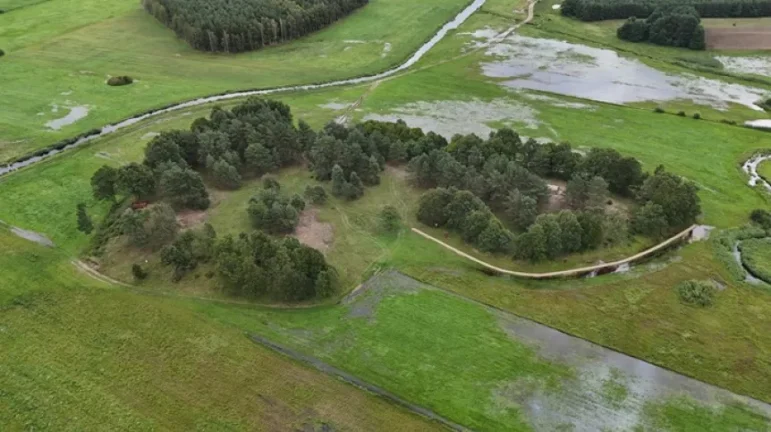
Łysa Góra, Source : Dr. Bartłomiej Kaczyński
Rewriting the Celtic Map
Until these discoveries, scholars believed the Celtic presence in northeastern Poland was minimal. Now, with a helmet, hundreds of artifacts, evidence of metalworking, and a trepanation scalpel, Łysa Góra stands as the northeasternmost known Celtic settlement yet identified in Europe.
The trepanation tool adds a particularly intriguing dimension. It shows that Celtic travelers included individuals skilled in interventions that today border both medicine and magic. Whether the scalpel was used to heal, to perform ritual openings of the skull, or simply as a symbol of status within a druidic role remains unknown. No trepanned skull has yet been found at the site, but the tool’s presence makes future discoveries more likely.
The finding also raises profound questions. What conditions did Celtic healers believe could be treated by cutting into the skull? Who wielded the blade? Was it a specialized physician, ritual specialist, or someone who embodied both, possibly a druid? And was this specific instrument ever used? These questions now guide the next phase of research.
Looking Ahead
Artifacts from the site, including the bronze helmet, are undergoing restoration and are expected to be displayed beginning in 2026. An educational trail at Łysa Góra will soon open, allowing visitors to explore the layered story of a settlement that blended warfare, craft, healing, and spirituality. It definitely reveals a past in which healers traveled with merchants and metalworkers, carrying practical tools for possibly medical and sacred knowledge.
The Wild Hunt is not responsible for links to external content.
To join a conversation on this post:
Visit our The Wild Hunt subreddit! Point your favorite browser to https://www.reddit.com/r/The_Wild_Hunt_News/, then click “JOIN”. Make sure to click the bell, too, to be notified of new articles posted to our subreddit.