

According to the latest Religious Landscape Study conducted by the Pew Research Center in 2023-2024, only about 1% of US adults identify as followers of New Age movements, which include Pagan and Wiccan traditions. Global research shows this trend extends worldwide, with only 2.2% of the world population falling into “other religions”—capturing Baha’is, Daoists, Jains, Shintoists, Sikhs, Wiccans, Zoroastrians, folk, and traditional religions. As a minority faith group, modern Pagans often struggle to find a spiritual community. While some are content with a solitary practice, many seek out a circle that hosts rituals and meetings throughout the year. Circles, in this context, refer to Pagan groups open to the public, unlike closed or initiation-based covens. The desire to be part of an active circle is understandable when we consider our inherent need for social connections and camaraderie. With that said, establishing and maintaining a healthy Pagan circle can be challenging. Many well-intended groups flounder or dissolve for various reasons.

Circle of baby oak trees – Image credit: S. Bustamonte
Before diving into the how part of this article, let us consider some of the reasons why Pagan circles are important. Drawing from experience, when I decided to get serious about becoming a practicing Pagan, I was overwhelmed with the amount of information available online and in books. With numerous traditions to explore, I dedicated myself to researching different Pagan paths, practices, and pantheons. But the truth is, I wanted to learn from people who had been doing this longer than I had. I craved mentorship and to surround myself with people on a similar spiritual path. As luck (or fate) would have it, I discovered a Pagan and nature-based spirituality group nested within my local Unitarian Universalist fellowship. Joining this group provided the personal connection I was seeking and has had a significant impact on my spiritual journey and wellbeing. Creating and engaging in collective rituals with my circle throughout the year has proven to be one of the most powerful parts of my practice.

We know it’s a pain to ask for money—but here are the facts.
Since January, The Wild Hunt’s readership has soared past 400,000 views a month. That’s humbling—but higher reach also means higher costs. Hosting, technology, and reporting all add up.
Our editors are unpaid, and some of our staff volunteer their time. But we believe everyone deserves to be paid for their work.
We tried advertising once, and readers were flooded with Christian ads. That’s not who we are. The Wild Hunt is dedicated to providing Pagan readers with perspectives they won’t see anywhere else.
We’ll never hide our stories behind a paywall—our community deserves access, no matter their ability to pay. To keep Pagan news free, independent, and authentic, we rely on you.
A few hundred supporters pledging $10 a month — or more if you can — would keep The Wild Hunt secure for the year. If you’ve been thinking about supporting us, now is the time.
👉 This is how you can help:
Tax-Deductible Donation
PayPal
Patreon
As always, our deepest gratitude to everyone who has brought us this far.
In modern Pagan traditions, orthopraxy (meaning “correct practice”) is emphasized over orthodoxy (meaning “correctness of opinion”). As a spiritual community, we often hold disparate beliefs, yet we unite in ritual form. The only way to fully appreciate the power of group ritual is to participate in one. Something special happens when people collectively focus their attention on ritual actions and synchronize in mind, body, voice, and spirit to become one force within the ritual circle. Perhaps unsurprisingly, the science behind ritual tells us that shared ritual experiences promote social cohesion, cooperation, and collective identity.1 As part of our social cognition, researchers argue that ritual may have evolved to address adaptive problems related to living in groups. Rituals, with their familiar structures and heightened sensory and emotional salience, reinforce and strengthen our social ties to one another. Groups with strong social bonds are more likely to survive, which has implications for Pagan circles and the wider Pagan community.
Other research has found that the benefits of ritual participation extend to individual mental health.2 Engaging in rituals can build resilience by reducing stress and negative thoughts. Ritual gives us a sense of control and predictability while allowing us to process life’s events, emotions, and traumas in a safe environment. The rich symbolism embedded in Pagan rituals promotes deeper cognitive processing, which I believe can facilitate personal transformation and healing. Within my circle, I have experienced and seen members benefit tremendously from engaging in group ritual. Many have shared that a ritual was a turning point for them or was profoundly meaningful and helped to guide them in a significant way. In light of the varied social and mental health benefits tied to ritual participation as well as Pagan’s minority faith status, I believe we owe it to our faith community to create spaces where we can unify and strengthen through collective ritual.
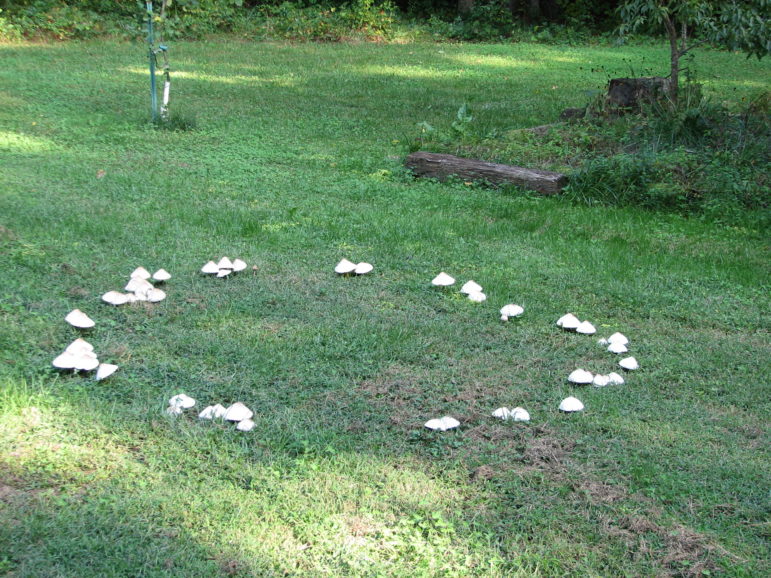
Circles of fungi are often referred to as “Fairy Rings” and in folklore are often said to be magical – Image credit: Aviddoghug at English Wikipedia(Original text: David Gough) – Public Domain https://commons.wikimedia.org/w/index.php?curid=2503987
More specific to core modern Pagan beliefs, group ritual offers a way to tap into the eternal web of existence and feel a deep connection to one another and to all of nature. These transformative spiritual experiences empower individuals and communities and are thus worthy of our time, patience, and perseverance. Collective rituals require people to align their efforts and actions, and success in doing so depends on many factors. When I initially joined the Pagan and nature-based spirituality group at my Unitarian Universalist fellowship, the group was just starting to meet again post-pandemic. There was one individual who had been leading the group on and off for a number of years. Recognizing a need for additional support, I soon began co-leading the group and learning along the way. Despite being a public-facing group affiliated with a local church, we struggled to maintain a stable circle with consistent attendance during the first year I was involved. As we worked to rebuild the circle, I took note of the challenges we faced and began thinking about how to address them.
One of the biggest challenges has been managing movement within the group as a result of people coming and going. Situated in the Bible Belt of the southern United States, our minority faith status is in sharp focus. Pagans in this region tend to stay in the broom closet due to fear of persecution. Attending meetings and rituals, especially public ones, requires being comfortable with others knowing about your religious identity. Some of our members have expressed concerns about family members or work colleagues finding out that they are Pagan or exploring Paganism. Therefore, it is important for Pagan communities to be transparent about how public-facing the group is to help mitigate some of these concerns. Groups can also respond by providing a safe space and validating feelings while encouraging people to live and practice their faith authentically. Our circle started hosting non-public-facing rituals, which has eased concerns, but the fear of being outed continues to limit engagement for some. In the US, I expect these fears will only rise given the current political climate and increasing marginalization of minority communities.
Another source of movement within circles is from Seekers who may attend a Pagan meeting or event out of curiosity. Seekers are not tied to a specific religious tradition and often explore their spirituality by experiencing what different religions offer. In my experience, they are typically transient within Pagan circles and soon move on as part of their own spiritual journey. There are also those who openly identify as Pagan but remain uncommitted to a circle for reasons unknown. My intuition is that some may not see the value of being part of a group and participating in collective rituals, while others have personal reasons that prevent regular engagement. Regardless of why movement occurs, circle leaders and members should expect it at some level and not let this dissuade efforts to cultivate a healthy and interactive community. The hope is that even those who stop in once for an event will leave with a positive experience and a better understanding of what their local Pagan group has to offer. They may connect others to the circle and spread awareness of a safe space for Pagans within the wider community. They also may rejoin the circle when they are called to do so and when the time is right for them.
With that said, nurturing a core group of members within a circle is essential for long-term success. For a circle to function well and maintain cohesion, it needs core members who attend events consistently and perform the work required to host quality meetings and rituals. It was not until my second year as co-lead of our circle that a core group began to form. These were people who, like me, sought a Pagan spiritual community and were invested in helping the group succeed and thrive. They came from different backgrounds and ranged from novice to experienced in their Pagan journey. Fundamentally, they all expressed the joy and benefits they experienced from engaging in group rituals and being part of a like-minded community. As our core group began to solidify and bond through collective ritual, we started to find our stride.
A growth mindset has contributed to developing strong leadership and being adaptive to meet the changing needs within our circle. It is critical for groups to recognize the wonderful diversity within Paganism and among those who follow the path. As a minority faith community with numerous traditions and practices, Pagan circles would do well to celebrate diversity and bring people together rather than fragmenting into microcosms. No two Pagans are exactly alike in terms of beliefs or practices. While some of the practitioners in our circle identify with specific traditions like Wicca, most are eclectic. Some are polytheists, while others are animists or prefer not to be pinned down to one way of thinking. Diversity of belief and traditions allows us to learn from one another and expand our perspectives, which can enrich our spirituality and practice. As mentioned earlier, collective ritual has the power to unite us through synchronized actions even when our beliefs vary.
Diversity, of course, goes beyond spiritual beliefs and practices. At any given event, we have participants from diverse economic, educational, generational, racial, ethnic, sexual orientation, gender identity, and neurodivergent backgrounds. We have participants with limited mobility, from military backgrounds, and those with young children who tag along to events. Circle leaders and members should expect and welcome diversity while considering how the group dynamic and events facilitate inclusion and accessibility. For example, as a nature-based faith, many of our members want to hold rituals outdoors. However, outdoor spaces are not always accessible to those with limited mobility. As a compromise, our group decided that the majority of our rituals would be fully accessible, allowing for some to be held in less accessible outdoor locations. In our communications, we note event accessibility and what to expect so members can make better-informed decisions about their ability to attend.
Like with all things, change is inevitable and will test a group’s ability to adapt. Our leadership dynamic changed when the other co-lead unexpectedly left for personal reasons. Meeting this crossroad prompted me to reevaluate how the group and its activities were managed. By this time, the circle had matured and grown. Our main offerings were in-person monthly meetings and Wheel of the Year Sabbat rituals. Initially, all our rituals were held as Sunday morning services. This was done, in part, to increase the group’s visibility within the fellowship and wider community. Public rituals helped to attract new members; however, as our core group formed, there was growing interest in more intimate (and less public) gatherings. We began experimenting with small-group rituals advertised within the circle email list. These smaller events permitted greater active participation from all attendees, which made them more meaningful. At the time of her departure, the co-lead and I had worked closely together for two years, sharing primary responsibility for organizing all circle events and activities. This included planning meetings and rituals, coordinating volunteers, and managing event logistics from start to finish.
Needless to say, I found the prospect of leading the circle on my own incredibly daunting. The group met a few times to discuss options on how to move forward, and together we decided to launch a circle planning committee composed of our core group members. Over the past year, the planning committee has been instrumental in the circle’s continued success. We have more people providing input on rituals and meeting topics, which has helped us tailor our offerings and consider multiple perspectives on content. We are better at dividing up responsibilities and delegating work to support our activities and prevent volunteer burnout. While most members of the planning committee fulfill vital support functions, it is important to keep in mind that dedicated leadership remains essential for the circle’s longevity.

Ritual Gathering [MJTM
What does it mean to be a dedicated circle leader? In my experience, it means prioritizing the group and its activities, ensuring the circle’s mission is successfully carried out, and maintaining harmony within the group. The circle’s mission should be clearly defined, and leaders can work with members to determine how best to carry it out. Circle leaders are expected to take ownership for the group and assume final responsibility for all group activities. Thus, leaders should expect this of themselves, which avoids diffusion of responsibility and encourages leaders to stay organized, be proactive, maintain transparency, be effective communicators, and manage changes within the circle effectively. Setbacks and missteps will occur, from time to time, and should not be viewed as failures. Strong leaders acknowledge when things go wrong or could have gone better. They seek to understand what happened and why, and use these instances as opportunities to learn how to better serve the circle moving forward.
Furthermore, circle leaders should prioritize the needs of the group as a collective whole. This means no one individual’s self-interests should drive decisions within the group. Decisions should reflect the majority opinion or have majority support in most instances. As noted earlier, Pagan circles tend to be highly diverse across many different dimensions. Conflicts due to differences in circumstances or opinions can be expected. Circle leaders must be prepared to navigate and redirect challenging conversations as they arise, with empathy and respect. Successful leaders have healthy boundaries and help to enforce those boundaries when appropriate. Examples of where this could apply include when a group member dominates a discussion, gets way off topic, or overshares personal struggles or trauma in the wrong setting. In these and other similar situations, leaders may need to restate goals and expectations or have a private conversation with an individual to address the matter. Maintaining a sense of calm while practicing active listening and demonstrating respect is key to achieving a positive resolution to any conflict that may arise.
As far as infrastructure is concerned, circles should strive to meet and host rituals on a regular cadence and have a “home” (primary location) where activities and gatherings often occur. These are core foundations that provide the stability needed to attract and retain members. Successful circles have regular programming that is advertised through familiar means, whether it be social media, email, group chats, etc. Regular programming keeps members engaged, builds trust, and legitimizes the group. Related to physical spaces to host gatherings, Unitarian Universalist churches are a great option if one is conveniently located. UU congregations are pluralistic, multi-faith communities and have been a spiritual home for modern Pagans since the 1970s. Pagan circles often exist within UU congregations, and some, but not all, are recognized as Covenant of Unitarian Universalist Pagans (CUUPS) groups.
If partnering with a UU congregation is not an option, circle leaders may consider other suitable public locations such as coffee shops, libraries, community centers, parks, and metaphysical shops with event space. Public locations are strongly recommended over private residences for the safety of all attendees. Finding public spaces for meetings is typically easier than finding spaces for hosting group rituals. Our circle has performed rituals in public parks, but these can attract the attention of passersby. Circle leaders should consider the safety, accessibility, expected foot traffic, and general suitability of physical spaces before planning to host a group ritual either indoors or outdoors. Any required permissions or reservations for spaces should be handled well in advance.
Now that I have shared my perspective on why pagan circles are important and some of the lessons learned on cultivating a healthy and enduring circle, I want to end with what the Pagan community can do to support their local circle. The most impactful step is showing up for the circle and not taking it for granted. Leading a circle and hosting rituals requires a significant commitment of time and energy. Circle leaders want to serve the greater Pagan community, but in order to do so, the community has to participate and get involved. For those who recognize the value of Pagan communities and collective rituals, I challenge you to consider what you are doing to support your local circle. Practical steps include putting circle events on your calendar and setting a goal to attend so many meetings and rituals each year. Connecting with circle leaders on how to get more involved with events and programming goes one step further. There is also the option of starting and leading a circle in your area to serve the local Pagan community, and I hope this article helps prepare you to do so.
An active circle creates personal connections and allows modern Pagans to fully experience the magic of collective ritual, which heals and strengthens not just the individual but the entire community. Most people have busy lives and are doing their best to navigate competing priorities and endless channels of information piped through our phones, computers, and televisions. Making space for a vibrant spiritual community that supports authentic Pagan expression through regular meetings and collective rituals is not easy. It takes passion, collaboration, and hard work. Ultimately, it is worth it because it enriches our lives, our spiritual practices, and our connections with one another. May we go forth with powerful intentions to weave the web, creating beauty and meaning together. Blessed be.
References:
1 See studies by Harvey Whitehouse, Dimitris Xygalatas, Cristine Legare, Juliana Schroeder, and colleagues.
2 See studies by Michael Argyle, Dimitris Xygalatas, Pascal Boyer, Janet Jacobs, Juliana Schroeder, Jeffrey Snodgrass, and others.
The Wild Hunt is not responsible for links to external content.
To join a conversation on this post:
Visit our The Wild Hunt subreddit! Point your favorite browser to https://www.reddit.com/r/The_Wild_Hunt_News/, then click “JOIN”. Make sure to click the bell, too, to be notified of new articles posted to our subreddit.