

I tricked the ancient Eagle.
I carved the primal Giant’s bones.
I set the land in the sea, and spilled the stars and
sang the runes
I gave you your mind, and I have flown with your
thought and memory.
I can take them all back, and drop them into the
next world.-“When Raven Steals the Sun”
Last month, the Icelandic Metal band Nexion released their third record and second album overall, Sundrung, on the legendary Italian label Avantgarde Music. To make it short, it is an absolute masterpiece, both musically and conceptually.
Active for almost ten years, Nexion has slowly but surely evolved their sound, and, in preparation for this review, I went back to their previous two offerings, their 2017 self-titled EP and their 2020 first full-length album, Seven Oracles, in order to gauge exactly where they were coming from. As I recalled, the Nexion EP was a solid, extremely heavy blackened death metal effort that pulled no punches, while the first album showcased a move away from death metal in favor of a more incisive, melodic black metal, somewhat reminiscent of the so-called “orthodox” scene which is so well represented in Iceland.
It was with those sonic spaces in mind that I approached Sundrung. Recorded almost four years after Seven Oracles, I was curious to find out whether the band had retained their preexisting sound or shifted to something new. The answer was, to my delight, in some aspects a consolidation of the more straightforward black metal nature of the band’s songwriting, coupled with an expansion (rather than a shift) towards other forms of metallic musical expression. As a result, if I had to use only a word to describe the album, it would be “rich.” If I were allowed a few more words, I would probably pick “powerful” and “ravaging.”
As it turns out, although Nexion incorporated a number of more melodious and mid-tempo elements to their newest album, they remain, at their core, an extreme metal band that will scare the average music listener into the dark depths of the earth. If the heaviest thing you tend to listen to is 80s heavy metal or mainstream radio rock, don’t necessarily stay far away from Sundrung, but prepare to be blown away, quite literally, by the violence of the Icelandic quintet’s music.
Beget Chaos. Birth defiance and unmake the state
Defile and transgress upon the civil shrines
Lothur! Burn out the Seals
Above and Below the pathways revealed.
Loki! Sunder the bonds
Over and Under, The Old Ones respond.-“Uþarpaspa”
Despite the album’s brutality, there are two hooks which I think Sundrung could use to infiltrate the minds and the playlists of more peaceable music lovers, namely its concept, and its aforementioned incursions in more melodic territory.
Unlike the band’s previous two offerings, whose concept revolved mostly around an inversion and corruption of monotheistic worship, Sundrung takes on a more Norse-inspired approach. Everything from the lyrics to the artwork reflects a cataclysmic interpretation of pre-Christian Nordic lore, fitting considering the origin of the band and the academic background of singer Joshua Rood.
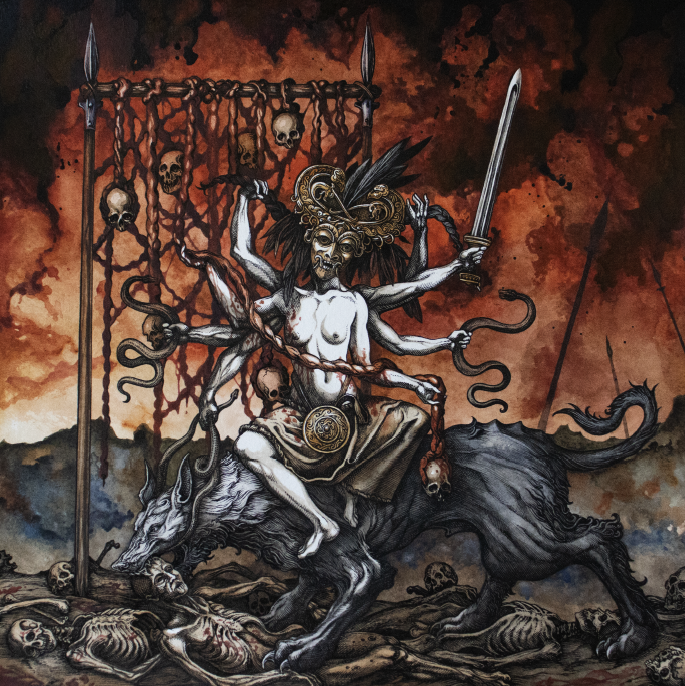
Sundrung album cover by José Gabriel Sabogal.
The cover art is something of beauty, all the while being truly revoltingly vile. It shows, as far as I can tell, a figure inspired by the gýgr Hyrrokkin (the one who pushes Baldr’s funeral ship to sea). Holding snakes in lieu of reins, the terrifying female creature rides a wolf feeding on the corpses of the dead, holding, among others things, thick braids of hair, perhaps a reference to the Old Norse ritual of keeping one’s hair uncut and unkempt while holding an oath.
On her head she wears a mask inspired by Iron-Age depiction of a warrior figures often associated with Odin, and on her hips, a metal plate identical to that of the Egtved girl, a mysterious Bronze-Age figure believed by some to have held a sacral position in her lifetime. Behind the wolf-riding figure, we can spot a loom held by spears, with threads made of entrails, with skulls acting as weights.
As you can see, this artwork, created by longtime collaborator José Gabriel Sabogal, not only looks sick as Hel but always carries deep meaning, which is reflected in the album’s lyrical concept, which was devised by Joshua Rood.
Sundrung, which is Icelandic for “discord” or “disharmony,” refers to the unraveling of bonds that keep the cosmos, humankind, the natural world, and society together. To make it short, Sundrung narrates an apocalypse of titanic proportions, brought about by mankind’s hatred, foolishness, short-sightedness and bloodlust. Incorporating mythical narratives from Old Norse, but also Anishinaabe (“Visions of the Seventh Fire”) lore, Sundrung is a forlorn and raging funereal dirge for an evermore collapsing world.
Burn! Oh Logi of of the Highest Fire!
Burn! Oh Báli of the funeral Pyre!
Burn! Searing Sun of the Spirits of Slaughter!
Burn! And don the destroying hamr of Surtr!
I call thy names, theyre only ones left to call
All other names now forgotten, maddened or no longer hear.
And we are lost on a path that is so black, and barren that only the dead can walk it.
I can hear waterdrum pulse, but its rhythm is far away. It’s of another time. And For us it is too late.-“Visions of the Seventh Fire”
Alternating between the perspectives of mankind’s enthusiastic participation in this cosmic massacre and that of a more distant observer lamenting and warning about imminent destruction, Sundrung avoids the all-too common trappings of extreme metal lyricism, namely sterile nihilism and exhibitionistic vulgarity.
Sundrung actually oozes a sort of dark mysticism which can only stem from a deep understanding of Old Nordic lore. “Hymn of the Valkyrjur” for instance, incorporates stanzas from the often-overlooked skaldic poem “Darraðarljóð,” which is uniquely rich in bloody imagery. “Uþarpaspa,” the album’s opening track, is named after an ancient runic inscription and is conceptualized, according to the band as “a ritual incantation to the spirits of inversion, of subversion.”

Sundrung artwork by José Gabriel Sabogal
The most magickal song of the album, however, is without a doubt “Gandr.” Written in the spell-like meter galdralag, the song is once again extrapolated from a thousand-year-old runic inscription acting as a protection against nefarious spirits which Josh Rood quite literally turned upon its head to create a vicious curse spell. “I have changed the lines so that instead of being used against these unnamed spirits that were buried with a corpse 1000 years ago,” he says, “it calls on them, and sends them to specific unnamed targets. Targets in positions of power and corruption. Nothing makes magic more powerful than to amplify it over thousands of listeners who repeat and multiply it.”
Sundrung’s complex and intricately crafted lyrical concept, although substantial on its own, reaches another level paired with the intense sonic architecture erected by the band’s musical smiths, Óskar Rúnarsson Jóhannes S. Smárason, Kristján Guðmundsson, and Atli J. Martin.
As mentioned earlier, Sundrung retains the grand, fantastically produced biting sound the band had shaped on their previous album Seven Oracles, all the while branching out and going the extra mile to conquer new, even wealthier territories. Although Nexion’s second album is, at its core, a loud, heavy, and aggressive black metal album, one can already get a sense of the band’s progression on the album’s first track, “Uþarpaspa.”
Encased in a girdle of blast-beats, supersonic tremolo-picking riffs and monstrous howls, one may find some truly melodic passages, superbly flowing mid-tempo rhythms and even a fair bit of clean vocal chanting. In a sense, “Uþarpaspa” works perfectly as an opening track as it fittingly represents the artistic orientation Nexion took on the album as a whole. If you are just considering whether or not you should give this album a try, just play that song a few times. If it managed to tickle your fancy, chances are that you will love what’s next.
Over the following six tracks (and a short ambient interlude), the listener will be transported into rich sonic landscapes, where the band alternates between absolutely brutal assaults inspired by old school black metal and less abrasive, yet just as intense melodious highs, flirting with doom-y metal reminiscent of the best outfits of the genre.
Always on point, Josh Rood manages to adapt his singing to this complex, ever-shifting musical scenery like some sort of Hellish summoner: calling in countless spectral voices, nasty shrieks and spell-binding chants, Rood displays a flabbergastingly wide vocal range which perfectly completes the band’s songwriting and gives Sundrung a gusto that was not nearly as noticeable on the band’s previous records.
All in all, Nexion’s second album is nothing short of a complete success. It successfully builds on the band’s musical background, retaining the bite and the might that was already fully developed on the first album all the while surpassing expectations and showcasing novel artistic strategies that truly push the envelope. Gods willing, Nexion could soon become a big name in metal circles, so you better give Sundrung a chance and immerse yourself in this masterpiece of raging pitch-black annihilation. You won’t regret it.
Disclaimer: The author of this review is a former classmate of singer Joshua Rood and a digital promotional copy of the album was sent free of charge to The Wild Hunt in preparation for this review.
The Wild Hunt is not responsible for links to external content.
To join a conversation on this post:
Visit our The Wild Hunt subreddit! Point your favorite browser to https://www.reddit.com/r/The_Wild_Hunt_News/, then click “JOIN”. Make sure to click the bell, too, to be notified of new articles posted to our subreddit.