

Editor’s note: There are some references to animal blood in this column.
In 2024, I was fortunate to attend Midgardsblot for the first time. Taking place every year in mid-August just south of Oslo, Norway, the festival distinguishes itself by appealing to not just fans of any specific musical subculture, but by bringing people from different horizons together for a celebration of music, history, spirituality, and community.
Upon coming home and realizing how amazing the whole experience had been, I could not be stopped from going on long tirades about the festival whenever I got into a chat, not even when talking to family members. I just needed to demonstrate to everyone I knew, and especially to my dear wife and daughter, how uniquely cool Midgardsblot really was.
This year, thanks in part to relocating to more southerly latitudes, it became possible to make a swing trip to the festival at the end of a longer family vacation. Finally, I would be able to experience Midgardsblot in a family setting and see for myself how the experience compares with hanging out with my bros as I did last year.
Alongside the change of company came some logistical challenges as well. While in 2024 I was able to stay at a friends’ place in Moss, a mere short bus+ferry ride from the festival, this was unfortunately not possible this year. Not wanting to tire ourselves out at the tail end of a long car-less trip (we went through 3 countries and 11 towns in two weeks using only trains, busses, and ferries) or spend huge sums on hotels or tenting, we accepted a friend’s offer to crash at her place in Oslo.
Now, although Borre, where the festival is held, lies just 60 kilometers (37 miles) from Oslo, getting there was harder than expected. Due to work on local rail network, the nearby train line was still non-operational when we set off on our trip, so what could have been smooth, one-hour long ride was replaced by a much longer detour east of the fjord combining boat and train. Although it was pretty comfortable and smooth, this seriously limited our time on site, especially in the evening, so we decided to focus on Friday, where the musical and academic lineup seemed the most promising.

Moshpit at Midgardsblot 2025. Photo by Lyonel Perabo.
Before that, though, I wanted to take a shorter swing to Borre to help my ladies get the lay of the land, take our wristbands, and also witness one of the festival’s most recognizable and advertised events: the blot. Organized by Folket Bortafor Nordaviden, an outfit which has progressively become a sort of house band for Midgardsblot, the blot revolves around a drum circle set up in front of the festival’s second largest stage. There, under clouds of incense (or was it sage?) and facing wooden god-poles, anyone who so wishes, may enter the circle, where a small vessel filled with blood purchased from a local butcher shop stands, and anoint him or herself with it.
In the minutes preceding the opening of the ritual, which serves to formally kick-start the festival, collective anticipation is palpable. Hundreds of people have already surrounded the very small (no more than 5 meters/16 feet across) circle, all eagerly awaiting the chance to smear themselves in the thick liquid of (most likely) bovine or ovine origin.
All of a sudden, one member of the crew, wearing, like most of his comrades, Norse-inspired garb, utters a few elusive words. The crow goes wild, the drums start beating. The ritual-master seizes a bundle of freshly cut leafy branches and dips them in blood before smearing the statues of the gods with it.
Next, three or four people step inside the circle, or rather, six or eight, as each of these fully grown adults carries a small baby in their arms. The little ones, likely no more than six to 12 months old, all dressed in iron-age style linen shirts, are then, quite literally, baptized in blood as the ritual-master, to the crowd’s wild delight shouts each of their names, before applying a small amount of the liquid unto their foreheads.
As the toddlers are transported a few yards away, where they would spend the remaining of the ritual rolling in the grass on their diapered bums, the general public is finally invited to the circle, one by one, to commune with the gods, with the land, and with their community.
Although festival representatives routinely try to provide nuance to the meaning of the blot and depict it as being not, or not only, an act of religious observance (a recent Instagram post described it, for instance, as “a modern, inclusive, and non-religious gathering”), when witnessing it, it is hard to see it through a purely secular lens. Would most of the blood-anointed participants necessarily describe themselves as Heathens or Pagans? This is hard to gauge (and could be the topic of some interesting research) but I would wager that pretty much all do it, at least partially, on spiritual grounds.
As I ponder these thoughts, I turn back to my wife. She utters, stone-faced, “this is it?” “Looks like, yep,” I answer.
“I thought there would be some kind of ceremony or something,” she says.
“I guess it is hard to coordinate something interactive with so many people where there is little space and manpower available” I retort.
Unfazed, she brings up her extensive experience with Pagan and New Age festivals in the US, where, she states, much grander ceremonies are arranged without any issues. Not knowing what to answer her, I remain quiet.
A few moments later, upon gazing at a bearded man who has covered his entire face with blood, she recoils, a jarred expression on her face. “Now that is a bit gross,” she says. “I don’t get why people need to put blood on themselves.”
“It’s partially to look cool you know?” I answer. “By marking yourself with the blood, you show that you have been there from the very beginning of the very first day of the festival, that you are truly hardcore, that you’re committed.”
“So, basically, if you have blood on your face, it shows that you are with the cool kids?” she asks, to which I answer, “Yep, and some people don’t even wash it off until the festival has ended.”
My wife falls silent, an incredulous look on her face, marking the end of the discussion.
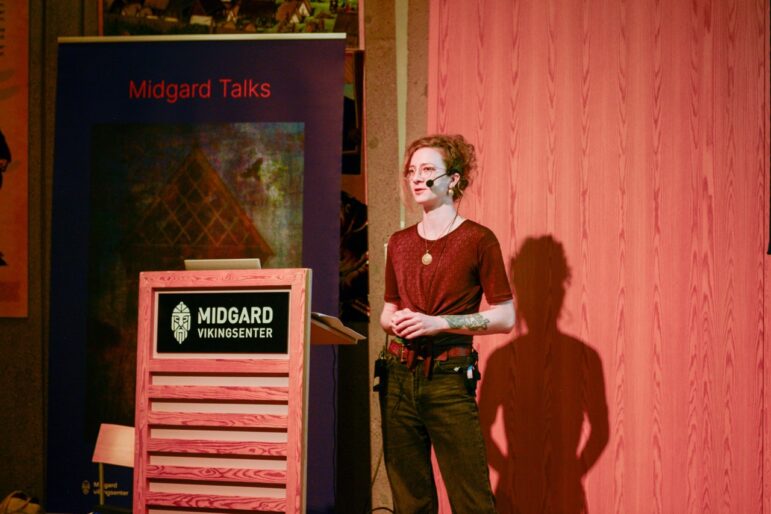
Charlotte Wenke presenting at Midgard Talks 2025. Photo by Linnea Nordström.
Unlike the blot, which I had missed last year, I was already familiar with the festival’s academic lineup, organized by the Midgard Viking center, a branch of the local Vestfold Museum. This time, I was lucky to witness the talks of Amina Otto, and Charlotte Wenke, two PhD students who shared aspects of their research – the former focusing on the use, communication and display of Viking-era gold treasures, and the former on the mythological and folkloric myth of, fittingly enough for our publication, the Wild Hunt.
I was also very much looking forward to hearing Josh Rood, with whom (among others) I participated in a roundtable at last year’s festival. Josh’s talk, coinciding with the rising of statues of Hugin and Munin on the festival grounds and focusing on (to oversimplify) mythical memory and the transmission thereof, was received with much enthusiasm in the museum’s fully packed conference room. Later, I also got the opportunity to hear him during a storytelling session on the small stage by the festival’s market square, this time, recounting the Sörla þáttr myth of the goddess’s acquirement of her magnificent necklace.
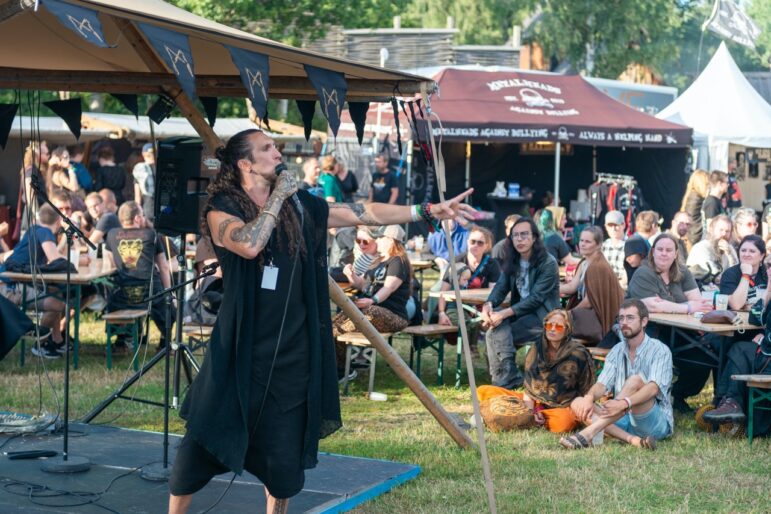
Josh Rood at Midgardsblot 2025. Photo by Lyonel Perabo.
On that occasion I also met up with a couple other scholars, some whom I had met mere days prior in Poland, where I had attended this year’s SAGA Conference, and others whom I had not seen for years, if at all. Once more, Midgardsblot proved to be a perfect meeting place, drawing in such a huge variety of people that it is downright impossible not to run into a bunch of people you know. Case in point: even before we got to the festival, as we waited for the ferry, we bumped into Pål-Cato and Viggo, with whom I had spent last year’s fest.
But Midgardsblot is also a place for new encounters, epitomized, at least for me this year, in Markus, who ran the Nordic Mission record stand. As I noted with more than a little bit of befuddlement in 2024, one of the best stands on site was Nordic Mission, a Norwegian Christian Metal label, which also works as a festival distributor for more profane Norwegian outfits. As I stood by the stand, looking for a souvenir for a young co-worker of mine who, surprisingly enough, is into physical music, I started to chat with Markus. I thought: I am supposed to be doing journalism today, right? I guess I could ask that dude a few questions.
As it turned out, Markus and I had a pretty lively and constructive conversation. I, as a very much non-Christian metal fan, mostly wanted to ask him what he was doing here, not only attending a very un-Christian event, but even helping to promote bands whose message go completely against his creed. Nonchalant, Markus shared with me his experience being a Christian Metalhead in Norway, an existence that does not come without its set of challenges. (“Back in the nineties, we Christians were not very welcome in the Metal scene,” he said, “but as metalheads, we were definitely not welcome in most church milieus either.”).

Markus from Nordic Mission at Midgardsblot 2025. Photo by Lyonel Perabo.
Still, Markus’ tale remained surprisingly free of any judgmental outlooks or adversarial rhetoric. When I brought up the fact that I saw him hanging around and even filming the festival’s blot ceremony, he told me that, as a Christian, he feels somewhat closer to people who engage in these kind of spiritual practices, as opposed to people who reject faith outright, and that it is one reason why he feels very comfortable at such a heavily Heathen and Pagan-themed event as Midgardsblot.
A little bit surprised by Markus’ display of undogmatic acceptance, I bring up the much touchier issue of political expression and alignment that have generated much controversy in parts of the metal scene, especially in the past few years. In such cases, metalheads who disagree with a band or an artist’s ideology, politics, or even image, will blacklist said outfit and instead seek similar acts displaying values more aligned with their own.
Unfazed, Markus rubs his shoulders before saying: “For me, I don’t see it that way. In my opinion, metal is music. It is art before anything else, and I support the freedom of expression, mostly because, deep down, it’s quite simple: I just really like metal.”
When I then ask him if he ever encounters hostility from some festival-goers, he answers that it is very rare, and never serious. “What happens a lot more are meetings like this: people just come by the stand and we have a pleasant conversation,” he says. “I am not here to preach, maybe to listen. I have nothing to sell.”
“Maybe some CDs?” I counter.
To which Markus answers with a big guffawing laugh. “Yeah, you are right, maybe some CDs.”
As I prepare to take my leave from the Nordic Mission stand, I am still mulling a bit over which of those CDs to get my coworker. Markus brings up Koldbrann’s latest album, Ingen skånsel, a highly praised followup to their 2012 album Vertigo (which I happen to own and love). In the end, though, I choose an album I already know, namely Taake’s masterful third album, Hordalands doedskvad, before heading towards the stage to check out the musical side of Midgardsblot 2025.
As mentioned earlier, we had chosen Friday as the day to focus on for this year’s festival, mostly because the day’s lineup looked the most eclectic of the four. With extreme metal a plenty but also a good array of less abrasive folk acts, it seemed to capture the festival’s identity pretty well.
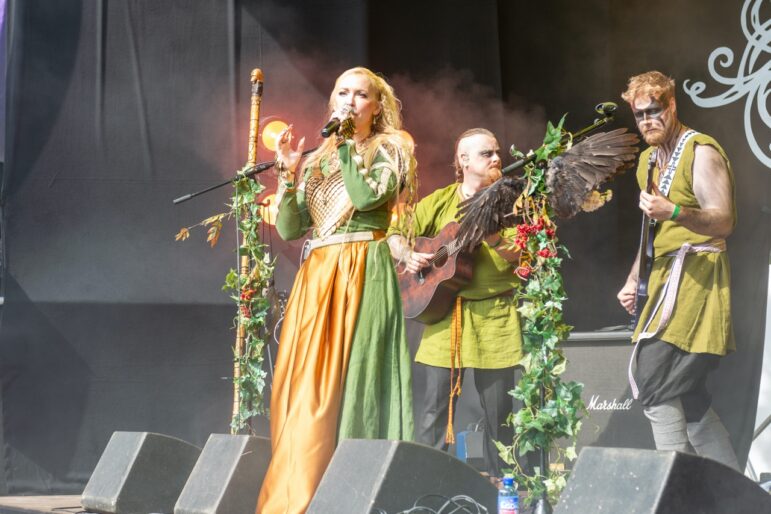
Voluspa at Midgardsblot 2025. Photo by Linnea Nordström.
The first band we got to experience was Vǫluspá, a Norwegian Folk Rock band drawing inspiration from Nordic folklore and pre-Christian myths. Fronted by Sól Geirsdóttir, arguably the most famous Viking reenactor and social media influencer in Norway, the band delivered an energetic set on a heavily redecorated Valhalla stage, effortlessly blending subtle acoustic melodies and catchy vocals. In many ways, Vǫluspá’s performance was the perfect way to start our musical day at the festival, and judging by the way the members of the public reacted, we were not the only ones to think so.
Next, I thought it would be neat to check out the Gildehallen (feasting hall) scene. Set up in the museum’s reconstructed longhouse, the stage generally welcomes smaller bands or solo artists in a club-like atmosphere which gives very different vibes from the outdoor concerts taking place simultaneously just a stone throw’s away. There were a couple bands I was curious about that day, but I decided to give the long-hall an early try just to gauge at how feasible even getting access would be.
Just like last year, the answer was: barely. Holding on my daughter’s hand at the threshold of the building, it took us 20 minutes to be able to get in, and 10 more to reach the main room where the concert was taking place. Once we were there, we were able to get glimpses of North-Norwegian melodic black metal band Iskald enjoying the undivided attention of a conquered audience. My daughter, siting on my shoulders, even managed to throw in some devil horns after noticing a bunch of other people going at it, and later told me she had had a cool time.
Still, for me, standing in the outermost corner of the room, with all her weight on my back was far from ideal, so we ended up leaving after a few songs, and I definitely gave up heading back for later acts. A bit of a disappointment, as I would have loved to see the Japanese avant-garde legends Sigh, among others. I just did not think that starting to queue an hour in advance would be very feasible.
Instead, we went back to the festival’s marketplace to get some food and browse various wares. Overall, although it is still small, I found the market to be livelier this year, with more sellers and attendees than in 2024. There was plenty of choice among various food stands and trucks, bar tents, craftsmen and merchandise distributors, and my wife even found herself a fitting Iron Age-style dress, something she had been on the lookout for quite a while. We could honestly have stayed at the market much longer, but TNT was starting and I felt that it would be important to hear them.
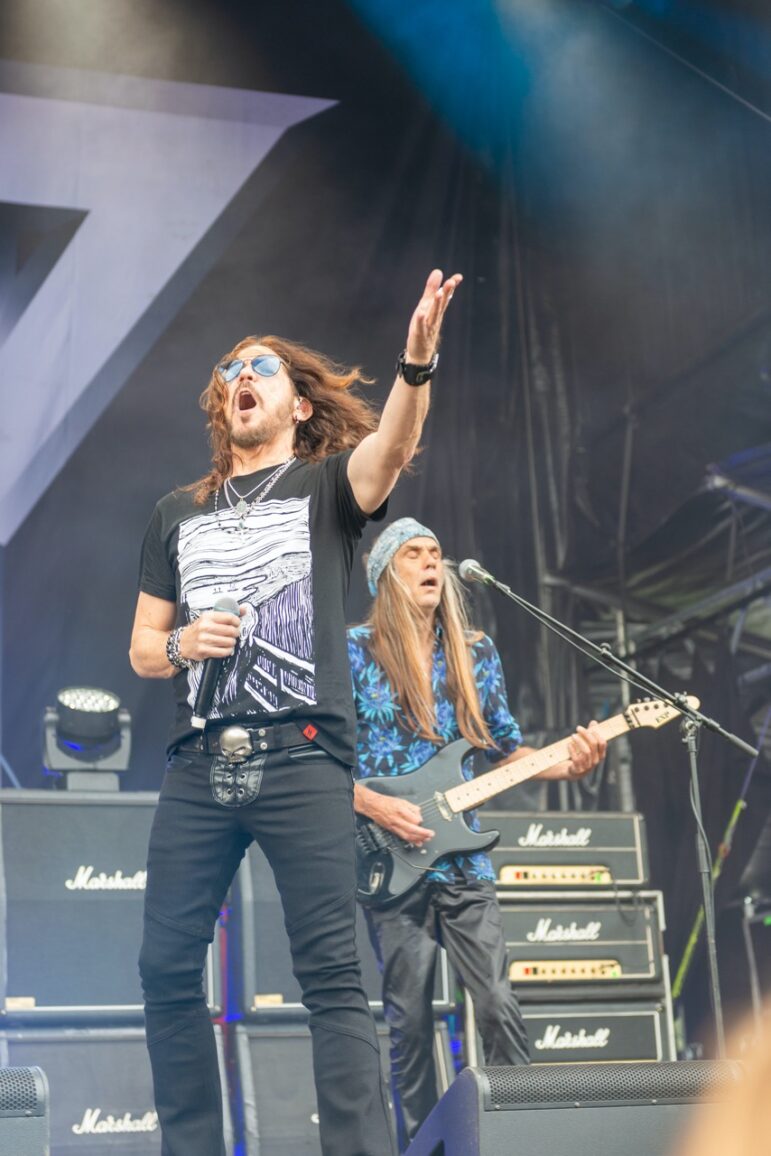
TNT at Midgardsblot 2025. Photo by Linnea Nordström.
Formed in the early 80s in Trondheim, TNT are one of, if not the, most emblematic Norwegian heavy metal bands. Their music, classic eighties Metal, fluctuating between easy-listening ballads drowning in keyboards and more traditional heavier, guitar-driven tracks falls, it has to be said, a bit outside what most people would associate with Midgardsblot. Nevertheless, due to their legendary status, the band brought in a huge crowd. Technically speaking, TNT was absolutely flawless. Vocals (including female backing singers), strings, keys, drums – everything was both finely mixed and magnificently played.
I was especially impressed by the vocal performance of lead singer Tony Harnell, who sang on arguably the band’s most successful early albums. Sporting a Munch’s “Scream” t-shirt (no doubt snatched at the museum in downtown Oslo), Harnell jumped around the stage, chatted with the audience, and hit all those high pitched notes he filled the band’s album with decades ago.
All in all, TNT’s performance left only a single thing to be desired: they forgot to play “Thor with the Hammer,” one of their best early songs, which would have fitted with the festival so very well. True, they played the Viking-themed “Seven Seas” to close their set, so it was not all bad, but still, I am a tiny tad disappointed for this oversight.
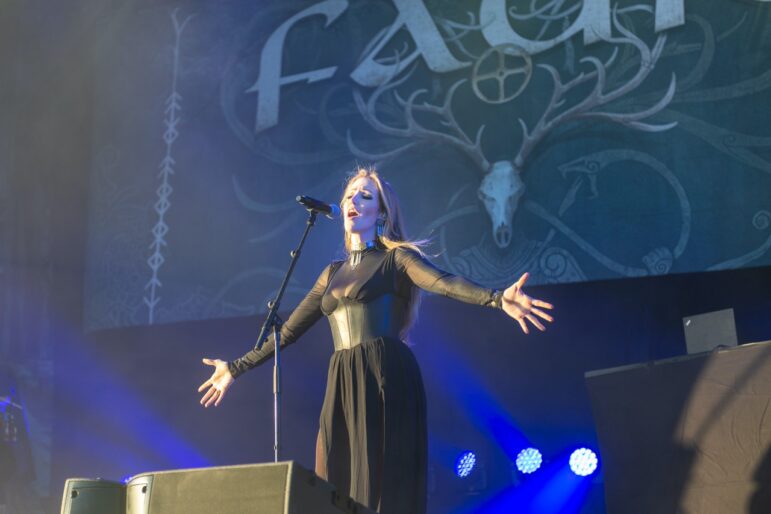
Faun at Midgardsblot 2025. Photo by Lyonel Perabo.
The next band on the big stage was the German outfit Faun. Emblematic of the popularity of medieval and golk inspired rock in (mostly the German-speaking parts of) Europe, Faun might not have been the heaviest band to ever have played at Midgardsblot, but they completely delivered nonetheless. Anchored by a variety of folk instruments (hurdy-gurdy, bagpipe, mandolin, nyckelharpa, etc…), Faun’s music features catchy melodies, anthemic singing (both male and female) and plenty of folksy, witchy, and Pagan-y elements.
To say that the band got the party going would be an understatement. Getting on stage as the sun began to set, Faun ushered the public into the night with their dynamic and melodic numbers performed with great enthusiasm and a towering stage presence. The band was clearly having fun and the only issue they me through their set was less than optimal mixing of the background’s electronic beats. Yet, even if some songs got quite messed up by the distorted rhythms, it did not dampen the public’s enthusiasm much. As Faun was closing their set – with a song about the Horned God, no less – a spontaneous conga line arose, going many rounds through the audience and spreading good cheer through the quickly darkening festival grounds.

Ensiferum at Midgardsblot 2025. Photo by Lyonel Perabo.
With the sun down, came the last gig of the evening, at least for us, namely Ensiferum. Playing on the smaller Valhalla stage, the Finnish quintet was already blasting through their folksy power-metal anthems when we got there and did not slow down one bit until they played the last chord of their last song. From the get-go, Ensiferum delivered straight, no-nonsense Metal with a capital M. Loud, crushing guitars, angry, yet catchy vocals, head-banging aplenty, and a couple of air-fans turned to 11 to keep that hair flowing.
In front of the stage, a literal sea of over-eager fans completely taken by the band’s heavy metal extravaganza. During pretty much every song, a group of zealous attendees even burst out in ever wilder moshpits where drunken, barely clothed metalheads, chain-mail wearing vikings, and diminutive hippie-goth girls alike met and relished in a storm of flowing and thrashing flesh.
As I witnessed the spectacular and near-theatrical show, memories from my younger days came back to the surface. This was when, during my first trip to Finland, I found Ensiferum’s third album in a second hand shop in Helsinki; that CD fueled my entire summer. Fifteen years later, I can say that the band’s performance left nothing to be desired. My only point of criticism, as someone who has not kept up with the band’s latest releases, was the lack of some old classics such “Lai Lai Hei,” “Victory Songs,” or “Old Man.” But then, the band only had 45 minutes to defend their legacy, and the inclusion of the anthemic “Token of Time,” and especially “Wanderer” (which your humble servant sung joyfully, alongside it seemed half of the audience) made up for it in full.
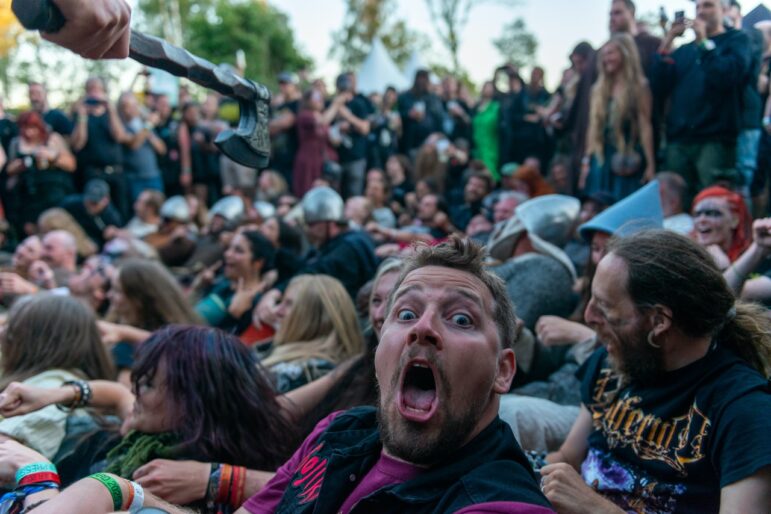
Fun times at Midgardsblot 2025. Photo by Lyonel Perabo.
By the time Ensiferum concluded their set (with their classic “In My Sword I Trust”), night had fallen over Borre and Midgardsblot. As the legendary Norwegian Black Metal band Mayhem was starting their set, it was unfortunately time for the Wild Hunt crew to head back to town. Missing such a promising show was quite a pity, but it was a choice between that and missing the last train back to town.
As I headed out of the festival grounds and heard the total fury unleashed by Mayhem and the roar of the conquered crew, I wrote a mental note to make plans for next year’s festival much, much earlier, and secure housing as close to the festival grounds as possible. As fun as experiencing the festival in a family setting was, there was just too much to do, too many people to see, and too huge distances to cover to fully immerse ourselves in the festival for just a single day. Had I been on my own, I think I would have managed well enough, but particularly with a small kid, and press duties to boot, a single, shortened day at Midgardsblot did get a bit stressful at times.
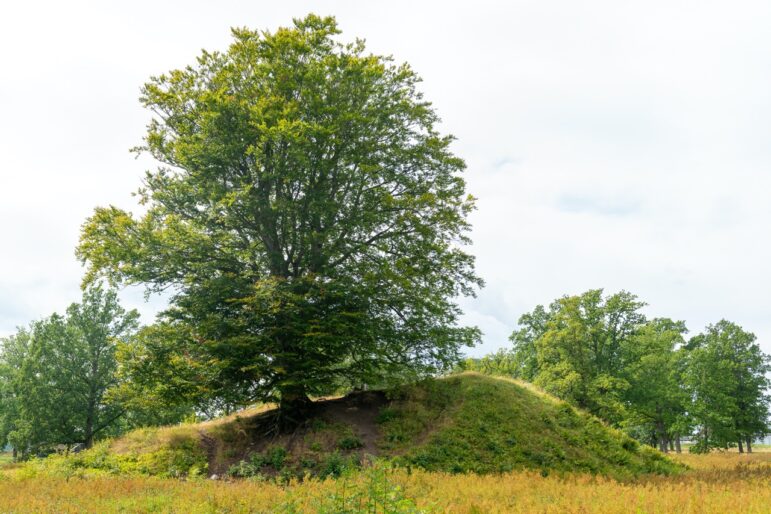
A Viking Age burial mound by the Midgard Viking Center museum. Photo by Linnea Nordström.
Still, I don’t regret coming back to Midgardsblot and digging deeper into the multiple layers of this intricate and multifaceted event. Last year I felt like I had discovered something too good to be true. This year, I feel like I have just began to truly engage with the community and the inner working of what remains, regardless if you are there for a day or more, a crucial experience any Pagan, Heathen, Metalhead, or Witch ought to partake in.
The Wild Hunt is not responsible for links to external content.
To join a conversation on this post:
Visit our The Wild Hunt subreddit! Point your favorite browser to https://www.reddit.com/r/The_Wild_Hunt_News/, then click “JOIN”. Make sure to click the bell, too, to be notified of new articles posted to our subreddit.