

“Capitalism wants to assign a value to each of us, based on our ability to generate profit for the owner class. They want to turn each of us into assets, pieces of capital, and decide whether we’re worth investing in. But we don’t have to live that way, none of us does. We can live for ourselves and the people we love.”
— Lessons in Magic and Disaster, by Charlie Jane Anders
A young Witch and academic named Jamie living in New England has a couple of things going for her: a supportive partner, a community that shares her socialist values, and an ongoing magical practice that makes the way clear for her to have what she wants. She decides to upend all of this to teach her mother how to do magic, which goes better than she expects, and then much worse.
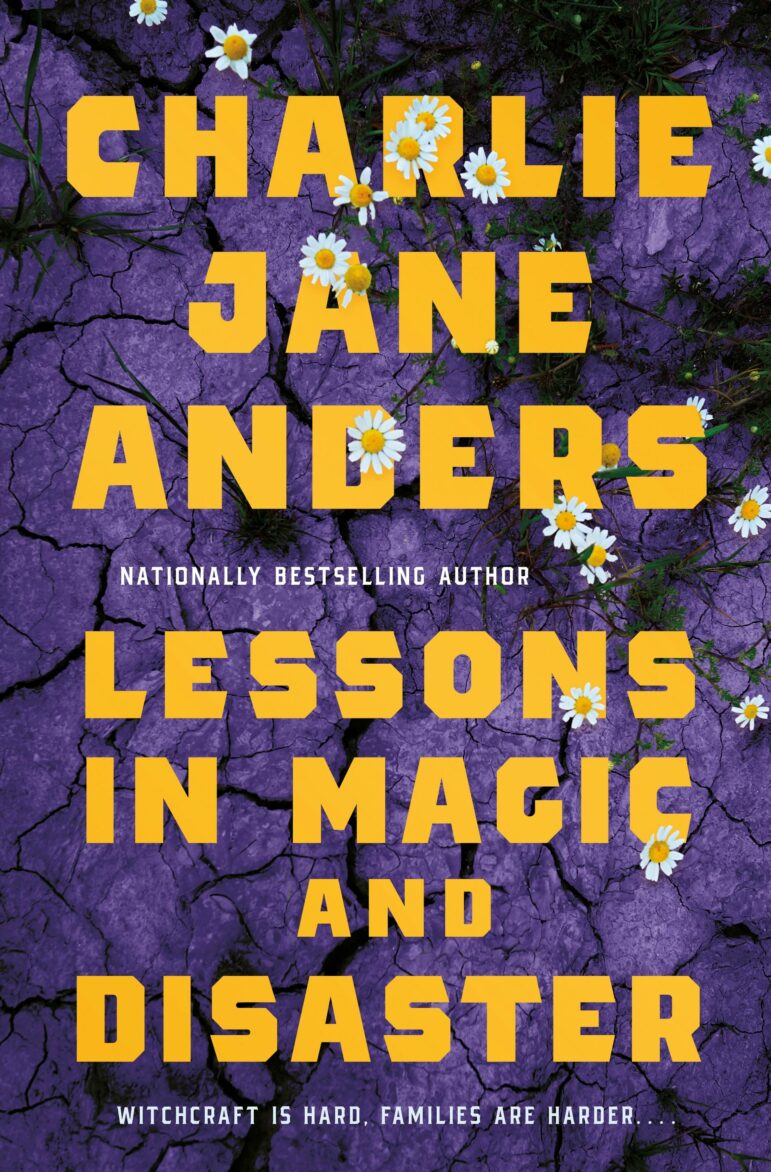
Cover to Lessons in Magic and Disaster by Charlie Jane Anders [Macmillan]
It’s famtrad meets family therapy in Lessons in Magic and Disaster, the newest of Charlie Jane Anders’ books to dazzle and dominate the lists of books every queer spec-fic nerd should be reading, but I’m here to tell you that it’s also a book for Witches. It’s about family driving us crazy and politics taking our jobs, about sacrifice and secrecy, and it deals better with what it is to be a Witch than almost any of the how-to manuals that have come out of the publishers that corner the market on books for Witches since the ‘90s renaissance.
Jamie’s mother Serena lives in a state of perpetual mourning for her dead wife. Jamie has the bright idea one day that she can crack through that grief, intergenerational queer trauma, and worsening political and professional landscape, as well as the difficulties in their relationship, by teaching her mother spellcraft. It’s not a structured practice as many Witches would recognize it. Jamie chooses a half-wild place— the empty foundations of a long-gone building or a former garden gone to seed— as the liminal, in-between sort of place where she can make an offering and ask for the object of her desires. When I encountered this, it reminded me of the liminal space called for by many practitioners: Gardner, Buckland, Sanders, and others have suggested a state of “neither bound nor free” to elicit the best state of mind and thus the best results. This was not where my sense of recognition ended, either.
The main struggle of the book is that Jamie believes in the necessity of wordlessness and secrecy to keep her magic potent and pure. Though she and her mother incorporate words and chanting into their shared workings, Jamie much prefers to say almost nothing. In teaching, she leans heavily on the experiential nature of learning on the job. She thrusts her mother right into the middle of casting not circles but straight arrows of desire, ambition, and revenge. Her lessons dwell on how the working feels and what consequences it brings on, not in worksheets of terminology or an assignment to label the spokes of a wheel. This, too, rang true to me. Though I belong to a tradition of Witches who keep a book and strive to write everything down, I mostly feel (like Anders, like Laozi) that the magic that can be named is not the real thing. The practice transcends language and is often cheapened by it. But Jamie’s worry that speaking the truth of what has transpired will ruin the efficacy of her works keeps her from saying some important things, leading to more trouble.
The real peril in Lessons in Magic and Disaster does not arise because Jamie and Serena are Witches; the danger lies in being publicly queer. Serena, a lawyer and advocate, has worked to protect her family on a legislative level, to shield her sometime sex-worker wife and her trans daughter. The trans daughter goes on to become a public intellectual who catches the attention of a reactionary conservative think tank intent of catching her on camera indoctrinating college students with gender ideology such as “some novelists are gay” and “the concept of gender is not static over the course of history.” (Jamie is hurt by what comes her way, but it doesn’t stop her from fighting, doesn’t even slow her down. Her declarations on what we are living for, for ourselves and for community, are the strongest parts of the novel. They made me forgive the novel’s hubristic idea that anyone, even a very powerful Witch, can successfully therapize an avoidant and self-centered parent through the powers of magic and communism.

Charlie Jane Anders [Sarah Deragon/Portraits to the People]
While all this is going on, Jamie is also deep in research on an 18th century text that carries secrets within it that I’d rather not spoil. I’ll just say that this is a good book for fans of A.S. Byatt’s Possession, as well as readers of Alice Hoffman’s messy magical families. There’s a touch of dark academia here, leading to my very favorite quote from the novel:
“Freaks and perverts created all the culture worth talking about. That’s how it’s always been. The people who have to go into the most desolate places and wallow in dirt just to find something, anything, that they can hold onto.”
Anders is correct, and as a freak and a pervert who creates culture, I’m reporting for duty. This is a wonderful book for freaks and perverts, for scared and tired academics, and for Witches who like to see Witchcraft done in new and interesting ways.
Lessons in Magic and Disaster reads like a wholly homegrown idea of what Witchcraft might look like if no one had ever told you what you’re not allowed to do. It’s my Witchy read of the fall, and I hope it will be yours, too.
Lessons in Magic and Disaster is available from Tor Books, wherever books are sold.
The Wild Hunt is not responsible for links to external content.
To join a conversation on this post:
Visit our The Wild Hunt subreddit! Point your favorite browser to https://www.reddit.com/r/The_Wild_Hunt_News/, then click “JOIN”. Make sure to click the bell, too, to be notified of new articles posted to our subreddit.