
In a bizarre series of seemingly connected (but more likely disparate) stories, Russian media and pro-Kremlin voices have accused Pagans, Witches, and even Celtic festivals of undermining Moscow’s war effort in Ukraine. These accusations, at once sensational and contradictory, are part of a well-honed propaganda strategy: portraying Ukraine as a Satanic, Pagan, Nazi state while casting Russia as the bulwark of Christian civilization.
Since the Euromaidan protests of 2013–14, Russia has relied heavily on the myth of a “Nazi-ruled Ukraine” to justify aggression. Kremlin disinformation insists that Ukrainian nationalism is inseparably tied to Paganism and Satanism, claiming that the country has been “saturated with Nazi ideology” since independence. According to this narrative, neo-Nazis spearheaded the revolution, paving the way for a godless, Western-leaning state that Russia alone could oppose as Holy Defender.
This framing allows Russian propaganda to mix cultural fear with religious fervor. By invoking “paganism,” pro-Kremlin media seek to demonize not only Ukraine’s armed forces but also broader European values. Such reports blur fact and fabrication, suggesting that eclectic religious practices among some troops constitute an organized “pagan” cult bent on Nazism.
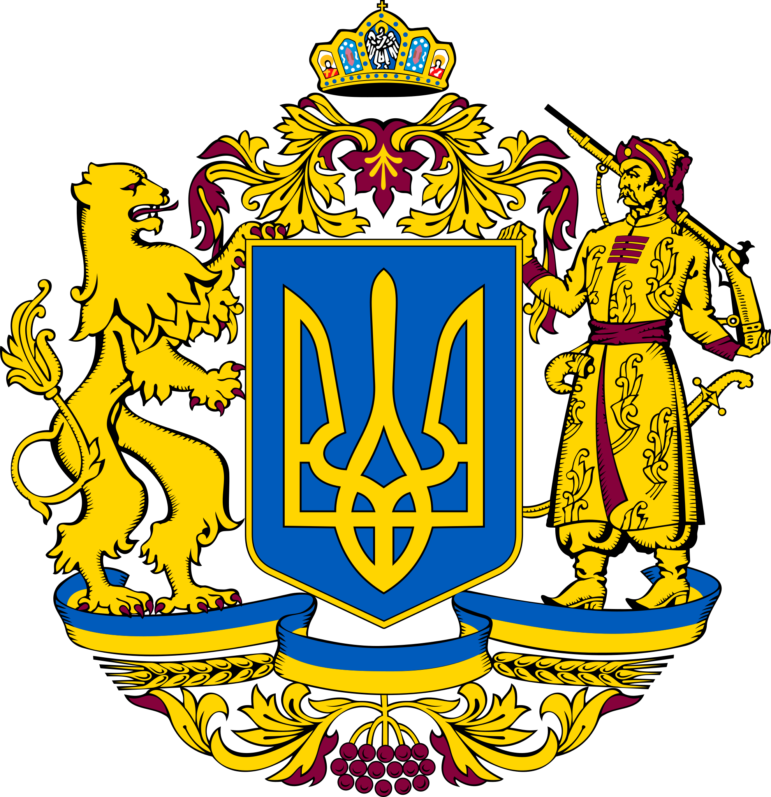
Seal of Ukraine [public domain]
The propaganda machine has grown even more surreal. On June 4, Ukrainian military blogger Denys Kazanskyi reported that a Russian Telegram channel accused a witch, who also, by reports, writes erotic novels, of helping blow up Russian military aircraft. This is not a reference to the Bucha witches, the women in the Ukrainian army trained to take down drones. This is an imagined erotic novelist witch.
“The terrorist’s wife also writes pornographic books. In Russian, of course. And she’s a witch. Just look at this combo: terrorism, Satanism, debauchery. That’s Ukraine in a nutshell — in three acts,” one post declared. The post on social media has since been removed.
Kazanskyi noted the absurdity of the claim but pointed out that such stories serve a purpose: to frame Ukrainian resistance as not only criminal but cosmically evil. The identity of the supposed witch remains unknown, but the narrative was widely circulated in pro-Kremlin groups, fueling the fantastical link between Ukraine and “black magic”.
If such claims sound absurd, Russia’s own political figures have further complicated the narrative. The propaganda’s contradictions are highlighted by the curious case of Natalia Poklonskaya. A Ukrainian-born lawyer who defected to Russia during the annexation of Crimea, Poklonskaya once embodied the Orthodox nationalist image. As Crimea’s prosecutor, she was a hero to Russian media and was later elected to the State Duma in 2016.
But her trajectory shifted dramatically. In 2022, she denounced Russia’s invasion of Ukraine, calling it a “catastrophe” and describing the “Z” war symbol as a sign of “tragedy and grief.” She was swiftly dismissed from her government post.
Since then, Poklonskaya has repeatedly startled Moscow by publicly celebrating Pagan festivals. In September 2024, she marked Mabon, the autumn equinox, on her Telegram channel. Earlier, she acknowledged Samhain and, in April 2025, offered greetings for Beltane, describing it as a holiday carrying the “power of Mother Earth.”
She wrote:
“This is the time when the Earth has borne its fruit for us humans, the harvest has been gathered, and the cold weather is approaching, as people prepare for winter. It’s the turning point between summer and winter, when day and night are equal and the element of Water begins to fall asleep, a time when the rhythm of our lives changes: external work ends and internal work begins.”
Such posts sparked outrage from the Russian Orthodox Church, which warned against a “revival of paganism.” Online critics nicknamed her “Idolopoklonskaya”—a pun linking her surname to “idolatry.” The irony was rich: the former crusader against “sacrilege” now embracing Celtic neopaganism.
Adding fuel, Russian media revealed Poklonskaya’s tattoos: a phoenix, entwined snakes with a lotus flower, and a tree of life with runic symbols. Whether these mark a true religious conversion is unclear, but her defiance unsettles a regime eager to claim moral supremacy.
The obsession does not end there. Last week, Yan Gagin, a Russian military-political expert, alleged that Ukrainian troops had left behind what he termed a Pagan-Satanic altar at a campsite in Kurakhovo, Donetsk. Gagin, who teaches at Moscow State University’s Sevastopol branch and specializes in “psychology of survival,” described a sinister discovery.
“This religious Satanic kit came with detailed instructions,” he said. “Here are several photographs illustrating how to set up this altar. Here are weapons, and these black candles lying down there… Here is a gong, a pentagram made of machine guns, which indicates that the kit was intended specifically for military personnel. The instructions… describe quotes from the Satanic Bible that can be written in Ukrainian, and these quotes themselves.”
The video is obviously staged, and the imagery, machine guns arranged in a pentagram, reads more like a dark fantasy novel than a battlefield find. Yet the story was amplified in Russian outlets as proof that Ukrainian soldiers worship Satan and are involved with Paganism.
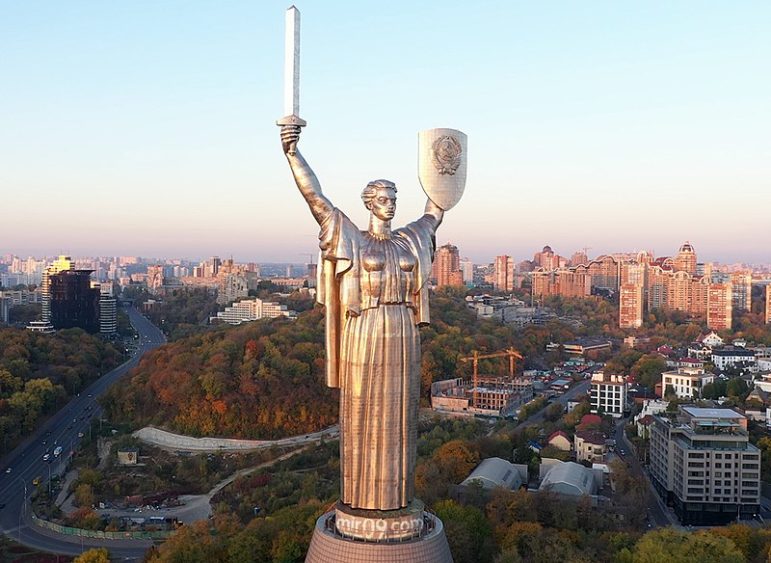
Motherland Monument in Kyiv, Ukraine [Photo Credit: Mir09info – CC BY-SA 4.0
The recurring theme is no accident. Paganism appears to be a convenient foil for Kremlin propaganda. Using paganism evokes barbarism, chaos, and heresy in the Russian Orthodox imagination. By linking Ukraine to Witches, Satanists, and Pagan images, Moscow’s narrative paints the war not merely as a geopolitical struggle but as some kind of religious cosmic battle of light versus darkness.
More importantly, this framing also distracts from Russia’s military failures. When planes are destroyed or offensives stall, it is easier to blame witches than to admit battlefield weakness. Stories of satanic altars or erotic-novelist witches externalize the problem: Russia is not losing to a smaller neighbor but rather to unholy forces with supernatural powers.
At the same time, highlighting Paganism undermines Ukraine’s Western allies. In Kremlin discourse, Europe and America are depicted as decadent, “godless,” and permissive of Pagan revival; thus, Ukraine is framed as their corrupted offspring.
Poklonskaya’s embrace of Pagan symbolism, whether sincere or performative, illustrates that spiritual dissent exists within Russia itself. The more the Kremlin demonizes paganism, the more it can distract from failures while also harnessing fear to further its plans.
The fantastical claims, nevertheless, often invite ridicule. A witch blowing up bombers, I’ll grant you, but a pentagram of machine guns?
As Russia struggles to maintain its crusading image of a Christian bulwark, it finds itself haunted not by Ukrainian witches but by its own overblown myths of power and control.
However, the use of pagan imagery is not benign. These images may spread online to test the strength of Russia’s disinformation machine. But they also gain traction in the West, and especially in America, where the fear of a rising “Pagan Threat” has gained traction.
Similar tropes migrate easily: Russian state-aligned stories about ‘pagan sacrifices’ by Ukrainian ‘neo-Nazis’ have already surfaced in Western discourse via aggregation and social media. Russian propaganda may have woven a tapestry of obsession around Paganism in Ukraine, but similar forces are at work in the West. In the end, Moscow may fear witches, but what truly haunts it is its own crumbling myth of invincibility. However, while these stories may mix the absurd with the sinister, they also mobilize religious paranoia.
The Wild Hunt is not responsible for links to external content.
To join a conversation on this post:
Visit our The Wild Hunt subreddit! Point your favorite browser to https://www.reddit.com/r/The_Wild_Hunt_News/, then click “JOIN”. Make sure to click the bell, too, to be notified of new articles posted to our subreddit.