

Today’s article comes from Alex J. Coyne, a journalist, author, and proofreader. He has written for a variety of publications and websites, with a radar calibrated for gothic, gonzo, and the weird.
Online connections and cyberspace meetings almost became the new normal after the coronavirus pandemic. After receiving my first wedding invitation in years to digitally stream a friend’s marital rites, I realized that many more ceremonies and rituals are taking place on the internet right now.
Virtual altars, live-streaming covens, and massively multiplayer online rituals (MMORs) are changing the way faiths connect. A virtual altar can be easier to access and more discreet than a physical one, and some covens are shaping their worlds using the tools of online games such as Minecraft and Roblox.
What are the potential benefits and dangers of future rituals in cyberspace?
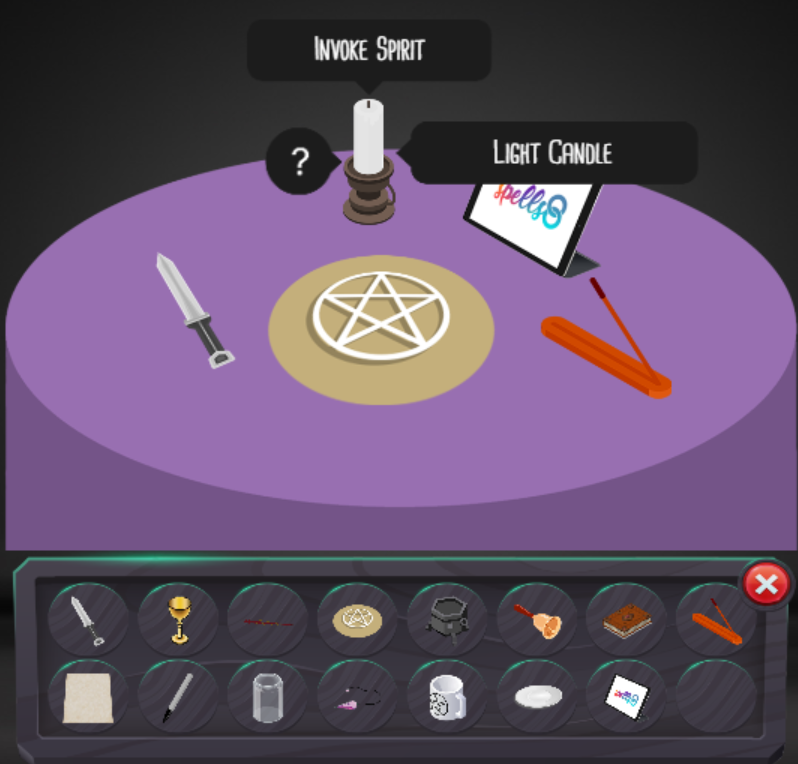
A virtual altar [A. Coyne]
Streaming and Zoom Rituals
Livestreaming means that anyone, anywhere in the world can tune into a live ritual. The same works for other events, of course, but this has particularly useful applications for faith-based groups – and streaming can open the doors to international outsiders who are allowed an insiders’ view. The Church of Satan’s 2006 Satanic High Mass was the first time many people would get a chance to see the ritual in full swing, for example. Today another group, the Satanic Temple, offers internet-connected, online services as one example.
Streaming also allows international groups an easier way to connect all their members in the same place – for whatever reason.
If you’re wondering, some video games have also embraced the concept on a larger scale: Age of Wushu introduced a marriage system for its members – and many people have so far used the idea of a purely online wedding to remember their relationship.
Any group can use Zoom to instantly connect their members. Meetings, services, or rituals with several participants can be set up in seconds – many religions have reaped the internet’s benefits, not limited to Paganism and Christianity.
Virtual Altars
Virtual altars are any designated, online ritual space.
Discussions on Reddit in the /r/witchcraft and /r/pagan subreddits indicate that it’s already becoming a more common practice. Virtual altars are useful because they’re easy to access, but also great because they’re discreet – simply by saving your progress, anyone is allowed a restricted and safe space to customize.
Accepting that ritual is powered by intent, virtual altars can still connect anyone to their choice of imagery. Virtual spaces can give people more space or freedom to explore than they might have access to in the physical realm.
For example, Spells8 has a simple browser-based virtual altar which users can customize with objects like candles, and each object is uniquely clickable or can be combined with others. (Clicking on the paper scroll, for example, allows the user to scrawl any sentence and place it back on the altar.)
Virtual altars also work in many multiplayer, open world games like Minecraft and Roblox. Entire worlds can be built, or users can have an altar set up for appropriate rituals or meetings restricted to a close group.
Let’s not forget that digital candle apps might be an excellent way to save future generations from potential fire-related accidents.
Safe and Discreet Online Spaces
While social media platforms are being criticized for their censorship and bias, users are taking control of their online safe spaces in other ways – including via online communities and digital covens, as well as ritual spaces within games.
The Cyber Spellbook (Sirona Knight, Patricia Telesco) seemed like a faraway, strange concept when the book was released in 2002. More than 20 years after its initial release, online rituals have become more commonplace – and might continue well into the future.
However, moderation is key to keeping these spaces safe.
Individual users have the responsibility to moderate their space (whether a Zoom meeting or a Discord group), while platforms should maintain the responsibility to ensure these spaces can stay safe for all users – the online world still has many pitfalls, scammers, or potential predators to watch out for.
Future generations will never know a world without connectivity: when responsibly embraced, it might forge many useful connections and rituals all over cyberspace.
The Wild Hunt is not responsible for links to external content.
To join a conversation on this post:
Visit our The Wild Hunt subreddit! Point your favorite browser to https://www.reddit.com/r/The_Wild_Hunt_News/, then click “JOIN”. Make sure to click the bell, too, to be notified of new articles posted to our subreddit.