
ROME – This article is partly an indulgence, so please forgive the mix of personal reflection and news.
My first fever in an Etruscan necropolis hit in 2016. We were visiting Cerveteri, a short drive from Rome, and I remember standing among the tombs feeling dizzy and oddly detached—almost as if I were both there and beside myself, a kind of déjà vu of distance, if that makes sense. That night, I spiked a fever of 103.5°F. Coincidence, I figured.
In 2018, I visited a smaller, lesser-known Etruscan necropolis near Manciano. That night? Fever again. The following year, we hiked to the so-called Etruscan Pyramid—a massive stone altar or platform nestled in the forest near Bomarzo. Fever.

The Etruscan Pyramid at Bomarzo, Italy. Photo Credit: M. Tejeda-Moreno
After flights resumed from the COVID-19 pandemic, I resumed my apparent tradition of Etruscan necropolis-induced illnesses. Vulci? Fever. Tarquinia, last year? You guessed it.
Maybe it’s an overactive immune system. Maybe it’s psychosomatic. Or maybe—and this is my preferred theory—the Etruscans are trying to tell me something. Perhaps it’s about my ancestors. Or perhaps they simply find me unappetizing.
Because despite the strange physical symptoms, what’s undeniable is the allure of Etruscan culture. These were a people whose tombs resemble houses, whose gods dwelled in thunder and soil, and whose language remains undeciphered. If you ever find yourself in or near Rome, make the trip north to Tuscany—for the food, yes, but also for the archaeology. Both are phenomenal. The mystery is palpable.
The Gods Without a Rosetta Stone
We don’t know as much about the ancient Etruscans as we do about their neighbors, the Greeks and Romans. The main reason? Their language isn’t related to anything else. It’s not Indo-European, Semitic, or even plausibly deciphered with the usual comparative tools. This linguistic isolation makes translating religious texts particularly difficult, and the field of Etruscology is still relatively young.
Still, fragments remain—just enough for some modern Pagans (myself included) to feel a spark of recognition.
In Etruscan religion, aiser (or ais, aisar) was the word for deity, a term that some scholars cautiously compare to the Norse Aesir. Their pantheon, though overlapping with Greco-Roman structures, was its own vibrant system. Tinia, for example, often dubbed the “Etruscan Zeus,” was more than a thunder god. He was a boundary-keeper and harmonizer, concerned with the sacred structure of life itself.
Researchers have suggested that the Etruscans believed in divinely ordered fate. Human agency could detect fate’s unfolding patterns—through divination and augury—but could not change them. That worldview contrasts sharply with the emphasis on free will in many modern Pagan traditions. Still, other connections persist:
-
Polytheism: Like many modern Pagan paths, the Etruscans revered a diverse set of deities with distinct powers and personalities.
-
Nature Spirits and Sacred Space: They believed that spirits inhabited specific places and natural features—an idea deeply resonant with earth-based spirituality today.
A Discovery in San Giuliano
On to the news…. In 2024, archaeologists from the San Giuliano Archaeological Research Project (SGARP), led by Baylor University’s Davide Zori, unearthed a sealed Etruscan chamber tomb northwest of Rome. It was a historic find—the first intact tomb discovered at the site since SGARP began work there in 2016.
Over the years, archaeologists have documented more than 600 tombs surrounding the ancient Etruscan town atop the San Giuliano Plateau in Lazio, central Italy. Until the recent discovery of an intact burial, every known chamber tomb—carved into rock and shaped like small houses with pitched roofs—had been looted, some as far back as the Roman occupation in the late third century B.C.
The tomb, cut into the rock around 600 BCE, was undisturbed for over 2,600 years. Inside were the remains of four individuals—likely two male-female pairs—laid to rest on stone beds and surrounded by more than 100 grave goods. These included bronze ornaments, iron weapons, delicate silver hair spools, and intricately crafted ceramic vessels.
“This completely sealed burial chamber represents a rare find for Etruscan archaeology,” said Zori. “In the internal hilly region of central Italy, where the SGARP team works, a preserved chamber tomb of this age has never before been excavated with modern archaeological techniques.”
The tomb reflects the Etruscan funerary banquet tradition, suggesting a strong continuity of belief and cultural identity. Despite Roman conquest in 294 BCE, the Etruscan worldview—and reverence for their dead—persisted for generations.
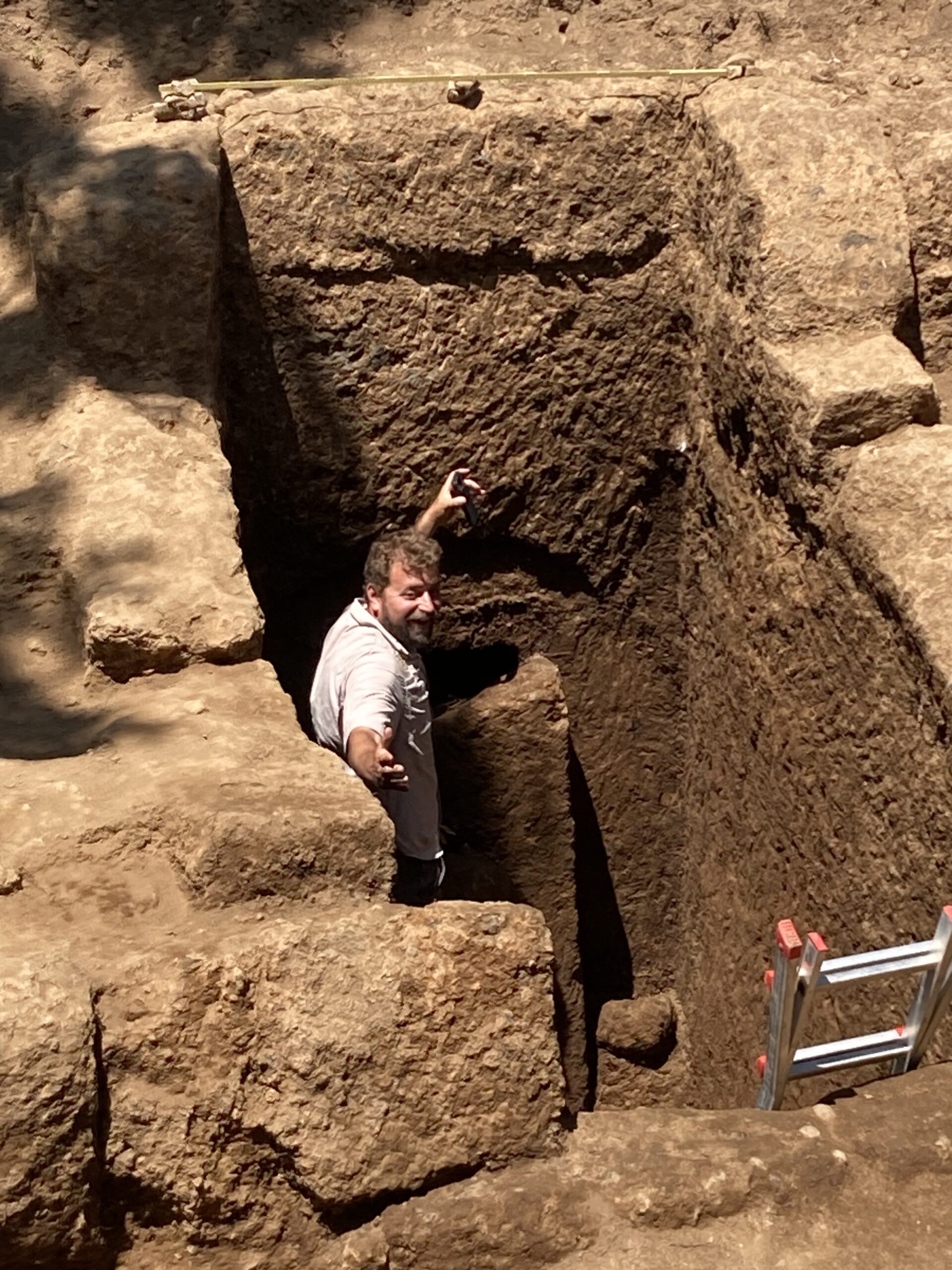
Davide Zori, Ph.D., project director and principal investigator, prepares to remove a massive stone slab that has been protecting the tomb's entrance for more than 2600 years. (Courtesy Baylor University - Credit: Jerolyn Morrison)

A total of 74 nearly completely intact pots were found inside the tomb. (Courtesy Baylor University - Credit: Jerolyn Morrison)

The Etruscan tomb held the remains of four individuals laid out on beds carved of stone, surrounded by a perfectly preserved snapshot of Etruscan funerary practices. (Courtesy Baylor University - Credit: Jerolyn Morrison)
Echoes from the Earth
Other recent discoveries echo these themes. Along the Ombrone River in Tuscany, a sealed grave near Podere Cannicci revealed the cremated remains of two individuals—one wearing a crown of gold-covered bronze olive leaves. Archaeologists believe the deceased were prominent members of an agricultural community. The burial chamber, shaped like a small house, contained 110 artifacts, providing a vivid picture of Etruscan material and spiritual life.
“The excavation of the intact Etruscan tomb represents more than just an archaeological discovery,” Dr. Zori said in a statement, “It embodies the potential of interdisciplinary collaboration, international partnership and educational innovation to advance human understanding of a shared cultural heritage.”
The Etruscans aren’t as silent as they might seem. Thanks to ongoing research, more of their story is slowly being unearthed. With any luck, we’ll know even more soon—especially if the work reaches a fever pitch. Their language may be lost, but their art, rituals, and resting places still speak.
The Wild Hunt is not responsible for links to external content.
To join a conversation on this post:
Visit our The Wild Hunt subreddit! Point your favorite browser to https://www.reddit.com/r/The_Wild_Hunt_News/, then click “JOIN”. Make sure to click the bell, too, to be notified of new articles posted to our subreddit.