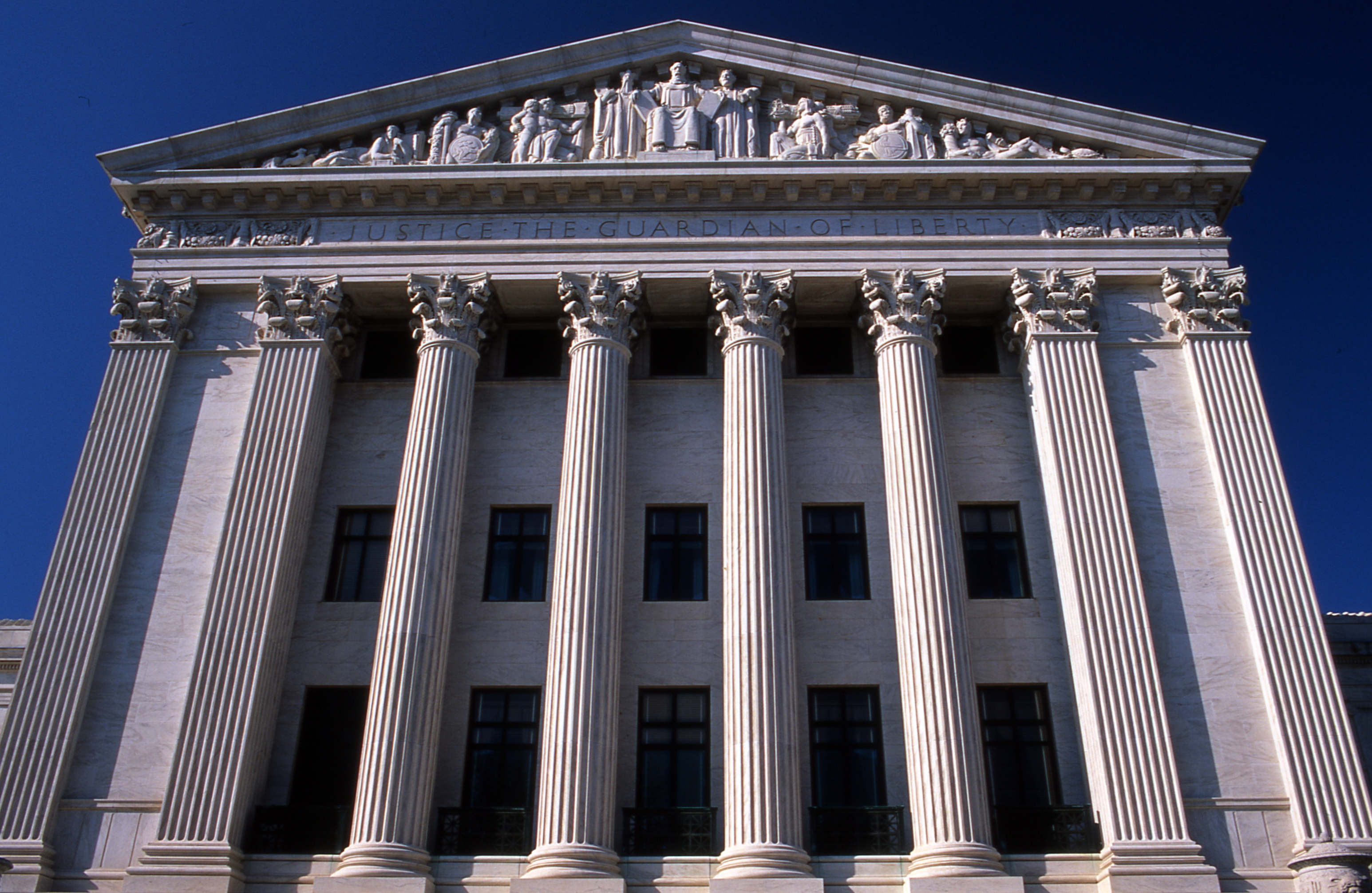
Archives For SCOTUS

The United States Supreme Court has agreed to hear a case stemming from sectarian prayers before local government meetings in Greece, New York. At the heart of the case is the question of if a policy regarding invocations can be pluralistic and inclusive in letter, but not in spirit.

Rev. Kevin Kisler prays prior to the start of a Greece, N.Y., Town Board meeting in 2008. Photo: Rochester Democrat and Chronicle

Rev. Kevin Kisler prays prior to the start of a Greece, N.Y., Town Board meeting in 2008. Photo: Rochester Democrat and Chronicle

“Town officials said that members of all faiths, and atheists, were welcome to give the opening prayer. In practice, the federal appeals court in New York said, almost all of the chaplains were Christian. [...] Two town residents sued, saying the prayers ran afoul of the First Amendment’s prohibition of the government establishment of religion. The appeals court agreed. “The town’s prayer practice must be viewed as an endorsement of a particular religious viewpoint,” Judge Calabresi wrote.”

This is a very big deal. One that strikes to the very heart of a “model invocation policy” peddled by conservative Christian legal advocacy group Alliance Defending Freedom (ADF – formerly known as the Alliance Defense Fund). The thesis is that sectarian prayers (rather than the “ceremonial deism” that permeates many government bodies) are constitutional so long as the written policy is inclusive of all faiths. However, they calm nervous Christian government officials worried about an influx of religious minorities by noting that no special efforts to be inclusive are necessary.

“If a public body implements a legitimately neutral policy and procedure to invite local clergy from established congregations in its community to offer an opening invocation, that public body is not required to extend any extraordinary efforts to include particular minority faiths. In other words, no apology is necessary for the demographics of the community that the public body serves.”

In short, opening invocations can overwhelmingly reference Jesus Christ, and they can send invitations only to “established congregations” (ie brick-and-mortar churches) so long as they include a religious minority who inquires/complains. Something I’ve dubbed the “include a Wiccan gambit,” which is exactly what Greece, New York did.

“In just a few seconds’ time during the April Town Board meeting, Jennifer Zarpentine made Greece history. Zarpentine, a Wiccan, delivered the first-ever pagan prayer to open a meeting of the Greece Town Board. Her hands raised to the sky, she called upon Greek deities Athena and Apollo to ‘help the board make the right informed decisions for the benefit and greater good of the community.’ A small cadre of her friends and coven members in the audience chimed in ‘so mote it be.’”

For a time, this gambit seemed to work in the lower courts. Then, the 4th Circuit Court of Appeals and the 2nd Circuit Court of Appeals both handed down rulings that called into question whether this invocation tokenism could really offset a regular schedule of Christian prayer.

“We conclude, on the record before us, that the town’s prayer practice must be viewed as an endorsement of a particular religious viewpoint. This conclusion is supported by several considerations, including the prayer-giver selection process, the content of the prayers, and the contextual actions (and inactions) of prayer-givers and town officials. We emphasize that, in reaching this conclusion, we do not rely on any single aspect of the town’s prayer practice, but rather on the totality of the circumstances present in this case.

The town’s process for selecting prayer-givers virtually ensured a Christian viewpoint. Christian clergy delivered each and every one of the prayers for the first nine years of the town’s prayer practice, and nearly all of the prayers thereafter. In the town’s view, the preponderance of Christian clergy was the result of a random selection process. The randomness of the process, however, was limited by the town’s practice of inviting clergy almost exclusively from places of worship located within the town’s borders. The town fails to recognize that its residents may hold religious beliefs that are not represented by a place of worship within the town. Such residents may be members of congregations in nearby towns or, indeed, may not be affiliated with any congregation. The town is not a community of religious institutions, but of individual residents, and, at the least, it must serve those residents without favor or disfavor to any creed or belief.”

Cynthia Simpson and Darla Wynne

Cynthia Simpson and Darla Wynne

These cases, and the “model invocation policy” itself, are haunted by the involvement and activism of modern Pagans. It isn’t just that Greece included a Wiccan sectarian prayer among thousands of Christian prayers. The ADF’s policy blueprint was partially constructed around two 4th Circuit cases involving public prayers and modern Pagans: Simpson v. Chesterfield County, the case that helped create the so-called “Wiccan-proof” invocation policy, and the Darla Wynne case, in which a Wiccan from South Carolina won a battle against sectarian government prayer. These two cases helped set the precedents that advocates of sectarian prayer have been navigating through, and their efforts at mob-rule prayer sectarianism will finally be tested by America’s highest court.

How will the court decide? It’s hard to say. SCOTUS took a pass on considering the similar 4th Circuit decision, letting their decision stand, but they may have simply been waiting for a case that would suit the Court’s needs better. For the most part, the modern Supreme Court doesn’t like to corner itself into making sweeping decisions, and it could be that the justices see a needle-threading solution to the issue at hand. Then again, we could be in for another “ministerial exception” moment where broad new freedoms are outlined and defined. At this point it’s anyone’s guess, but I’m sure advocates on both sides of this issue are readying themselves for a fight that could shape invocation policy for a generation.


We likely won’t know until June what the outcomes of the oral arguments at the Supreme Court over California’s Proposition 8 and the Defense of Marriage Act (DOMA) will be, but it does seem clear that a threshold has been crossed. No matter how narrow (or broad) the decisions will ultimately be regarding the rights of same-sex couples in the United States, many will look to 2013 (and the November 2012 elections) as a time when a cultural corner was turned. When marriage equality was now backed by a majority of Americans, when politicians quickly issue statements to be on the right side of history, and when culturally conservative opponents of same-sex marriage are collapsing.

“In 2004, the campaign to prevent gay marriage was in its heyday. The Bush administration had seeded an initiative banning gay marriage in Ohio to mobilize activists and peel off traditionalist Democratic voters. Democrats nationally were running for cover, and even Howard Dean’s pro-civil-unions stance appeared risky. Now the movement is in a state of total collapse, with every day seeming to bring new converts to the gay-marriage cause and the opposition losing all of its courage.”

For many years Pagans have been on the forefront of the marriage equality debate. As a decentralized movement, one that recognizes many different sources of authority and tradition, we have long accepted that same-sex rites (and rights) were a part of our larger tapestry. As thousands gathered in Washington DC to be a part of history of the making, modern Pagans were there too, adding our voices, our support, to the growing movement for full equality.

Pagans in Washington DC, including Selena Fox of Circle Sanctuary, and PNC reporter/author David Salisbury performing a rite for freedom and justice.

Pagans in Washington DC, including Selena Fox of Circle Sanctuary, and PNC reporter/author David Salisbury performing a rite for freedom and justice.

“On March 26th and 27th, two of the most historic cases to ever be heard by the Supreme Court of the United States will begin. One case would overturn Proposition 8, which years ago banned marriage equality for all same-sex California citizens. The second trial would overturn DOMA (the so-called “Defense of Marriage Act”). Depending on how the SCOTUS rules, both of these trials could have major nation-wide effects that would change the course of our movement forever. People from all over the country will be arriving here in the District to rally at the trial on Tuesday. A crew of people (including me) will be sleeping outside on the sidewalk of the Supreme Court on Monday night before the rally on Tuesday. That night I will facilitate a ritual calling upon the guardian Goddess of DC and of the United States, Columbia. We will ask Columbia to bring the sword of victory to our work, leading us in the march to freedom and justice. Before the Tuesday rally, I’ll attend an interfaith service with some of my of my coreligionists and people of other faiths. Rev. Selena Fox of Circle Sanctuary will be speaking at the service to give a voice from the Pagan perspective. This is all a very big deal.”

Selena Fox and other clergy at a National Interfaith Service in Washington DC.

Selena Fox and other clergy at a National Interfaith Service in Washington DC.

Selena Fox of Circle Sanctuary also took part in a National Interfaith Service, where she and clergy from several other faiths blessed more than 30 same-sex couples.

As we get closer to decisions in these cases I plan to showcase Pagan voices on this issue, including national Pagan organizations, activists on the ground, and the experiences of Pagan same-sex couples. Until then, here’s a selection of past coverage The Wild Hunt has done on marriage equality, which includes many important Pagan voices weighing in on the subject.

DOMA Ruling and Pagan Marriage Rites (October 2012)

“A truly pluralistic and secular government understands that allowing one religious paradigm concerning marriage to trump all others is wrong, and undermines the very rights a free society holds sacred. We no longer live in a solely Christian nation, nor did we ever, really, from the very beginning America was built on a dance of power and privilege that sought to establish dominance for one viewpoint. That can no longer stand, and today’s ruling is not only a positive step forward for the rights of same-sex couples, but is also a step forward for all those who would want to bless those unions.”

Christianity and Marriage Equality (May 2012)

“As a non-Christian I have become increasingly frustrated with the game of theological and political ”hot potato” when it comes to this issue. It’s always “those” Christians over there, not the “good” Christians who are “evolving” on the issue. When the Catholic Pope calls for a grand anti-gay-marriage religious coalition, when our country’s most popular Evangelical leader defends himself from the mere perception of tolerance, you simply can’t pretend that opposition to the basic humanity of LGBTQ individuals is some extremist fringe living in the wilderness. The real, unfortunate, truth is that Christianity is working against the lives of gay men and women, save for a small percentage who have broken away.”

On Faith: Is there a marriage crisis in America today? (December 2010)

“It’s telling that the “solution” provided by many to the marriage problem is to roll back freedoms, and enshrine a trapped-in-amber definition of marriage that is as much an artificial construction as any now criticized by the culture warriors. Just as many “traditional marriage” proponents would blanch at the thought of returning marriage to a time of dowries, land transference, political alliances, and women-as-bargaining-chip; so too do young people today recoil at the thought of marriage being limited to the “proper” genders, a vehicle for reproduction, social stability, and maintaining an illusory status quo. A return to a time when private detectives where required to extricate oneself from an unhappy union, and domestic abuses were glossed over for the sake of social order.”

Pagans and Prop. 8 (August 2012)

“Within modern Pagan communities same-sex marriage is almost wholly uncontroversial. Shortly after Walker’s ruling was handed down, several Pagan organizations and noted figures within the movement reaffirmed their commitment to same-sex marriages and praised the decision. Druid group Ar nDriaocht Fein (ADF) said in a statement they “warmly welcome the decision of the court”, and that their organization has “never believed that the institution of marriage could possibly be threatened by the existence of married people of any gender”. T. Thorn Coyle of Solar Cross Temple and Morningstar Mystery School, speaking to those now recoiling from Prop. 8′s overturn, noted that“we are not trying to change your religious beliefs. We are only saying that we have the same civil rights as you do.” Holli Emore of Osireion and the Pagan Round Table said in a message to The Wild Hunt that we are “living in the last days of the kind of bigotry that would presume to dictate such matters, in my opinion.”

For even more, check out the “LGBTQ” and “marriage” tag categories. You may also be interested in my coverage of Cascadian “nones” in Washington and how they voted for marriage equality.

Here’s to freedom, here’s to love, here’s to equal rights (and rites) for everyone. More on this topic in the coming weeks.

Just some quick updates on stories previously discussed here on The Wild Hunt.

More Discussion on Exorcism and Demonic Influences: Last week I took issue with Patheos Catholic columnist Fr. Dwight Longenecker, who made the argument that Aurora, Colorado killer James Holmes may have been demonically possessed. Now, Religion News Service has picked up the story, bringing this controversial view to a much wider audience.

“Longenecker dismissed the range of explanations for what might have motivated Holmes — a bad childhood, mental illness, social awkwardness, extreme political or religious views, or exposure to violent video games or to the Batman movie that was showing when he allegedly opened fire. The real culprit, he says, was spiritual, and malign.”

Meanwhile, other Catholics, like  About.com’s Scott P. Richert, are doubling down on the demonic “infestation” scenario, referencing Ouija board use in the 1973 film “The Exorcist” as an accurate portrayal of how possession begins.

Troubling Expansion of the Ministerial Exception? At the beginning of this year I wrote about the Supreme Court of the United State’s decision in in Hosanna-Tabor Church v. Equal Employment Opportunity Commissionwhich centered on the question of whether an employee of a religious organization could be fired without recourse to anti-discrimination laws if they were ordained within said faith. The ruling established that a ministerial exception from federal discrimination laws does exist. Now, Religion Clause reports on two linked ruling from the Kentucky Court of Appeals that says the exception applies even when faculty at a seminary aren’t even of the same religion.

“Because Kant’s primary duties involved teaching religious-themed courses at a seminary, his position was one that prepared students for Christian ministry…. Given his position as a faculty member teaching at a seminary, Kant’s personal views are not determinative of the function he served. Rather, we review the function of his position: teaching future Christian ministers primarily on Judeo-Christian subjects and culture. Kant’s personal faith and beliefs do not clash with the actuality that the classes he taught at LTS were for the purpose of preparing future church leaders of the Christian faith.”

So a Jew can be considered a “minister” of a Christian seminary, so long as his role supports the institution’s goals. One wonders how this interpretation could be abused by organizations who want to evade litigation over a firing. More on this particular story, here.

The Olympics and Religion (and those dualistic Greeks): I recently linked to two articles that looked at the ancient (pagan) history of the Olympic games, now underway in London. Now, USA Today spotlights an editorial by Pastor Henry Brinton that also looks at religion and the games, specifically the Christians history of the modern games, and how “muscular Christianity” saved us from the dualism of the ancient Greeks.

“Ancient Greeks are partially to blame. While they provided the inspiration for the modern Games, they also created a dualistic philosophy that included antagonism between the physical and spiritual. Christians embraced this approach for many years, until muscular Christianity came along and people began to reclaim the ancient biblical truth that human beings are created with a unity of flesh and spirit. [...] As for the Olympics, perhaps the opening ceremonies should have had a celebration of religions as well as a parade of nations. Most of the world’s great faiths honor both body and spirit, and encourage health and vitality. This would correct the error made by the ancient Greeks, and would pay tribute to the religious leaders who made the modern Olympics possible. It could even inspire a few religious people to get off the couch and into the gym.”

I wish I could stamp a giant “citation needed” on these claims, because it sounds like revisionist triumphalism to me. Ancient Greeks may have believed in a physical world and a world of spirit, but that didn’t create an antagonism between the two realities. It sounds to me like Christians blaming Greek philosophy for their own shortcomings in how they adopted and adapted pagan thought. I’ll leave it to my philosophy and ancient Greece buffs to let me know if my suspicions are correct, or if Greek dualism really did create this antagonism Brinton claims.

That’s all I have for now, have a great day!

The imposing cross that stands on Mt. Soledad in California was dedicated to “Our Lord and Savior Jesus Christ” in 1954. For decades it was known as the “Mt. Soledad Easter Cross” and was the site of Christian services (and may even have been a reminder of Christian triumphalism to area Jews). After initial litigation was filed in the late 1980s against the cross standing on public lands, it was dubbed a veteran’s memorial, and expensive “improvements” were made to stress this new role. Why was a Christian cross, obviously erected for religious purposes, suddenly named a war memorial? In hopes of magically transforming it from a religious icon into a secular memorial symbol. A tactic that initially worked.

The Mount Soledad Cross.

The Mount Soledad Cross.

Litigation over the 43-foot-tall Mt. Soledad cross has been under way for nearly 20 years. Several federal courts have ruled against its display on city property. In an effort to save the cross, the federal government acquired the land underneath the cross in 2006. Legal action proceeded against the federal government’s ownership of the towering religious symbol. In July of 2008, U.S. District Judge Larry Alan Burns ruled that the cross “communicates the primarily non-religious messages of military service, death and sacrifice” and can remain on public property.

How can a Christian cross communicate a non-religious message of military service, death, and sacrifice to non-Christian soldiers? The answer is it can’t, it’s a purely political ploy to exploit American patriotism in order to “secularize” a religious symbol so that it can remain standing despite complaints from atheists, agnostics, religious minorities, and church-state separation activists. Here’s Supreme Court Justice Scalia showcasing how the argument typically goes.

Mr. Eliasberg said many Jewish war veterans would not wish to be honored by “the predominant symbol of Christianity,” one that “signifies that Jesus is the son of God and died to redeem mankind for our sins.” Justice Scalia disagreed, saying, “The cross is the most common symbol of the resting place of the dead.” “What would you have them erect?” Justice Scalia asked. “Some conglomerate of a cross, a Star of David and, you know, a Muslim half moon and star?” Mr. Eliasberg said he had visited Jewish cemeteries. “There is never a cross on the tombstone of a Jew,” he said, to laughter in the courtroom. Justice Scalia grew visibly angry. “I don’t think you can leap from that to the conclusion that the only war dead that that cross honors are the Christian war dead,” he said. “I think that’s an outrageous conclusion.”


You see, there are a lot of Christian crosses on the graves of dead soldiers, because there are a lot of Christians, ergo, it must be a common symbol of “the resting place of the dead” (repeat sentence until your rhetorical opponent grows tired). In 2010 the Supreme Court took a step towards secularizing the cross with its decision in Salazar v. Buono, which challenged the constitutionality of a eight-foot Christian cross war memorial situated on public lands in California’s Mojave National Preserve. Justice Kennedy acknowledged that the cross is “a Christian symbol,” but this particular cross didn’t mean to send “a Christian message” (how, I’m not entirely sure, but this was a mess of a decision, with six separate opinions filed), and thus was constitutional. Only Justice John Paul Stevens, a wartime veteran, had the courage to call a Christian cross a Christian cross.

“The nation should memorialize the service of those who fought and died in World War I … But it cannot do so lawfully by continued endorsement of a starkly sectarian message.”

However, while there was some secularizing wiggle room in Salazar v. Buono, that wasn’t the case with the Soledad cross. In the beginning of 2011 the 9th Circuit Court of Appeals ruled that the memorial was unconstitutional, citing its long history of being a sectarian religious symbol.

“Much lore surrounds the Cross and its history. But the record is our guide and, indeed, except for how they characterize the evidence, the parties essentially agree about the history. A cross was first erected on Mount Soledad in 1913. That cross was replaced in the 1920s and then blew down in1952. The present Cross was dedicated in 1954 “as a reminder of God’s promise to man of everlasting life and of those persons who gave their lives for our freedom . . . .” The primary objective in erecting a Cross on the site was to construct “a permanent handsome cast concrete cross,” but also “to create a park worthy of this magnificent view, and worthy to be a setting for the symbol of Christianity.” For most of its history, the Cross served as a site for annual Easter services. Only after the legal controversy began in the late 1980s was a plaque added designating the site as a war memorial, along with substantial physical revisions honoring veterans. It was not until the late 1990s that veterans’ organizations began holding regular memorial services at the site.

That ruling was appealed, and on Monday, the Supreme Court denied certiorari, leaving the 9th Circuit’s decision in place. Which means one of two things has to happen. Either the cross has to be taken down, or the memorial has to be modified so as to pass constitutional muster. A process that will necessitate even more litigation. Supporters of the cross are already calling for the Department of Justice to raise the issue, as allowed in the 9th Circuit’s decision.

Rep. Duncan Hunter (R-Alpine), in urging the Department of Justice to continue the legal fight, said the government should preserve “such a historic memorial that pays tribute to the service and sacrifice of America’s veterans.”

Notice that cross supporters now completely ignore the history of this monument, invoking veterans to cloud the issue, despite the fact that it this challenge was brought by the Jewish War Veterans, who obviously don’t feel a large Christian cross pays tribute to their sacrifice. In addition, I somehow doubt these cross secularizers are going to stand in our corner when someone tries to erect a “secular” Wiccan or Asatru war dead memorial. Nor would anyone try to argue for a “secular” Jewish star of David, or “secular” Muslim crescent (particularly not the latter in our current climate). They would argue that these symbols are sectarian, and could not represent them. It’s all part of the hypocrisy that comes with the privilege of being the overwhelming majority.

To many Christians their immense privilege seems invisible. They don’t understand how much of our society panders to their unspoken power. The churches on every corner, the holidays and celebrations structured around Christian dates, the pandering of politicians, the ceremonial deism that acts as a placeholder for state-sponsored religion. Even our vernacular is colored by Christianity: “God bless you,” “we’ll pray for you,” “I’m in heaven,” or even “go to hell.”  Yet despite this, many Christians, particularly conservative Christians, have a major investment in seeing themselves as part of a persecuted minority. This was reinforced for me in the comments section of a recent post at the journalism commentary site Get Religion. There, I was informed that Michele Bachmann was part of a religious minority, and that due to mainstream media criticism “one has to speculate that perhaps Christians are a small minority in the United States.”

Eventually, like the memorial crosses erected in Utah, this Soledad cross will have to be removed. We can no longer claim to be a secular, pluralistic nation while winking at those who crave a “Christian Nation.” The time of pretending the cross isn’t the cross, or that monuments to the 10 commandments are religiously neutral, are quickly coming to an end. Public spaces will either have to accommodate all the other faiths that inhabit this country, or leave such expressions to the private sphere. While Christians may not think twice about a “secular” cross, it’s not a luxury many non-Christians have.

There are lots of articles and essays of interest to modern Pagans out there, sometimes more than I can write about in-depth in any given week. So The Wild Hunt must unleash the hounds in order to round them all up.

Preliminary Australian Census numbers. (PaganDash)

Preliminary Australian Census numbers. (PaganDash)

That’s all I have for now, have a great day!

In the long-simmering battle over the inclusion of (largely Christian) prayers at the beginning of government meetings, an assumption held sway that a written policy of pluralistic inclusion would provide a fig-leaf of legal protection against lawsuits from organizations like Americans United or the ACLU. At least that was the assertion of the conservative Christian advocacy organization Alliance Defense Fund (ADF). In their “model public invocations policy,” the ADF noted how important it was to have an inclusive “neutral” policy on paper, if not in actual practice.

“The bottom line is that any policy adopted and implemented [...] must ensure that the invocation opportunity is not exploited to proselytize any particular faith or disparage any others, or show any preference of the Council for a specific faith or religious denomination. It is our belief that the Policy we have carefully drafted meets these criteria and would pass court muster if challenged. [...] No invocations policy has a chance to be upheld by a reviewing court today unless it offers equal opportunity to at least the broad array of monotheistic faiths and denominations with a presence in that particular geographic area.  One conclusion from the case law is clear: if a public body allows any prayers, it is required to allow for most all prayers, without unlawful discrimination against any.”

The document goes on to assert that no “extraordinary efforts to include particular minority faiths” were necessary, and “no apology is necessary for the demographics of the community that the public body serves.” In other words, in their opinion, a predominately Christian town doesn’t have go out of its way to include Wiccans, Hindus, or Buddhists. This policy blueprint was partially constructed around two 4th Circuit cases involving public prayers and modern Pagans: Simpson v. Chesterfield County, the case that helped create the so-called “Wiccan-proof” invocation policy, and the Darla Wynne case, in which a Wiccan from South Carolina won a battle against sectarian government prayer. The idea was that if local governments threaded the needle of this issue carefully, they could have their cake (opening prayers), and eat it too (mainly Christian-only prayer).

Cynthia Simpson and Darla Wynne

Cynthia Simpson and Darla Wynne

For awhile, this tactic of de facto tokenism seemed to be working well. Towns like Greece, New York and Lancaster, California won lower-court challenges by including a smattering of minority religions in sectarian prayers (aka the “include a Wiccan gambit”), with the majority of prayers being Christian ones. Then a setback for sectarian prayers to Jesus emerged in the 4th Circuit Court of Appeals, who ruled that simply saying you’re inclusive while showcasing predominantly sectarian Christian prayer is not acceptable.

The 4th U.S. Circuit Court of Appeals today ruled 2-1 that the Forsyth County Board of Commissioners’ preference for Christian prayers violates the constitutional separation of church and state. [...] The record in the case indicates that 26 of the 33 invocations given from May 29, 2007, until Dec. 15, 2008, contained at least one reference to Jesus, Jesus Christ, Christ, Savior or the Trinity. The appellate court majority said government favoritism in religion is wrong. “Faith is as deeply important as it is deeply personal,” wrote Judge J. Harvey Wilkinson, “and the government should not appear to suggest that some faiths have it wrong and others got it right.”

This ruling withstood appeal when the Supreme Court of the United States denied certiorari (judicial review), prompting the ADF to complain that “the standard for prayer policies in the 4th Circuit will be different from the standard held by the rest of the country.” Now, it seems like the 4th Circuit has just been joined by the 2nd Circuit, who ruled on Thursday that invocations given before the town of Greece, New York (one of the early winners in the “include a Wiccan” gambit) should have been more inclusive, and the town should have gone to greater lengths to ensure religious diversity.

“…the U.S. Court of Appeals for the Second Circuit ruled the town of Greece, a suburb of Rochester, should have made a greater effort to invite people from other faiths to open monthly meetings. [...] The court found that religious institutions in the town of just under 100,000 people are primarily Christian, and even Galloway and Stephens testified they knew of no non-Christian places of worship there. [...] “The town’s process for selecting prayer-givers virtually ensured a Christian viewpoint,” it ruled.” The court acknowledges there was no formal policy on who should be invited to deliver invocations, and that the town was open to people of all faiths speaking at meetings. But it also noted the town board didn’t publicize the idea that anybody could volunteer to deliver prayers…”

The decision went on to note that a town’s religious community cannot be defined by a list of churches or religious organizations, since a town is a community of “individual residents” who each have may have unique beliefs and philosophies.

“The town fails to recognize that its residents may hold religious beliefs that are not represented by a place of worship within the town. Such residents may be members of congregations in nearby towns or, indeed, may not be affiliated with any congregation. The town is not a community of religious institutions, but of individual residents, and, at the least, it must serve those residents without favor or disfavor to any creed or belief.”

The ADF, who were defending the town of Greece, has already vowed to appeal this ruling, saying that towns will have to “complete an obstacle course” in order to have opening prayers at government meeting. If this decision holds, as the 4th Circuit’s did, it could help establish a new standard for government prayer, one that demands strong pluralism if a body is going to allow sectarian invocations. It remains to be seen how long the Supreme Court will punt on this issue by denying judicial review. Eventually, they will have to make a stand on these policies, just as it recently took a stand on the question of “ministerial exception.” However, for now, Pagans and other members of minority religions have a new precedent to use in demanding equal treatment in regards to public prayer. No doubt several towns and cities who fall under the jurisdiction of the 2nd and 4th Circuit Courts are currently talking with their lawyers over their prayer policies, and whether they need to include far more Wiccans (and Buddhists, Hindus, Musilms, Jews, etc) than previously imagined.

There are lots of articles and essays of interest to modern Pagans out there, sometimes more than I can write about in-depth in any given week. So The Wild Hunt must unleash the hounds in order to round them all up.

Anusara Yoga founder John Friend.

Anusara Yoga founder John Friend.

Kenneth Anger. Photograph: Linda Nylind

Kenneth Anger. Photograph: Linda Nylind

That’s it for now! Feel free to discuss any of these links in the comments, some of them I may expand into longer posts as needed.

Top Story: Indian Country Today reports on a new documentary, “Holy Man: The USA vs. Douglas White,” that looks at the case of a Lakota medicine man who was accused of abusing his two grandchildren. Jennifer Jessum and Simon Joseph, a husband and wife duo who produced and directed the film, knew White through a member of his family, and were shocked to hear about the charges made against him. After White was convicted and sentenced to prison, they investigated the matter and uncovered several “holes” in the prosecution, and eventually, saw one of the grandchildren recant his testimony.

[Roy Helper Jr.] met the film crew at a hotel in Rapid City, and he confessed on film that he had lied about the alleged abuse. He said that he and his brother, Lloyd, were under tremendous pressure from lawyers, judges and “people in suits,” and he said the experience was frightening. He also indicated that they were coaxed to say certain things. In return, they were told they would get money, toys, even a horse. (They received none of those things.) “We were just little, dumb, stupid Indian kids, being tossed around,” Helper says in Holy Man, his voice choked with emotion. “Eventually it’s going to come out. Like today.”

Despite a cascading series of events that proved White’s innocence, the U.S. Attorney’s office engaged in stalling and delaying tactics, and White died in prison in 2009 before he could be exonerated. There is now a petition to have President Obama posthumously exonerate Douglas White, apologize for his wrongful conviction, make reparations to White’s family, and initiate an investigation into the agents who pursued the case against White. The filmmakers are now working on issues of Tribal sovereignty, and the epidemic of teen suicide in Indian country. DVDs of the film are expected to be available this Summer.

In Other News:

  • Actress Lynn Collins, one of the stars of the new Disney film “John Carter,” tells an Irish reporter that she studied “mysticism, paganism, everything” and that ultimately “they’re all the same thing.”
  • Pagan and political scientist Gus diZerega has a new article published in The Independent Review entitled “Spontaneous Order and Liberalism’s Complex Relation to Democracy.” Here’s the abstract: “American and European liberalism began to take different paths in the nineteenth century, particularly with respect to their views on democracy. This divergence stems in part from the fact that liberal principles give rise to different types of spontaneous order, each of which generates unique patterns of social coordination.” You can download the article for free. For diZerega’s Pagan work, check out his column at Patheos, and his blog at Beliefnet.
  • Archaeologists in Norway have apparently uncovered a “unique” and ”unparalleled” pre-Christian temple site. It is believed the temple was built around 400AD and that “the last people who used it over 1,000 years ago did their utmost to hide the entire system with an unusually thick layer of soil.” Despite the historic nature of the site, the land is scheduled to be cleared for a housing development. Applications are currently being made to have the site preserved.
  • Rev. G. Jude Geiger, a Unitarian Universalist minister, writes about the concept of religious freedom in our highly polarized political atmosphere. Quote: “By requiring citizens to follow the religious teachings of certain faith traditions, we in essence are asking our country to follow and abide by those particular traditions.”
  • The Supreme Court of the United States has refused to hear an appeal to a 9th Circuit Court decision that upheld a California state universities policy requiring all student groups, including religious groups, to not discriminate in membership on the basis of religion or sexual orientation. More on this, here. You’ll be hearing a LOT about this decision in the coming weeks, and I expect I’ll put in my two cents sooner rather than later.

That’s all I have for now, have a great day!

On Tuesday the Supreme Court of the United States denied certiorari (judicial review) in the case of Forsyth County, North Carolina v. Joyner, which challenged the local government’s opening prayer policy. In this instance, Forsyth County had constructed an ”inclusive” (and thus theoretically constitutionally protected) model where all comers could have a turn, but challengers to the policy noted that the prayers were overwhelmingly Christian, and created a chilling atmosphere towards non-Christian faiths.

On Joyner and Blackmon’s account, the overall atmosphere made them feel distinctly unwelcome and “coerced by [their] government into endorsing a Christian prayer.” Blackmon claimed that she felt compelled to stand and bow her head because of the Chair’s instruction to stand and because of the audience’s response. Joyner offered a similar account, believing that if she had failed to comply, it would have “negatively prejudice[d] consideration of [her] intended petition as a citizen appearing for public comment.” Both characterized the prayer as sectarian, with Blackmon referring to it as including a “one-minute sermon.”

During the period contested in the lawsuit, four-fifths of the prayers referred to “Jesus” in one form or another. The 4th Circuit made very clear that the lack of balance in presented prayers was an important factor in ruling that Forsyth’s policy violated the Establishment Clause.

The Lewis F. Powell, Jr., U.S. Courthouse
The Lewis F. Powell, Jr., U.S. Courthouse, home of the Fourth Circuit Court of Appeals.

“…legislative prayer must strive to be nondenominational so long as that is reasonably possible — itshould send a signal of welcome rather than exclusion. Itshould not reject the tenets of other faiths in favor of just one.Infrequent references to specific deities, standing alone, donot suffice to make out a constitutional case. But legislativeprayers that go further — prayers in a particular venue that repeatedly suggest the government has put its weight behinda particular faith — transgress the boundaries of the Establishment Clause. Faith is as deeply important as it is deeply personal, and the government should not appear to suggestthat some faiths have it wrong and others got it right.”

This skirmish over prayer before government meetings is just the latest in a protracted struggle between the ACLU and the more socially conservative-minded Alliance Defense Fund. While the ACLU is generally skeptical of allegedly inclusive sectarian open prayer models, the Alliance Defense Fund believes them to be constitutionally protected, and part of America’s heritage. Responding to this setback, the ADF said that “the standard for prayer policies in the 4th Circuit will be different from the standard held by the rest of the country.”

“No federal court has ruled that prayers cannot be offered before public meetings. The Supreme Court has simply missed an opportunity to clear up the differing opinions among the various circuits about the content of the prayers. This means that, for the time being, the standard for prayer policies in the 4th Circuit will be different from the standard held by the rest of the country. ADF will continue to litigate in favor of the historical standard until the Supreme Court eventually hears a case that will clear up the confusion.”

The Alliance Defense Fund had a lot invested in this case, and other cases like this, as Forsyth was following their blueprint for protected government sectarian prayer. A blueprint partially constructed around two 4th Circuit cases involving public prayers and modern Pagans: Simpson v. Chesterfield County, the case that helped create the so-called “Wiccan-proof” invocation policy, and the Darla Wynne case, in which a Wiccan from South Carolina won a battle against sectarian government prayer. Despite the fact that towns like Greece, New York and Lancaster, California have won lower-court challenges by including a smattering of minority religions in sectarian prayers (aka the “include a Wiccan gambit”), the law isn’t settled on what, if any, formula for sectarian prayer at a government meeting will pass constitutional muster. It can be folly to read too much into a denied certiorari request, but by letting this decision stand, a decision that invokes both Simpson’s and Wynne’s cases, SCOTUS does leave the idea that balance is necessary in a sectarian prayer model on the table.

Cynthia Simpson and Darla Wynne

Cynthia Simpson and Darla Wynne

Eventually, SCOTUS will have to make a stand on these sectarian prayer policies, just as it recently took a stand on the question of “ministerial exception.” A concept that had been invoked several times in the lower courts, but never in our nation’s highest court. When it does, cases that involve Wiccans and other minority faiths will have a major influence on how that decision is made. In the meantime, Americans United, the ACLU, the Alliance Defense Fund, and several other advocacy groups, will try to build up their positions in the lower courts. No doubt several towns and cities who fall under the jurisdiction of the 4th Circuit Court of Appeals are currently talking with their lawyers over their prayer policies, and whether they need to include more Wiccans.

Today the Supreme Court of the United States issued a ruling in Hosanna-Tabor Church v. Equal Employment Opportunity Commission, which centered on the question of whether an employee of a religious organization could be fired without recourse to anti-discrimination laws if they were ordained within said faith. The case heard by the Supreme Court involved a teacher at a Lutheran school who was fired due to a sleep disorder. The Equal Employment Opportunity Commission, backed by the Justice Department, felt that her role at the school was largely secular in nature, and shouldn’t fall under the exceptions usually given to clergy within religious groups. However, the court, in a rare unanimous ruling, sided with Hosanna-Tabor Church, and for the first time, acknowledged that a ministerial exception from federal discrimination laws does exist.

The Supreme Court of the United States

The Supreme Court of the United States

“Closing the courthouse door much of the way, but not completely, to workplace bias lawsuits by church employees who act as ministers to their denominations, the Supreme Court on Wednesday unanimously gave its blessing — for the first time — to a “ministerial exception” to federal, state and local laws against virtually all forms of discrimination on the job.  The Court’s ruling, which only Justice Clarence Thomas said did not go far enough, did not order courts to throw out all such lawsuits as beyond their jurisdiction, but it left them with only a narrow inquiry before the likely order of dismissal would come down.  As soon as the denomination makes its point that it counts an employee as a “minister,” within its internal definition, that is probably the end of the case.  And the employee could be anyone from the congregational leader, on down to any worker considered to be advancing the religious mission.”

In short, ministerial exception involves not only ministers, but any employee who is performing religious work within a faith group. This was plainly expressed in the concurring opinion of Justice Alito and Justice Kagan, who noted that many religions do not use the term “minister” and that “courts should focus on the function performed by persons who work for religious bodies.”

“The First Amendment protects the freedom of religious groups to engage in certain key religious activities, including the conducting of worship services and other religiousceremonies and rituals, as well as the critical process of communicating the faith.  Accordingly, religious groupsmust be free to choose the personnel who are essential tothe performance of these functions. The “ministerial” exception should be tailored to this purpose. It should apply to any “employee” who leads a religious organization, conducts worship services or important religious ceremonies or rituals, or serves as a messenger or teacher of its faith. If a religious group believes that the ability of such an employee to perform these key functions has been compromised, then the constitutional guarantee of religious freedom protects the group’s right to remove the employee from his or her position.”

This concurring opinion will no doubt be very welcome to a coalition of minority faiths, the Muslim-American Public Affairs Council, United Sikhs, Church of the Lukumi Babalu Aye, International Society for Krishna Consciousness, O Centro Beneficente Uniao Do Vegetal, and Templo Yoruba Omo Orisha, who filed an amicus brief in this case  warning that they were particularly susceptible to judicial encroachment, and that their faiths often categorize what might be seen as “secular” work within a sacred context.

“…many seemingly secular activities take on deep religious significance within specific faith traditions. For Sikhs, for example, operating a community kitchen and providing meals (langar) to the needy and vulnerable is an indispensible element of religious worship. For some temple-centric religions, the actual process of constructing a temple carries deep religious significance. Hindu temple architects and artisans follow ancient religious traditions in their work. For others, temple overseers may be tasked specifically to ensure that construction workers follow religion-based standards and refrain from profane acts that might desecrate the temple. For other religious organizations, meditation is a form of worship, distributing aid through prescribed means is an essential sacred ritual, and counseling and healing are acts inspired by deity. But because such religious functions – at least from the external view – may be indistinguishable from the same activities carried out for secular purposes, courts trying to parse the sacred from the profane jeopardize the ability of religious organizations to define and carry out their own sacred missions.”

The court agreed with this view, noting that the “amount of time an employee spends on particular activities is relevant in assessing that employee’s status, but that factor cannot be considered in isolation, without regard to the nature of the religious functions performed.” Justice Roberts went on to say that the lower court’s ruling “placed too much emphasis on Perich’s performance of secular duties.”

I don’t think it is hyperbole to say that this is a landmark ruling, enshrining the concept of ministerial exception in our highest court, and all but eliminating workplace discrimination suits if the plaintiff performs a significant religious role within an organization. That said, the court did stress that this doesn’t protect religious organizations from criminal investigation or other kinds of litigation, and should only be applied to the hiring and firing of “ministers”. How broad or narrow the understanding of “ministerial” duties will be is something that will no doubt be settled in the courts for years to come. For minority faiths, it seems to signal that the ministerial exception isn’t isolated to traditional minister-congregational models, and can be applied to any number of religious situations. What the ramifications might be for adherents to non-Christians models of worship and work remains to be seen.

You can read my original post regarding this story, here. For extensive links to documents and analysis of this case, do check out the information-packed SCOTUSblog.