

“Why should a man die in whose garden grows sage?” – Regimen Sanitatus Salernitanum
Like parsley, culinary sage is now more associated with the kitchen cabinet than the stillroom or the cauldron. And just as with parsley, this comfortable domesticity conceals a whole wealth of magical and folkloric traditions that stretch back into antiquity and the plant’s origins in the Ancient Mediterranean.
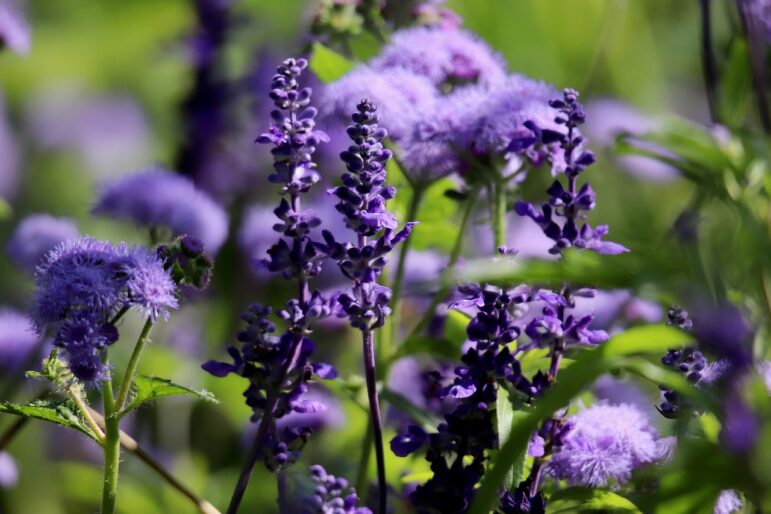
Salvia Farinacea [Nennieinszweidrei, Pixabay]
As with similar herbs that we’ve covered before, sage has ties to love, life, and death, in European folklore. Its uses as medicinal herb, identified as early as the Classical era in Greece and Rome, brought it its botanical name, salvia, “to heal, to save”; and while they may have overestimated its healing powers a bit (it is unlikely to do much for snake bites), its reputation as a cure-all only expanded as time progressed. By the medieval era sage was a staple of the monastic physic garden, with common sage even picking up the epithet officinalis after the store room where dried herbs and tonics would be kept.
Like with her sisters rosemary and parsley, belief in sage’s curative properties straddled the medical/magical divide. It was even said that eating fresh sage every day during May would grant eternal life, though I suspect that this was poetic hyperbole rather than a sincere, literal belief as the evidence to the contrary would have been obvious and abundant. Still, the idea that eating fresh sage every day in May would result in a very long life is undoubtedly magical in nature, even if it originally derived from the evident health benefits of the plant. Further into the magical was the use of sage to cure or prevent illness by warding off the evil eye, or, in combination with other herbs and rituals, alleviate the effects of a curse.
Should magic and medicine fail, sage had a role to play then too, once again joining with rosemary and parsley as an ingredient in the rites of the dead. Just like rosemary, sage has deep symbolic ties to memory, ties that may or may not be rooted in a shared ability to enhance cognition and preserve memory, particularly as we age. It’s also a good antimicrobial agent, something historically attributed to its strong smell, believed to keep miasma at bay, and its use as a burial herb and embalming agent in Europe goes back to at least the Middle Ages. Sage was tucked into coffin linings and head rests, rubbed directly onto the body in an attempt to slow decay, and tossed into the open grave or planted over it to stand for the living’s long remembrance of the dead.
Death wasn’t all that sage had in common with parsley. Like parsley, sage flourishing in a garden was taken as a sign that the women of the household dominated the men, rather than bowing to them in proper, patriarchal submission. Strangely at least one English county, Wiltshire, held it as proof that the man of the house was doing well, though depending on how you interpret that I suppose the two beliefs aren’t mutually exclusive. Sage took this shared metaphysical misandry one step further, however: where new growth of parsley signified a pregnancy, a healthy sage bush allegedly ensured all babies born to the household would be girls.
Sage could also be used in love magic, though as ever that’s something of a misnomer as many spells in that category are anything but loving. One such coercive charm involved writing the name pairs of Jesus and Mary, Adam and Eve, the caster’s and the target’s, on sage leaves before reducing them to powder and then secretly feeding them to the victim. Something I find particularly fascinating about this one isn’t just the syncretic folk Christianity, as ever deeply heretical by the standards of the church, but the inclusion of Jesus and his mother with the other, partnered dyads. Somehow I feel Christ and the Blessed Virgin wouldn’t be particularly happy about any of this.
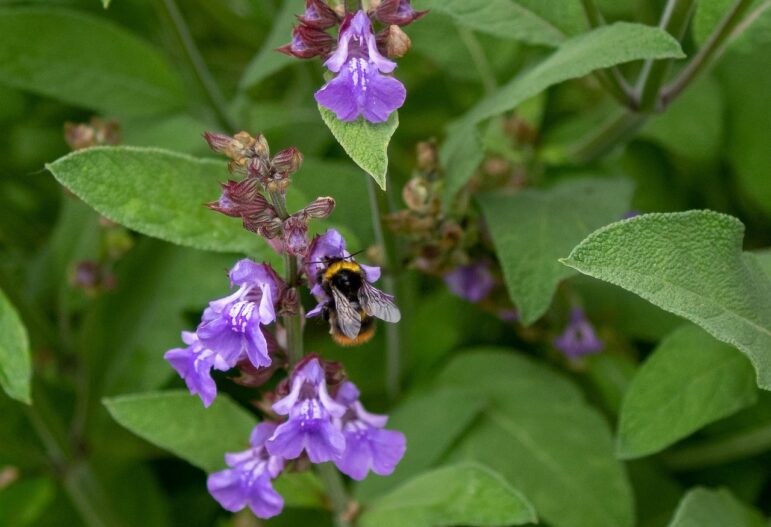
Salvia officinalis, with friend. [wenzlerdesign, Pixabay]
If a young lady was ready to marry, but less set on the who, or at least, less willing to magically force a certain special someone into becoming her groom, she might use sage then too. Aspiring brides across England utilised sage leaves to either summon a husband, any husband, or to catch a glimpse through dream or vision of the man they would eventually marry. Taking place on the eve of significant dates, ranging from Christmas to midsummer, these rituals could be as simple as plucking 12 leaves at midnight or as complex as this elaborate group rite recorded by Folkard in the 19th century:
“just after sunset, three, five, or seven young women are to go into a garden, where there is no other person, and each is to gather a sprig of Red Sage, and then, going into a room by themselves, set a stool in the middle of the room, and on it a clean bason full of Rose-water, on which the sprigs of Sage are to be put; and tying a line across the room, on one side of the stool, each maiden is to hang on it a clean smock, turned the wrong side outwards; then all are to sit down in a row, on the opposite side of the stool, as far distant as the room will allow, in perfect silence. At a few minutes after twelve, each maid’s future husband will take her sprig of Sage out of the Rose-water and sprinkle her smock with it”
Like many plants, sage also had a dark side (beyond dubiously consensual love spells); and charmingly, this dark side involved toads. Widely believed to be poisonous in Europe, tradition held that toads were attracted to sage plants, where they would rub their bodies, and therefore their poisonous secretions, all over the leaves. Supposedly an attempt to make use of sage’s healing properties to neutralise said poison, anyone who then consumed part of the afflicted plant would die soon after. Literally none of this is true of course, but I find the idea of clever toads using sage like dockleaf on a nettle sting rather cute; and the Piedmont idea that “in every Sage-leaf is concealed a little toad” is adorable.
White Bean Soup with Sage and Chorizo Crumb (serves four)
Though the recipe for long life is fresh sage leaves on top of buttered bread I decided to make something a little more substantial, and add in some other apotropaic ingredients to make a really lucky brew.
Ingredients
For the Soup
- Head of garlic
- 1 large onion
- 2 ribs of celery
- 1 carrot
- 1 large bay leaf
- 500g dry cannelini beans
- 1.5 ltr of vegetable Stock
- Black pepper
- Salt
- Olive oil
Soak the beans overnight in the fridge, with just a pinch of salt in the water.
Cut the top off the garlic bulb, rub it with olive oil and roast in in the oven for 25 minutes at 170 degrees C.
While the garlic is roasting dice the onion, celery, and carrot, and sauté them in olive oil with a sprinkling of salt and pepper. Once the garlic is ready remove the cloves from the paper and add them, along with the vegetable stock, the bay leaf, and the beans to the pot. Allow the liquid to come up to a boil, and then lower it to a simmer after ten minutes, and cook for a further hour to an hour and a half with the lid on.
When the beans have softened take the pot off the heat and blend, carefully, with an immersion blender. Taste and then add salt and pepper as needed.
For the Crumb
- 5 -6 fresh sage leaves
- 50g chorizo
- 80g breadcrumbs
Finely dice the chorizo and then slowly fry it off to render the fat. Remove the chorizo and set it aside. Roughly chop the sage leaves and add them and the bread crumbs to the pan, and toast them for around five minutes while stirring smoothly (add some olive oil if necessary). Add back in the chorizo, mix together, and then scatter over the top of the soup in a decorative spiral. Any leftover crumb should go in a little dish so people can top up as desired.
The Wild Hunt is not responsible for links to external content.
To join a conversation on this post:
Visit our The Wild Hunt subreddit! Point your favorite browser to https://www.reddit.com/r/The_Wild_Hunt_News/, then click “JOIN”. Make sure to click the bell, too, to be notified of new articles posted to our subreddit.