

Uncovering the Past
MILLARES, Spain — Nearly 2,000 years ago, worshippers traveled more than 200 meters into a cave in eastern Spain to leave offerings and inscribe prayers to a goddess whose name has been lost. They called her Domina, conventionally translated as “the Lady.”
Now, a remarkable collection of inscriptions and artifacts is beginning to reveal something about the people who worshipped her, particularly the women who appear to have participated actively in rituals deep underground.
Cova Dones, or Cave of the Women, lies near the municipality of Millares in Valencia, eastern Spain. The extensive cave system has attracted archaeological attention for evidence of human activity spanning tens of thousands of years. Researchers have documented more than 100 Paleolithic paintings and engravings dating back more than 24,000 years, as well as stalagmite formations intentionally modified by prehistoric people.
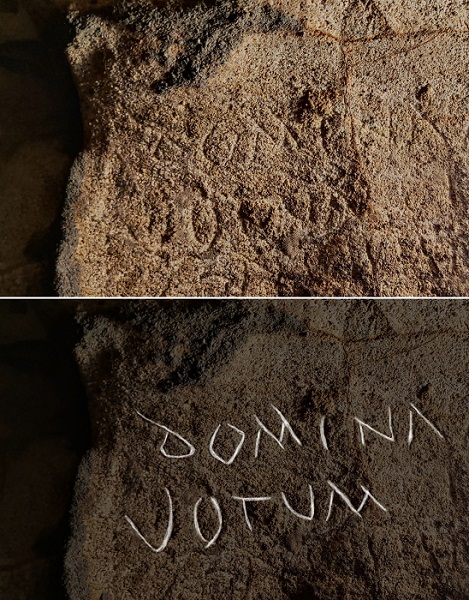
Detail of one of the inscriptions. Author: Grupo ArcheoSymbol. via Universitat d’Alacant
The Roman sanctuary is located more than 200 meters inside the cave in a chamber researchers first identified in 2024. Its walls and ceilings bear Latin inscriptions, while small natural pools, known as gours, collect groundwater on the chamber floor. Archaeologists have found material offerings deposited in those pools and elsewhere in the sanctuary.
Research at Cova Dones is being conducted through the DONARQ project, begun in 2023 and financed by the Generalitat Valenciana and the British Academy. The multidisciplinary research is led by Virginia Barciela of the University of Alicante and Aitor Ruiz-Redondo of the University of Zaragoza and includes specialists in archaeology, ancient history, Roman religion, epigraphy, geomorphology and other fields.
When researchers first identified the Roman sanctuary in 2024, they documented about 15 Latin inscriptions and a Roman coin dating to the reign of Emperor Claudius, who ruled from 41 to 54 C.E. The coin had been deliberately placed in a crevice between the cave ceiling and a stalactite and is believed to have been an offering.
Excavations conducted in May and June 2026 dramatically expanded that picture. Researchers have now documented at least 120 Latin inscriptions, most dating to the first and second centuries C.E. According to the research team, Cova Dones now contains the largest known collection of Latin inscriptions in a Roman cave sanctuary anywhere in the former Roman Empire.
Five votive inscriptions are dedicated to a goddess addressed as Domina, conventionally translated as “the Lady.” The Latin, however, carries a stronger sense of authority than the English translation may suggest.
Domina is the feminine counterpart of dominus, “master” or “lord,” and could refer in Roman society to the female head or mistress of a household. In that domestic context, the word carried implications of hierarchy and authority, including a woman’s position of command over enslaved members of the household. Calling the goddess Domina, then, did not merely identify her as a distinguished or revered “lady.”
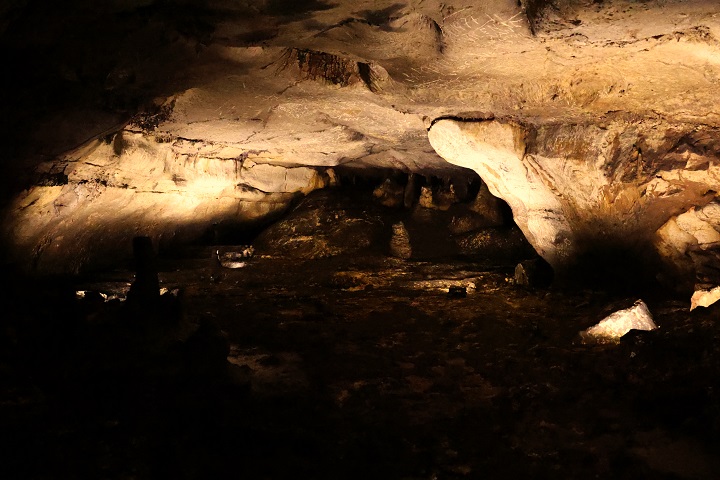
General view of the hall of the Roman sanctuary of Cova Dones. Author: Grupo ArcheoSymbol via Universitat d’Alacant
The title could therefore have conveyed more than reverence, presenting her as a divine female authority: a figure possessing command and power.
“Thanks to a quintet of votive inscriptions, we know for certain that in Roman times a goddess was worshipped in the cave whom they reverentially called Domina, ‘the Lady,’ and that women actively participated in her cult,” said Silvia Alfayé, professor of Ancient History at the University of Zaragoza and one of the specialists studying the inscriptions.
Three of the inscriptions also contain Malaci, which researchers believe may represent a previously unknown epithet or invocation of the goddess. Alfayé said the term appears to describe a particular aspect of the otherwise unknown deity, perhaps one associated with water, although researchers are still working on its definitive reading and interpretation.
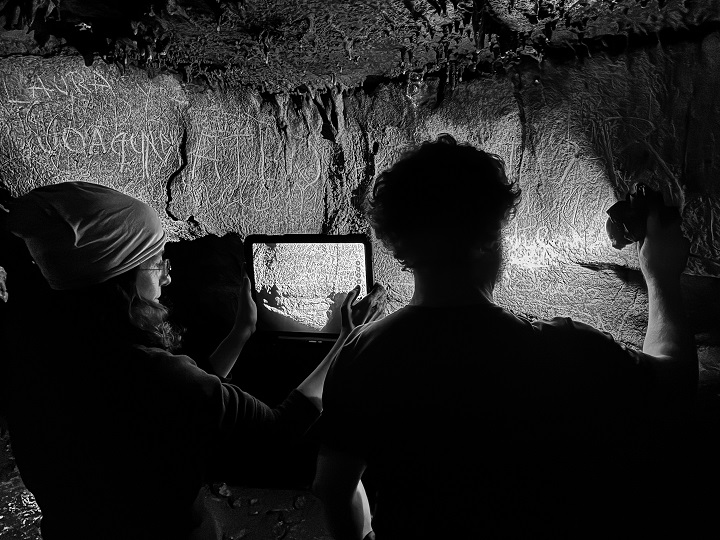
Members of the research team during the documentation and analysis work. Author: Grupo ArcheoSymbol. via Universitat d’Alacant
Who Domina was remains uncertain.
The title may nevertheless offer an important clue to how her worshippers understood her. Rather than preserving a divine personal name, the inscriptions may address the goddess through her authority or relationship to her worshippers. She was not simply “a lady,” but someone divine and powerful
The possible connection with water is especially intriguing because groundwater is a conspicuous feature of the sanctuary. Visitors deposited offerings in the cave’s natural pools, although researchers have not established whether those offerings were specifically intended for Domina or for other divine beings.
The number and placement of the inscriptions nevertheless suggest something more organized than occasional religious activity. The five dedications to the same goddess are concentrated in a defined area deep within the cave.
Sergio García-Dils, professor at UNED-Sevilla and director of the Spanish School of Speleology, said the evidence indicates “a specific cult to a particular deity,” rather than sporadic visits for general religious purposes. Their concentration in a particular area of the cave, he added, supports the interpretation of an organized cult.
The worshippers themselves are also beginning to emerge from the archaeological record.
Several inscriptions contain female names, leading the researchers to conclude that women frequented the sanctuary. Archaeologists have also recovered numerous spindle whorls, objects used in spinning thread. Because spinning and textile production were closely associated with women in the ancient world, researchers believe spindles may have been brought into the sanctuary as offerings.
Other finds from the 2026 campaign include two rings, a bracelet, chalice-shaped vessels, ceramic fragments, animal remains and other archaeological materials. Their association with the inscriptions makes Cova Dones unusually valuable for reconstructing what people actually did within an underground Roman sacred space.
Even the cave’s modern name raises an intriguing question. Barciela noted that Cova de les Dones means “Cave of the Women” and suggested the name could preserve an older memory associating the cave with women or female beings, although no direct continuity with its Roman name or cult has been established.
The Roman sanctuary also represents only one chapter in the cave’s extraordinarily long relationship with humans. Its Paleolithic art demonstrates that people were entering Cova Dones more than 20,000 years before the Roman worshippers of Domina. Later prehistoric communities altered stalagmite formations within the cave, providing further evidence that the underground landscape continued to attract human attention across very different periods and cultures.
“Each new finding points to the fact that Cova Dones has been a place of reference for the human groups that inhabited this territory for millennia, perhaps due to the permanent presence of water, the characteristics of the underground landscape or its easy access,” the project coordinators said.
Much of the cave remains to be studied in detail, and many inscriptions are still being read and interpreted. Future work may provide additional clues about Malaci, the role of water, the women who visited the sanctuary, and the identity of the deity they approached deep beneath the landscape.
For now, her personal name remains unknown. But the inscriptions preserve something perhaps equally revealing about how her worshippers regarded her. She was Domina, the one with authority.
The Wild Hunt is not responsible for links to external content.
To join a conversation on this post:
Visit our The Wild Hunt subreddit! Point your favorite browser to https://www.reddit.com/r/The_Wild_Hunt_News/, then click “JOIN”. Make sure to click the bell, too, to be notified of new articles posted to our subreddit.