
WASHINGTON – Earlier this year, the U.S. Department of Defense revised its controversial overhaul of military religious affiliation codes after acknowledging what officials described as “mistakes,” while the U.S. Army separately announced that chaplains would replace rank insignia on combat uniforms with faith-specific branch insignia.
As The Wild Hunt previously reported, the Pentagon reduced recognized religious affiliation codes from more than 200 categories to just 31, describing the change as an administrative simplification intended to help chaplains anticipate the religious needs of service members. Meanwhile, the Army said replacing rank insignia with religious insignia would make chaplains more approachable while emphasizing that they remain commissioned officers.
As those administrative changes continue to unfold, lawmakers have introduced legislation that would significantly reshape the statutory role of military chaplains.
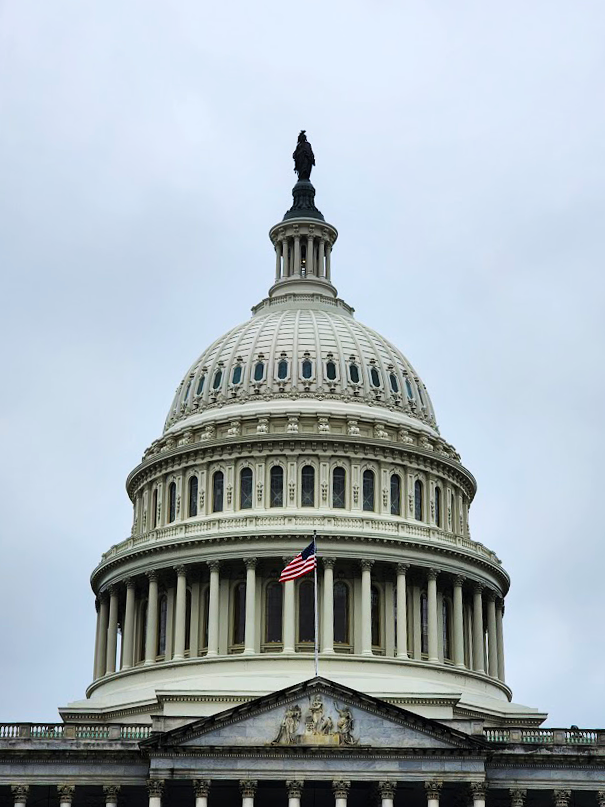
US Capitol [Photo Credit: S. Ciotti
Introduced in May by Rep. Keith Self (R-TX), with Rep. Pat Harrigan (R-NC) as a cosponsor, H.R. 8769, the Military Chaplains Modernization Act of 2026, would substantially revise federal law governing military chaplaincy across the Armed Forces. The bill is currently before the House Armed Services Committee.
The legislation opens with an extensive series of congressional findings asserting that religion and religious liberty have long been essential to American society, democratic governance, and military service. It traces the history of military chaplaincy from the Continental Army through the present day, citing George Washington’s requests for chaplains, the establishment of the Continental Army chaplaincy in 1775, John Adams’ support for naval chaplains, President Franklin D. Roosevelt’s commitment to the spiritual needs of troops during World War II, the First Amendment, the Religious Freedom Restoration Act (RFRA), and recent Supreme Court decisions, including Kennedy v. Bremerton School District (2022) and Parker v. Levy (1974).
The bill would codify the primary mission of military chaplains as protecting the free exercise of religion for service members and their families while providing ministry consistent with the beliefs of their endorsing faith organizations. It defines chaplains’ responsibilities to include conducting religious services, providing confidential counseling, advising commanders on religious accommodation, and supporting the moral and spiritual well-being of military communities. The legislation also establishes statutory qualifications for chaplains, including endorsement by recognized religious organizations and appropriate professional preparation.
A central feature of the legislation is its expansion of statutory protections for chaplains’ religious exercise. The bill provides that chaplains may preach, teach, counsel, and perform religious rites according to the doctrines of their endorsing faith tradition without being required to act contrary to their sincerely held religious beliefs. It further prohibits adverse personnel actions against chaplains who decline to perform religious functions that conflict with those beliefs.
The legislation also states that chaplains remain responsible for facilitating service members’ access to religious support regardless of faith tradition. Compared with existing statutory law, however, the bill more explicitly distinguishes between a chaplain personally providing ministry and the military’s broader responsibility to facilitate access to appropriate religious support through other means.

Seal of the CIA [public domain
That language represents a broader statutory protection than Congress has previously enacted for federal chaplains. Congress also enacted 50 U.S.C. § 3527, which took effect yesterday as part of the Intelligence Authorization Act for Fiscal Year 2025. The law establishes conscience protections for chaplains serving within the Central Intelligence Agency.
That provision prohibits the CIA Director from requiring a chaplain to perform a religious rite, ritual, or ceremony that conflicts with the chaplain’s conscience, religious beliefs, or the teachings of the chaplain’s endorsing organization, while also prohibiting discrimination against chaplains who decline such duties.
By comparison, H.R. 8769 would extend similar protections across the Armed Forces while applying them more broadly to a chaplain’s ministry and official duties rather than limiting them to specific rites or ceremonies.
How those expanded protections would operate in practice remains uncertain. The bill does not explicitly state that chaplains may refuse to minister to members of other faith traditions. It does, however, broaden statutory protections for chaplains who decline religious functions that conflict with their sincerely held beliefs while requiring the military to facilitate access to religious support through other means.
Current military practice already generally allows chaplains to decline to officiate weddings that conflict with their faith. For example, a Catholic chaplain cannot be compelled to officiate a same-sex marriage, just as a Reform Jewish rabbi cannot be compelled to officiate an interfaith wedding if that conflicts with denominational rules. Other chaplains may choose differently according to their own traditions. Depending on how courts interpret that language, the legislation could extend beyond the performance of marriage ceremonies to encompass pastoral counseling, religious instruction, and other ministerial functions. The bill itself, however, does not specifically address marriage equality or define how those protections would apply in that or other specific circumstances.
For minority faith communities, including Pagan, Heathen, Humanist, and other non-majority traditions, the practical implementation of those provisions may ultimately prove as significant as the legislation’s stated protections for religious liberty.
The legislation leaves unanswered how those obligations would be fulfilled when no chaplain of a service member’s faith tradition is available, a question of particular interest to members of minority religions whose representation in the military chaplaincy remains limited.
The Wild Hunt will continue to follow the legislation as it moves through Congress and report on its implications for minority faith communities.
The Wild Hunt is not responsible for links to external content.
To join a conversation on this post:
Visit our The Wild Hunt subreddit! Point your favorite browser to https://www.reddit.com/r/The_Wild_Hunt_News/, then click “JOIN”. Make sure to click the bell, too, to be notified of new articles posted to our subreddit.