
WASHINGTON — The U.S. Supreme Court has agreed to hear a case that could reshape how federal courts evaluate disputes over religious gatherings held in private homes, a decision that may have implications far beyond the Orthodox Jewish congregation at the center of the dispute.
Although the case does not involve Pagan religious practice, the legal questions before the Court closely resemble how many contemporary Pagan communities, such as Wiccan covens and other minority religious groups, regularly gather for worship in private residences rather than dedicated temples or churches.
The Court granted certiorari on June 30 in Grand v. City of University Heights, Ohio, agreeing to review whether local governments may require religious groups meeting in homes to complete local zoning proceedings before challenging alleged violations of their constitutional rights and the federal Religious Land Use and Institutionalized Persons Act (RLUIPA).
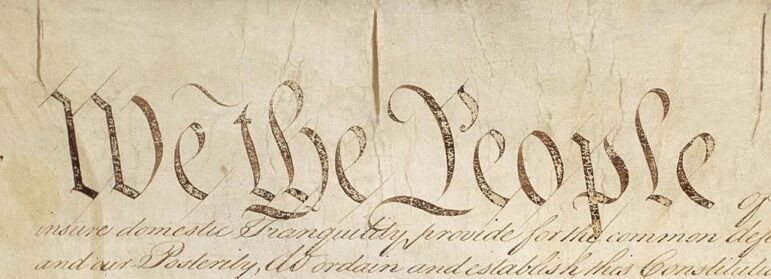
Preamble of the U.S. Constitution – We the People…
The dispute began in early 2021 when Daniel Grand, an Orthodox Jewish resident of University Heights, Ohio, invited approximately a dozen friends to form a Sabbath minyan, the quorum of ten adults required for certain Jewish prayers. Because Orthodox Jewish law prohibits driving on the Sabbath, Grand contends the gatherings would have consisted primarily of people walking from nearby homes.
Before the first prayer meeting occurred, the city’s law director sent Grand a cease-and-desist letter stating that using his residence as “a place of religious assembly” or “a shul or synagogue” violated the city’s residential zoning ordinance.
Grand subsequently applied for a special-use permit while maintaining that the proposed gatherings were informal prayer meetings, not a traditional synagogue.
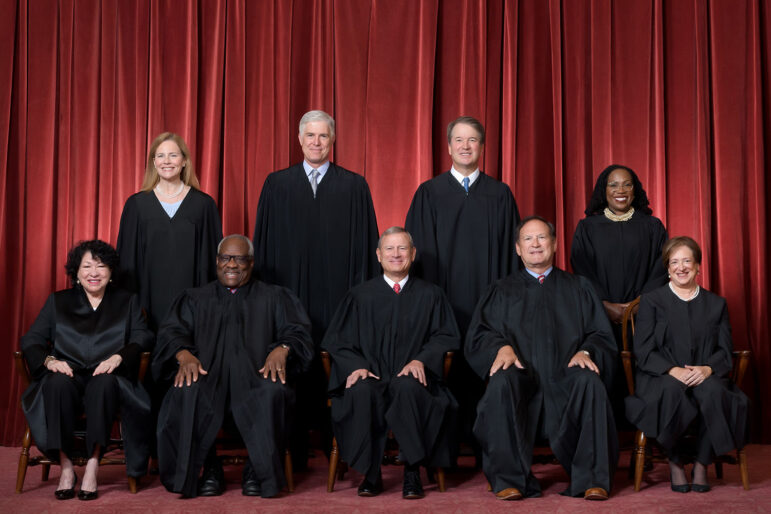
Formal group photograph of the Supreme Court. Seated from left are Justices Sonia Sotomayor, Clarence Thomas, Chief Justice John G. Roberts, Jr., and Justices Samuel A. Alito and Elena Kagan. Standing from left are Justices Amy Coney Barrett, Neil M. Gorsuch, Brett M. Kavanaugh, and Ketanji Brown Jackson. Credit: Fred Schilling, Collection of the Supreme Court of the United States
According to the Alliance Defending Freedom (ADF), which represents Grand, city officials went beyond ordinary zoning enforcement. The complaint alleges officials characterized his planned prayer group as an unpermitted synagogue under the city’s zoning ordinance, directed police to monitor his residence, encouraged neighbors to report activity at the home, and engaged in a broader pattern of harassment after he sought to host religious gatherings.
The City disputes those characterizations. In its brief opposing Supreme Court review, University Heights argues that Grand voluntarily withdrew his special-use permit application before the Planning Commission reached any final decision and therefore never received an enforceable determination regarding whether the ordinance applied to his proposed gatherings. The City further argues that no enforcement action was ever taken against Grand after he withdrew his application and that he remains free to seek relief should the ordinance ever be applied in a manner that violates his constitutional or statutory rights.
After withdrawing the permit application in March 2021, Grand filed suit in federal court in September 2022, alleging violations of the First Amendment, the Fourteenth Amendment, Ohio law, and RLUIPA.
The federal district court dismissed the principal constitutional and RLUIPA claims as unripe, concluding that because no final zoning decision had been made, there was no justiciable controversy.
The U.S. Court of Appeals for the Sixth Circuit unanimously affirmed that ruling in November 2025.
ADF argues, however, that requiring Grand to continue through the local permitting process before seeking judicial relief misunderstands the nature of the constitutional injury. “The City had no reason to limit Daniel’s prayer meetings,” ADF said in a statement. “Because Orthodox Jews are forbidden from driving on those days, there would be no traffic or parking issues.”
Grand, ADF argues, should not have been required to pursue what it describes as a legally unnecessary permit. “You don’t need a city permit to pray with your friends,” ADF wrote. “Every American has the right to peacefully practice their faith in their own home—and to seek relief from federal courts when government officials interfere.”
The legal question before the Court is narrower than whether municipalities may regulate religious land use. Local governments retain authority to enforce neutral health and safety regulations involving occupancy limits, parking, traffic, fire codes, noise, and nuisance.
Instead, the Court will consider whether a credible governmental threat that allegedly deters religious exercise is itself enough to permit immediate review in federal court, or whether property owners must first obtain a final zoning decision before bringing constitutional and RLUIPA claims.
In practical terms, the case asks where the line exists between ordinary religious gatherings in a home and a “house of worship” subject to zoning approval.
That question could prove significant for many minority faiths that regularly worship in private homes.
An amicus brief filed by the Pacific Justice Institute argues that discretionary zoning systems have historically imposed disproportionate burdens on minority religions because unfamiliar religious practices often encounter neighborhood opposition and ad hoc governmental decision-making.
For many contemporary Pagan traditions, home worship is a central feature of religious practice. Groups frequently meet in members’ homes not only because they may lack the resources to maintain dedicated temples or permanent worship spaces, but also because private residences offer a degree of privacy and security. Some covens and other Pagan communities intentionally keep the locations of their gatherings private to reduce the risk of harassment, discrimination, or unwanted public attention. For some traditions, gathering in a private home is not simply a practical necessity but an established expression of religious practice.
A Supreme Court ruling clarifying when home-based religious gatherings become subject to zoning regulation could therefore affect a broad range of minority faith communities whose religious practice centers on private residences rather than traditional houses of worship.
The Court is expected to hear oral arguments during its October 2026 Term, with a decision anticipated before the end of the Term in late June or early July 2027.
The Wild Hunt will continue following the case as it proceeds before the Court.
The Wild Hunt is not responsible for links to external content.
To join a conversation on this post:
Visit our The Wild Hunt subreddit! Point your favorite browser to https://www.reddit.com/r/The_Wild_Hunt_News/, then click “JOIN”. Make sure to click the bell, too, to be notified of new articles posted to our subreddit.