
BENTON PAIUTE RESERVATION, California – On July 8th, the U.S. federal government plans to remove some 650 wild horses from the area around Mono Lake, situated in eastern California near the border with Nevada. But an Indigenous tribe has filed suit to prevent the removal of the horses, claiming the government has not fulfilled its legal obligations to consult the tribe under the National Historic Preservation Act.
The situation demonstrates a complex set of interests between land management, Indigenous rights, and ecological preservation. All sides involved – the Bureau of Land Management (BLM), the Utu Utu Gwaitu Paiute Tribe, and various nonprofit organizations and land-users – believe their approach to the herd of wild horses will be best for the land and the environment.
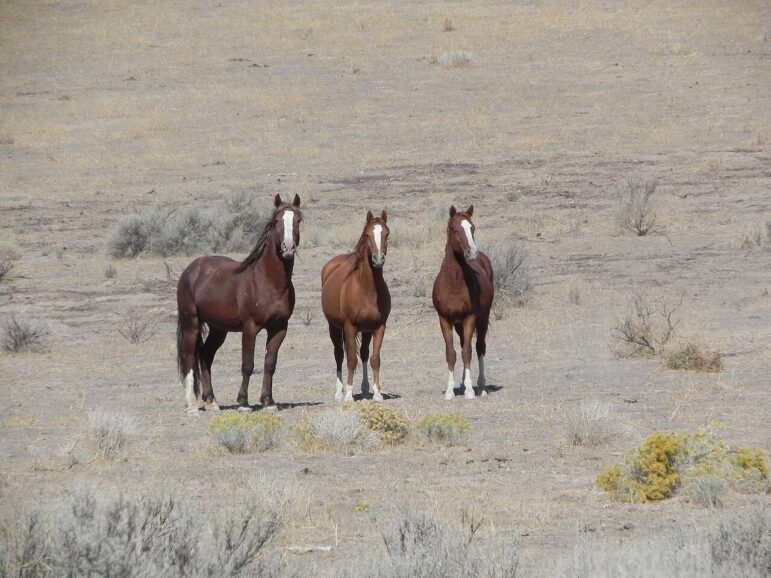
Wild horses at the High Rock Herd Management Area, California [Photo by Amy Dumas, BLM]
At question is a herd of wild horses that roams in the area around the Montgomery Pass Wild Horse Territory, especially near Mono Lake. The BLM estimates that there are approximately 700 horses in the herd, but that the area can only sustain 138 to 230 horses.
The horse population has grown precipitously over the past 20 years, since the horses began to spend most of their summers in lower elevations where mountain lions, who traditionally preyed on them, had more difficulty hunting.
For some, this is a necessary step to preserve the landscape around Mono Lake.
“There weren’t a lot of people that saw the transition that I saw, from healthy wetlands to completely trampled and devastated wetlands,” Dave Marquart, a retired interpretive naturalist for the Mono Lake Tufa State Natural Reserve, told the Los Angeles Times last year. “It was quite a drastic change.” According to Marquart, the growth of the herd has caused considerable damage to the Mono Lake ecosystem, driving away populations of yellow-headed black birds and marsh wrens and polluting the water with their defecation.
Other complaints come from local ranchers, who claim the horses are overgrazing the area and leaving no vegetation for cattle, and from drivers who find the horses present safety concerns.
According to BLM, the removal plan will address these concerns: “This plan will allow the Inyo National Forest to gather horses… from high-priority areas outside the Montgomery Pass Wild Horse Territory,” said BLM Bishop Field Manager Sherri Lisius, “where wild horses are causing impacts to sensitive wildlife habitat, riparian areas, and tufa geological formations; where there are safety concerns for motorists; and areas where private landowners have requested their removal.”
But the Utu Utu Gwaitu Paiute Tribe disagrees. The tribe claims that the horses are part of the “living cultural landscape” of the Utu Utu Gwaitu Paiute and Kootzaduka’a people, and that the government did not engage in the “required government-to-government” consultation process, as alleged in their complaint, filed on June 29.
“The Utu Utu Gwaitu Paiute Tribe has attempted in good faith to engage with these agencies through every available channel. We have been ignored,” said Shane Saulque, chair of the tribe, as reported by Native News Online. “Today we are asking a federal court to enforce the law that Congress enacted to protect places like ours, because the agencies charged with upholding that law have chosen not to.”
The complaint alleges that the government reached out to the tribe in 2023, but after the tribe responded the government did not contact them again for over a year, and had already made its assessment by the time they did reach out.
The tribe also argues that the government’s depiction of the horse population as “excessive” is offensive: “These horses have lived alongside our people on this land since before any of these agencies existed. They are not ‘excess,’” Rana Saulque, tribal vice chairwoman and tribal historic preservation officer, told Native News Online. “They are part of who we are and where we come from. ”
The tribe alleges that the government’s figure of approximately 700 horses is stale and does not account for the particularly harsh winter of 2023, which they believe reduced the size of the herd.
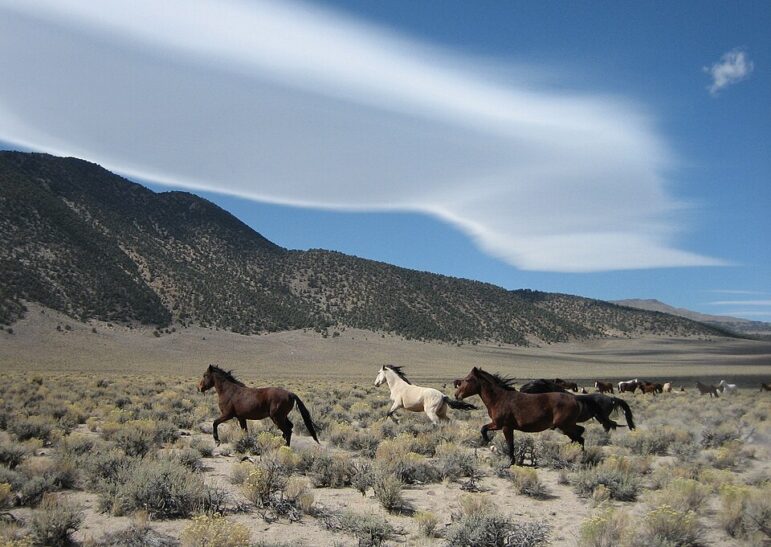
Inyo National Forest, in coordination with the Bureau of Land Management Bishop Field Office, is seeking public input on proposed gathers of wild horses outside the Montgomery Pass Wild Horse Territory in Mono County, California. Photo by Jeff Starosta, BLM. Montgomery Pass horses in the Granite Mountain Basin. [BLM]
One particularly controversial part of the plan to remove the horses involves the use of helicopters to bait horses into traps, a process the tribe claims could injure animals and cause damage to the tribe’s cultural heritage. “Once a petroglyph panel is damaged by helicopter rotor wash, ground vehicle traffic, or removal infrastructure, it cannot be restored,” the tribe argues in its complaint.
“Helicopter operations, vehicle traffic including heavy equipment, construction of trap sites and temporary holding infrastructure, and bait trap installation across unassessed cultural landscapes create imminent risk of physical damage to bedrock mortar sites, burial areas, petroglyphs, springs, and other resources that the Agencies have never identified because they never asked,” the complaint also argues.
Last year, Rana Salque drew an even more striking parallel between the use of helicopters to trap the horses and the historical treatment of Indigenous people in the United States. “They’re going to run them down with helicopters and genocide them, just like they ran down us.”
Under the government’s plan, the horses rounded up will be seen by veterinarians and then placed for adoption or sale, or removed to pastures.
The Utu Utu Gwaitu Paiute have another vision for managing the horses. According to the Los Angeles Times, they are part of a coalition that wants to create a sanctuary for the horses to roam in, where “local tribes would help manage the herd, including darting horses with a birth control vaccine to limit population growth.” The horses could become a deeper part of life for the Indigenous tribes in the area, reconnecting a deep bond by using horses for equine therapy and rodeo schools.
“These horses are living culture,” said Ronda Kauk, a member of the Mono Lake Kootzaduka’a Tribe and the Benton Paiute Tribe’s cultural monitor to Native News Online. “They are one with our ancestors on this land. Their removal is not a neutral management decision. It is an action taken over the objections of the people whose homeland this is.”
The removal of the horses is still currently scheduled to begin on Wednesday unless a judge issues an injunction in response to the tribe’s complaint.
The Wild Hunt is not responsible for links to external content.
To join a conversation on this post:
Visit our The Wild Hunt subreddit! Point your favorite browser to https://www.reddit.com/r/The_Wild_Hunt_News/, then click “JOIN”. Make sure to click the bell, too, to be notified of new articles posted to our subreddit.