

Uncovering the Past
STARAYA RUSSA, Russia — Archaeologists in northwestern Russia have discovered an 11th-century pendant combining the image of a Christian warrior saint with a snake-haired female figure whose imagery draws on the ancient Gorgon tradition, offering an unusually early example of how Christian and older religious traditions could coexist in medieval Rus’.
Researchers at Novgorod State University discovered the copper-alloy object at the Pyatnitsky excavation site in Staraya Russa, an ancient city in the Novgorod region. The area where it was found was only beginning to be settled during the 11th century.
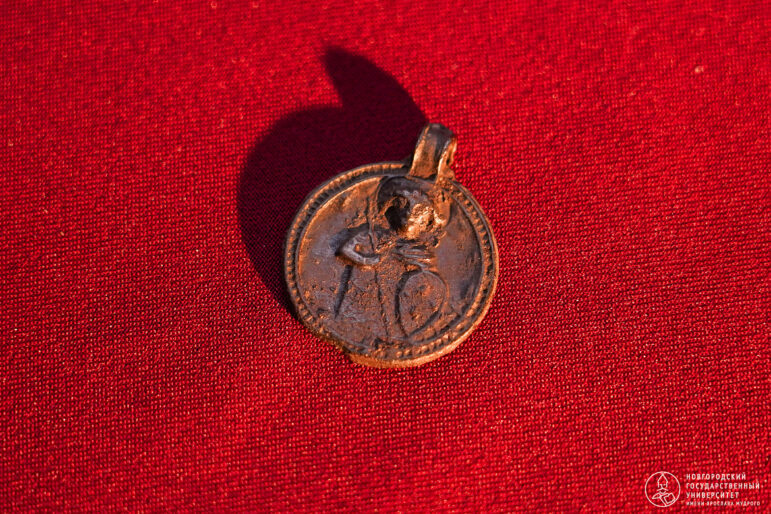
The “Saint” side – Image Courtesy of Novgorod State University
Known as a serpent pendant, or zmeevik, the double-sided amulet belongs to a class of objects that reached Rus’ through Byzantine cultural connections. The newly discovered example dates to the 11th century, placing it among the earliest known serpent pendants from ancient Rus’. Previously, only four such serpent pendants were known from Staraya Russa, all dating from the 12th through 14th centuries. The new find pushes the local evidence for the tradition back by at least a century.
One side bears a relief image of a warrior saint carrying a spear and shield, whom researchers tentatively identify as Saint Theodore Stratelates. The reverse depicts a woman’s head surrounded by snake-like forms. While the motif ultimately recalls Medusa and the Gorgon tradition of the ancient Mediterranean world, researchers do not identify the figure on this particular pendant simply as Medusa. Instead, they suggest the image had evolved into a more generalized representation of dangerous or malevolent forces within the amulet tradition. Archaeologists believe the amulet may have been cast locally in a metalworking workshop on the urban estate, copied from an earlier model.
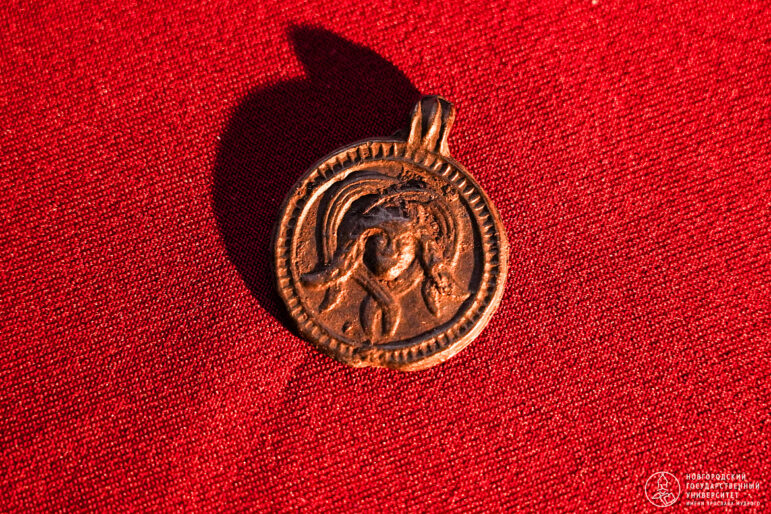
The “Medusa” Side – Image Courtesy of Novgorod State University
“The main characteristic of the serpentine pendant is its combination of images that are incompatible, from a strictly dogmatic standpoint,” Sergei Toropov, director of the Novgorod State University Center for Archaeological Research, said in the university’s announcement.
“The obverse always features a canonical Christian image: Jesus Christ, the Virgin Mary, Archangel Michael, or serpent-fighting saints, such as St. George the Victorious,” Toropov said. “The reverse features a non-Christian serpentine composition, which harks back to Medusa the Gorgon, a character from ancient Greek mythology.”
The distinction is important. The Gorgon-like image did not necessarily indicate continuing worship of Medusa or even an explicit belief in the Greek mythological figure. Rather, an older protective image appears to have been absorbed and transformed within a medieval religious context. On the Staraya Russa pendant, researchers interpret the snake-haired figure as a generalized image of threatening or dark forces, while the juxtaposition with the Christian image may have represented their defeat.
Some surviving examples also carry Greek inscriptions or incantations, suggesting that they were worn for protection, particularly against illness.
“Some of these pendants bear incantations in Greek, suggesting that the serpentine pendants were likely worn as a talisman against illness,” Toropov said. “And the ‘incompatible’ images in this case could symbolize the victory of the forces of light over the forces of darkness.”
“On its front is a relief image of a warrior saint with a spear and shield—presumably Saint Theodore Stratelates,” Toropov explained. “On the back is a woman’s head with snake-like hair. This likely represents not a specific mythological creature, but a collective image of dark forces.”
The imagery also invites a gendered reading: a male Christian warrior saint occupies one face, while a female-coded, serpent-haired figure appears on the other as an image of threatening or dark forces, reflecting a broader cultural association between female monstrosity and danger familiar from the Gorgon tradition.
The Wild Hunt is not responsible for links to external content.
To join a conversation on this post:
Visit our The Wild Hunt subreddit! Point your favorite browser to https://www.reddit.com/r/The_Wild_Hunt_News/, then click “JOIN”. Make sure to click the bell, too, to be notified of new articles posted to our subreddit.