
STONY BROOK, N.Y. — It’s that time of year, and a story like this becomes irresistible. The author may be particularly biased, having been bitten by a bat last year.
Three years ago, researchers described two of the oldest complete bat skeletons ever discovered. Unearthed in southwestern Wyoming and dating to about 52 million years ago, the fossils offered a remarkable glimpse into the early evolution of the only mammals capable of true powered flight.
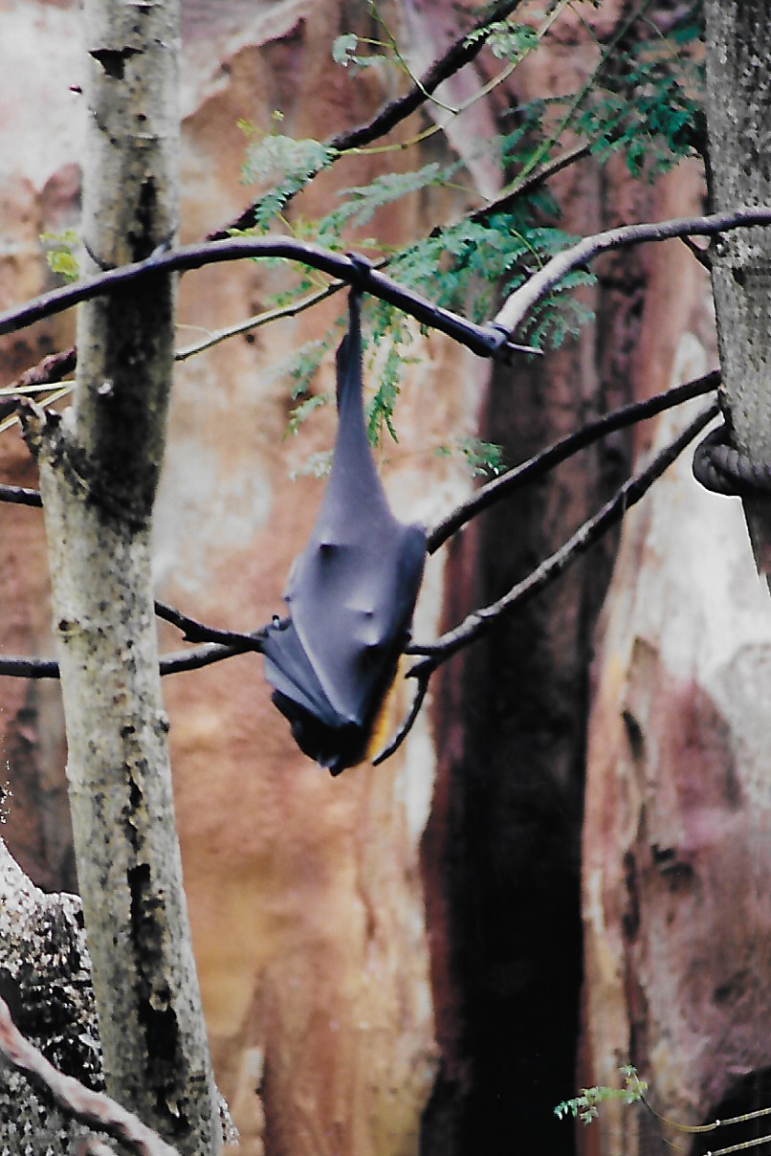
Fruit Bat at Zoo Miami [Photo Credit: MJTM
The fossils belonged to a previously unknown species, Icaronycteris gunnelli, closely related to other early bats found in Wyoming’s Green River Formation. During the Eocene epoch, the region was nothing like modern Wyoming. It was a warm, humid, subtropical landscape surrounding a large freshwater lake.
One fossil was discovered in 2017. The other had been excavated in 1994 but was only later recognized as representing the new species.
What was particularly striking was how thoroughly bat-like these ancient animals already were. They possessed wings, elongated fingers supporting flight membranes, and many of the anatomical characteristics familiar in bats today. The fossils were ancient, but they did not reveal the mysterious transitional animal that first took to the air.
Now, scientists have taken another swing at that mystery.
A major study published September 23 in the journal Nature combines fossils with the largest collection of high-quality bat genomes assembled to date. Researchers with the international Bat1K project analyzed chromosome-level genomes from 103 bat species representing all 21 living bat families. They then combined those data with 699 anatomical characteristics from 65 species, including 44 fossil bats. The result is a substantially revised bat family tree.
And that tree leads back to Europe.
The researchers concluded that bats most likely originated in Europe during the late Paleocene, before roughly 56 million years ago. Earlier hypotheses had placed their origin variously in Africa, Asia, or North America. The new analysis strongly favors Europe, with descendants subsequently dispersing into Africa and elsewhere.
That changes how scientists can interpret those spectacular Wyoming fossils. They remain among the oldest complete bats ever found, but North America apparently was not where bats began. By the time Icaronycteris was flying over that ancient Wyoming lake, bats had already spread far from their probable evolutionary birthplace.

Bats emerging from the Ann W. Richards Congress Avenue Bridge in Austin, Texas. [Photo Credit: MJTM
The study also sheds light on another longstanding question: when did bats develop echolocation?
Many bats navigate and hunt by producing high-frequency sounds and interpreting the echoes that return from objects and prey. Researchers can find clues to that ability in fossil skulls, including specialized structures of the inner ear.
The placement of the fossil bat Vielasia within the oldest known “Eochiroptera” lineage suggests that laryngeal echolocation appeared before modern bat groups diversified. Combined with early Eocene fossils, the evidence suggests that both powered flight and echolocation had emerged remarkably early in bat evolution. The researchers say the findings point toward a close evolutionary relationship between the development of flight and echolocation.
Exactly which came first, however, remains uncertain.
And neither genomes nor fossils have yet revealed what the immediate ancestors of bats looked like.
Bats are the only mammals to evolve powered flight. Their wings developed along a different evolutionary path from those of birds and the extinct pterosaurs: a bat wing is essentially a dramatically modified mammalian forelimb, with elongated fingers supporting a flexible membrane of skin.
Their emergence also followed one of the greatest ecological disruptions in Earth’s history. The asteroid impact 66 million years ago eliminated non-avian dinosaurs and pterosaurs, opening ecological opportunities that mammals subsequently exploited. The new research places the beginnings of bats millions of years later, during the late Paleocene, with major bat lineages radiating around the Paleocene-Eocene Thermal Maximum approximately 56 million years ago.
Today, bats are one of evolution’s extraordinary success stories. More than 1,500 species account for over one-fifth of living mammal species. They inhabit every continent except Antarctica and have evolved diets ranging from insects, fruit and nectar to fish, small vertebrates and, in three vampire bat species, blood. Some also possess unusual longevity and immune adaptations that have made them increasingly important subjects for biomedical research.
The genomic analysis produced another intriguing clue. Researchers reconstructed the ancestral bat genome as having 26 pairs of chromosomes and found that modern bat genomes appear to have evolved primarily through chromosomes fusing together rather than splitting apart. Bats possess some of the smallest genomes among mammals.
Yet perhaps the most tantalizing part of the story remains what scientists still cannot see.
The earliest complete fossils already look like bats. They could fly. They apparently could navigate the darkness using sound. Within a relatively short evolutionary interval, they had spread across continents and begun diversifying into new forms.
Somewhere before them remains an animal we have yet to find: the creature whose descendants stretched their fingers, took to the Paleocene sky, and eventually became bats.
The Wild Hunt is not responsible for links to external content.
To join a conversation on this post:
Visit our The Wild Hunt subreddit! Point your favorite browser to https://www.reddit.com/r/The_Wild_Hunt_News/, then click “JOIN”. Make sure to click the bell, too, to be notified of new articles posted to our subreddit.